
Is My Thumb Broken or Sprained Quiz
How the Scales are Structured
Who Usually Takes This Test?
See How You Compare
Below is a preview of how scores are typically distributed across each scale.
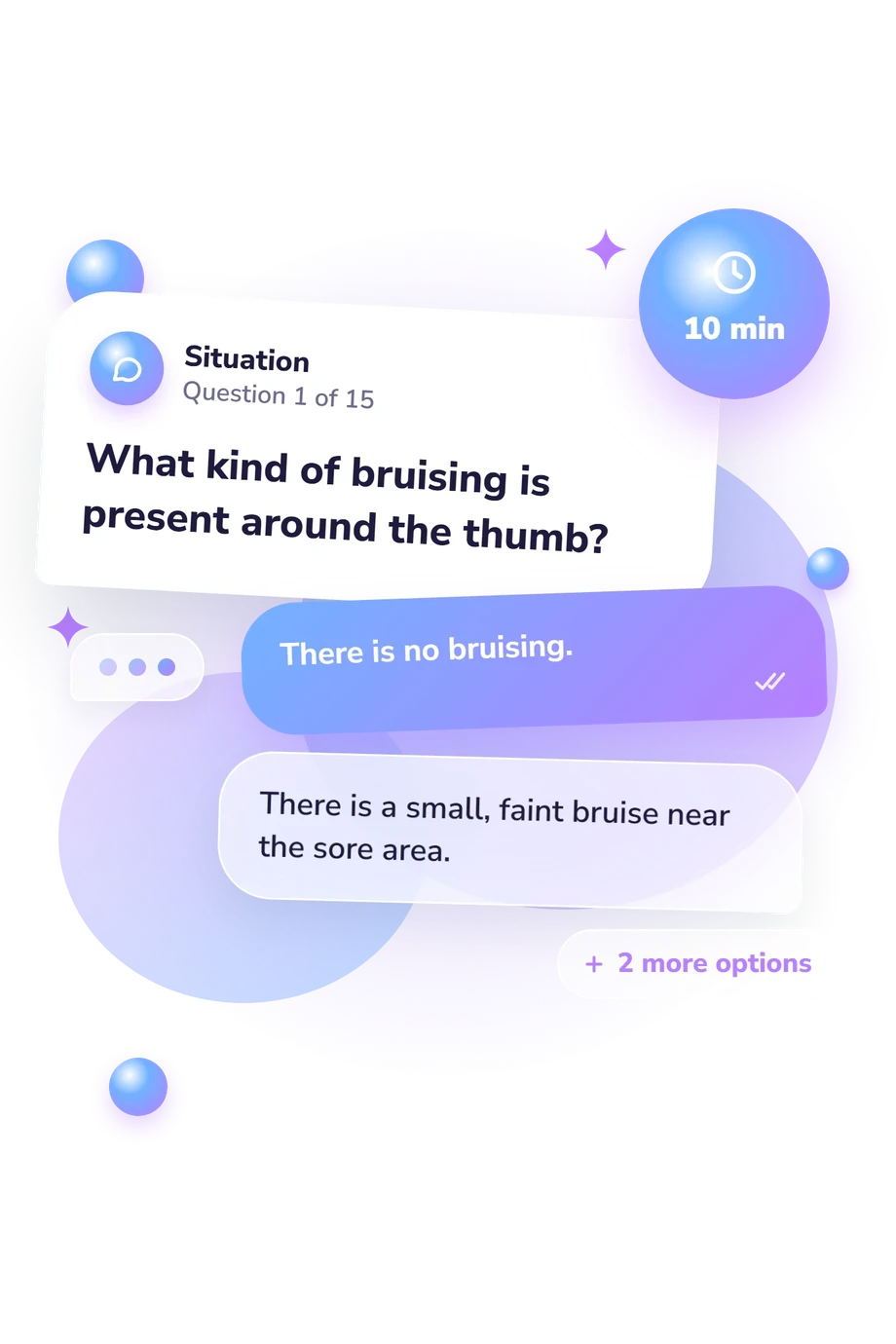
Example Questions From the Test
- There is no bruising.
- There is a small, faint bruise near the sore area.
- Dark bruising covers much of a thumb joint or appears on more than one side.
- Heavy bruising is spreading into the palm or wrist, especially after a forceful injury.
- The skin is intact, with no cut or scrape.
- There is a small, superficial scrape away from the most painful area.
- There is a cut or puncture near the painful joint, nail, or swollen area.
- The wound is deep or gaping, bone is visible, or firm pressure does not stop the bleeding.
- There is no pain at rest.
- Pain is mild and settles with rest.
- Strong pain continues despite rest and gentle support.
- Pain is severe, rapidly escalating, or accompanied by a tight pressure sensation.
Is My Thumb Broken or Sprained Quiz - Description and methodology of the test
People with a recent thumb problem may find the Is My Thumb Broken or Sprained Quiz useful for organizing what they notice before deciding what to do next. It is intended for someone seeking a structured self-check that sorts warning signs from ordinary discomfort and highlights changes in function. This thumb injury self-check points to red flags, functional change, and possible next steps.
What This Assessment Explores
Items cover bruising, wounds, pain, swelling, sensation, alignment, movement, strength, stability, spread, and change over time. The Is My Thumb Broken Quiz compares mild, worsening, and severe patterns. It cannot distinguish a fracture from a sprain or identify the injured structure.
For every scale, a red-flag response scored 3 overrides that scale's total; applicable circulation, sensation, or wound alerts require immediate action. Its scales are:
- Circulation, Sensation, and Wound Alerts (0-15) covers circulation or sensation changes, wounds, escalating pain, and spread: Context only 0-0; Some indicators 1-2; Urgent action 3-15.
- Injury Mechanism and Structural Signs (0-15) summarizes onset, swelling, bruising, tenderness, and alignment: Context only 0; Some indicators 1-2; Prompt assessment 3-15.
- Movement, Strength, and Stability (0-15) reflects motion, pinch, everyday use, steadiness, and progression: No functional indicators 0-0; Some functional impact 1-2; Marked impact (prompt assessment suggested) 3-15.
Methodology and Evidence Base
Each prompt offers four ordered choices, moving from mild or absent findings toward impairment or warning signs. The self-report format uses concrete situations, and answers may vary with pain, timing, recall, or self-awareness. The questionnaire displays totals and bands but does not specify each response's contribution.
Leggit and Meko (2006) identify mechanism, deformity, tenderness, function, neurovascular findings, and wounds; Cheung, Hatchell, and Thoma (2013) add motion, stability, sensation, circulation, and open injury. The questionnaire is conceptually consistent with these domains, not an adaptation or validation of the cited instruments or guidance. This Is My Thumb Sprained Quiz asks whether symptoms fit a sprain.
ACR guidance from Torabi et al. (2019) addresses imaging decisions after hand and wrist trauma; this summary cannot make them. Walenkamp et al. (2015) illustrates separate derivation and external validation for the Amsterdam Wrist Rules; these bands have not undergone it and are unvalidated reflective summaries, not diagnostic, severity, or clinical cutoffs. Severe red flags warrant emergency services; prompt-assessment bands call for evaluation with deformity, numbness, color change, open wounds, worsening symptoms, or persistent loss of function.
- Leggit JC, Meko CJ. Acute Finger Injuries: Part II. Fractures, Dislocations, and Thumb Injuries. American Family Physician. 2006;73(5):827-834.
- Cheung K, Hatchell A, Thoma A. Approach to Traumatic Hand Injuries for Primary Care Physicians. Canadian Family Physician. 2013;59(6):614-618.
- Torabi M, Lenchik L, Beaman FD, Wessell DE, Bussell JK, Cassidy RC, Czuczman GJ, Demertzis JL, Khurana B, Klitzke A, Motamedi K, Pierce JL, Sharma A, Walker EA, Kransdorf MJ. ACR Appropriateness Criteria® Acute Hand and Wrist Trauma. Journal of the American College of Radiology. 2019;16(5 Suppl):S7-S17. 10.1016/j.jacr.2019.02.029
- Walenkamp MMJ, Bentohami A, Slaar A, Beerekamp MSH, Maas M, Jager LC, Sosef NL, van Velde R, Ultee JM, Steyerberg EW, Goslings JC, Schep NWL. The Amsterdam Wrist Rules: The Multicenter Prospective Derivation and External Validation of a Clinical Decision Rule for the Use of Radiography in Acute Wrist Trauma. BMC Musculoskeletal Disorders. 2015;16:389. 10.1186/s12891-015-0829-2
Updated: