
Toxic Shame Quiz
How the Scales are Structured
Who Usually Takes This Test?
See How You Compare
Below is a preview of how scores are typically distributed across each scale.
Example Questions From the Test
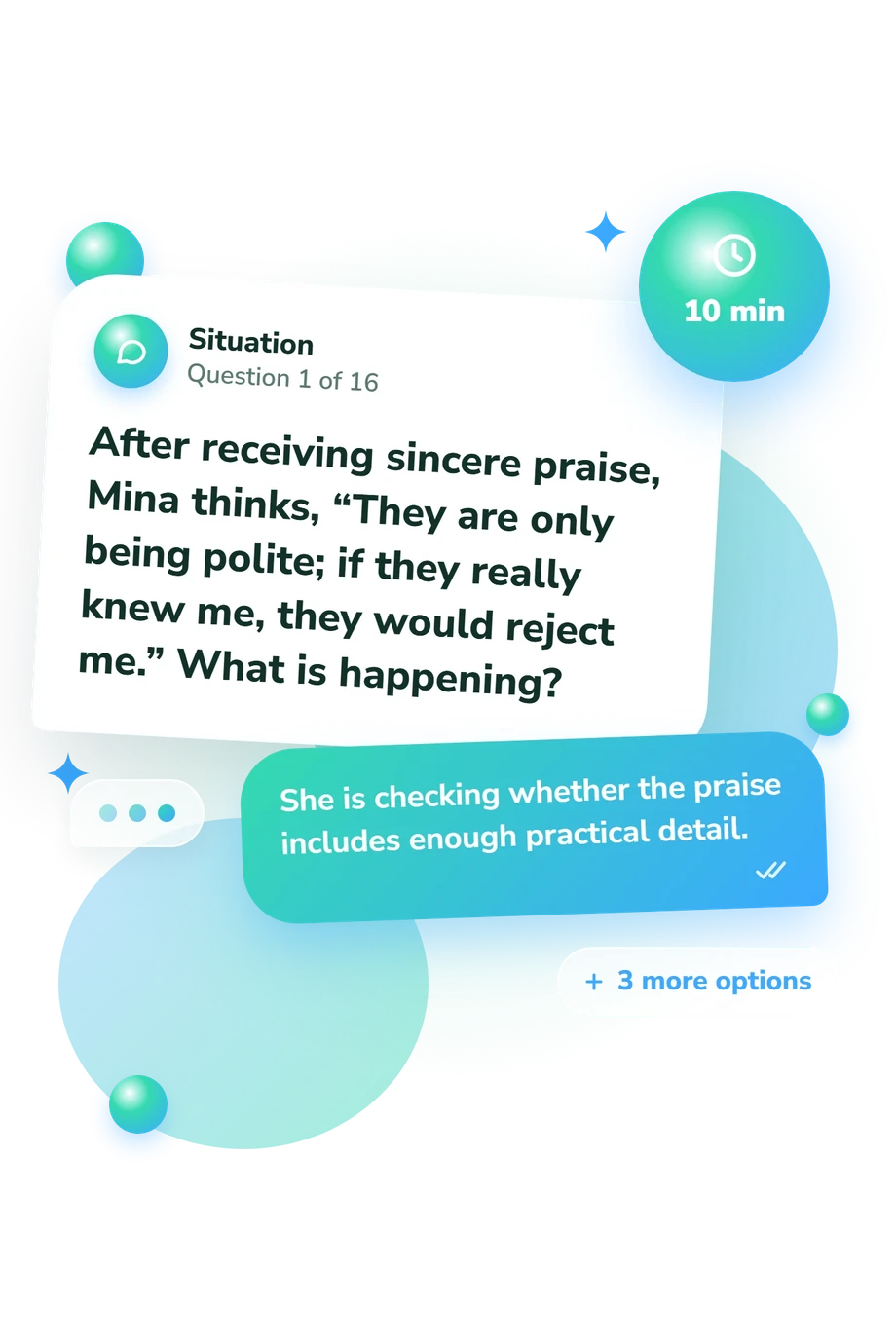
- She is checking whether the praise includes enough practical detail.
- She is experiencing guilt and planning to make amends.
- She is discounting positive evidence to preserve a negative belief about herself.
- She is accurately proving that praise is generally insincere.
- That you answered many educational questions correctly, not whether you personally have toxic shame
- That you are qualified to diagnose shame-related difficulties in others
- That any distress you experience can be managed without support
- That you definitely do not experience harmful shame
- “I should correct the error before the discussion ends.”
- “This mistake proves I am fundamentally worthless.”
- “I misunderstood that point, so I will review it later.”
- “I feel embarrassed because I wanted to make a good impression.”
Toxic Shame Quiz - Description and methodology of the test
Readers who want a clearer, evidence-aware introduction to shame can use the toxic shame quiz to examine how well they recognize important psychological distinctions and supportive responses. As a toxic shame test, it is intended for personal learning, reflection, or a structured discussion about the topic. The result describes conceptual understanding, not the presence or absence of a personal condition.
What This Assessment Explores
Rather than asking whether someone has toxic shame, the questionnaire checks whether the respondent can distinguish shame from guilt and recognize how a specific mistake can become a global self-judgment. It also covers withdrawal, perfectionism, criticism, self-compassion, and supportive responses. As a shame and guilt quiz, it builds vocabulary for the topic.
The items group into four areas:
- Shame and guilt are distinguished as identity-based condemnation versus concern about an action.
- Shame-maintaining patterns include hiding, discounting praise, perfectionism, and global self-judgment.
- Constructive responses connect self-compassion with accountability, repair, and respectful support.
- Boundaries and urgency separate ordinary embarrassment from situations needing prompt help.
The result is reported as Toxic Shame Knowledge, 0-16: Foundations to build (0-6), Developing understanding (7-12), and Strong understanding (13-16). These bands describe educational understanding, not severity or whether someone has toxic shame.
Methodology and Scientific Basis
Each item uses a short scenario or statement followed by several answer choices, with one response best matching the concept being tested. The questions focus on recognition and response, not symptom-frequency ratings. The displayed total summarizes performance across the knowledge items; it does not estimate clinical severity or infer personal history.
The conceptual anchor is the Guilt and Shame Proneness Scale (Cohen et al., 2011), which distinguishes shame-focused self-evaluation from guilt-focused concern about conduct. This questionnaire is conceptually consistent with that instrument, not an adaptation of it. Tangney, Stuewig, and Mashek support the same moral-emotion distinction; Bradshaw provides context for the term toxic shame; and Neff explains how self-kindness can coexist with honesty, responsibility, and repair. It also works as a self-compassion quiz, without treating compassion as self-excuse.
The score is an unvalidated educational result, not a standardized clinical measure. Performance may reflect prior reading, wording interpretation, attention, or socially desirable answering, while recognizing a pattern does not prove it is personally present. Use the result to choose concepts for reflection, not as a standalone account of current distress or safety.
- Cohen, Taya R., Scott T. Wolf, A. T. Panter, and Chester A. Insko. (2011). "Introducing the GASP scale: A new measure of guilt and shame proneness." Journal of Personality and Social Psychology, 100(5), 947-966. 10.1037/a0022641
- Bradshaw, John. (1988). Healing the Shame That Binds You. Deerfield Beach, FL: Health Communications.
- Tangney, June Price, Jeff Stuewig, and Debra J. Mashek. (2007). "Moral emotions and moral behavior." Annual Review of Psychology, 58, 345-372. 10.1146/annurev.psych.56.091103.070145
- Neff, Kristin. (2003). "Self-compassion: An alternative conceptualization of a healthy attitude toward oneself." Self and Identity, 2(2), 85-101. 10.1080/15298860309032
Updated: