
Teamwork Quiz
How the Scales are Structured
Who Usually Takes This Test?
See How You Compare
Below is a preview of how scores are typically distributed across each scale.
Example Questions From the Test
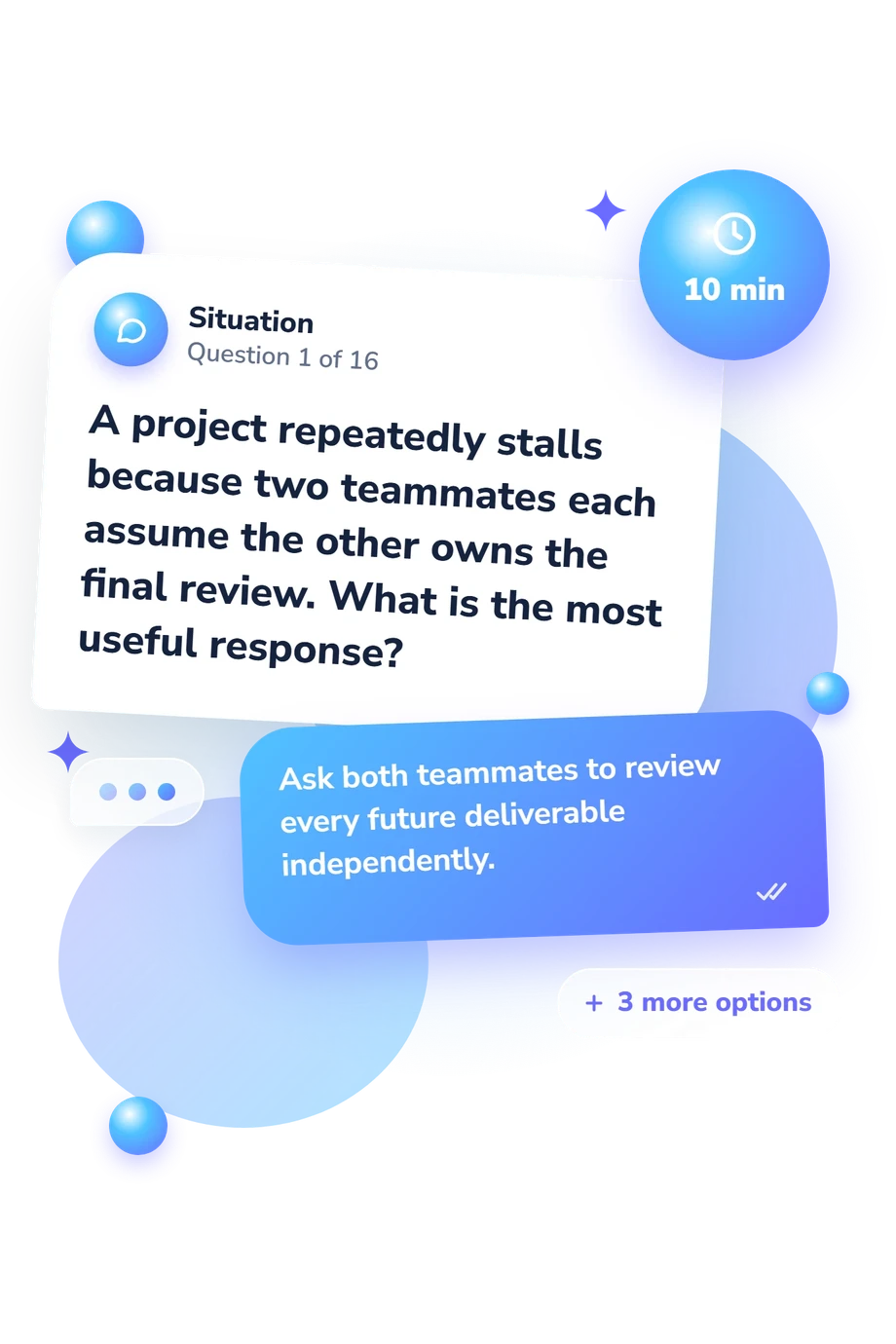
- Ask both teammates to review every future deliverable independently.
- Add a status meeting without changing how responsibility is assigned.
- Let ownership remain flexible so either person can step in when available.
- Assign a clear owner and confirm responsibilities, decision rights, and deadlines.
- Move every conversation to whichever channel has the most active users.
- Agree on channel purposes, expected response times, and where final decisions are recorded.
- Copy all messages into every channel so nobody has to search for them.
- Let each project lead choose communication rules without documenting them.
- Ask the most senior member to select the proposal that seems most practical.
- Take an immediate vote to reveal which proposal already has the most support.
- Agree on evaluation criteria and the decision method that will be used.
- Commit to discussing the proposals until every member favors the same one.
Teamwork Quiz - Description and methodology of the test
People who want a practical way to examine how they understand collaboration, communication, and shared responsibility can use this teamwork quiz as a focused knowledge check. It suits students, employees, team leads, and anyone reflecting on group work. The result offers a teamwork assessment of strengths across common workplace situations, helping you identify principles worth practising rather than judging a particular team's performance.
What This Assessment Explores
This questionnaire tests practical knowledge of how teams coordinate, communicate, decide, handle disagreement, learn, and protect useful participation. Situations include unclear ownership, channel confusion, missed commitments, meetings, feedback, and dissent.
One scored scale, Teamwork Knowledge, runs from 0-16. The questions cover these thematic areas:
- Questions about role clarity and accountability ask you to recognize visible ownership and commitments.
- Communication and listening items ask you to recognize clear channels and checked understanding.
- Decision making and conflict handling items ask you to recognize shared criteria for disagreement.
- Team learning and participation items ask you to recognize retrospectives and balanced contribution.
- Psychological safety and feedback items ask you to recognize constructive discussion of concerns and mistakes.
Results appear as Foundations to build 0-6, Developing knowledge 7-12, or Strong knowledge 13-16. This score reflects practical teamwork knowledge, not how a particular team performs.
Methodology and Scientific Basis
Each item presents a workplace situation with four answer choices. Selecting the most effective response tests recognition of teamwork practice rather than satisfaction with your own team. The result is a single knowledge score; it is not an observation of behavior.
Conceptually, the questionnaire is consistent with the Teamwork KSA Test, which frames teamwork requirements as knowledge, skills, and abilities. It is not presented as an adaptation of that published instrument. Stevens and Campion’s 1994 framework supports its attention to coordination, communication, planning, and interpersonal processes. Salas, Sims, and Burke’s model adds a broader account of monitoring, support, adaptability, and team orientation, while Edmondson’s work clarifies psychological safety and learning behavior.
This tool assesses knowledge of team collaboration and is best read as a knowledge profile. Its bands are descriptive catalogue ranges, not norms for an occupation or team. The published instruments provide conceptual context, not validation of this online questionnaire. Answers may be affected by prior familiarity with teamwork concepts, guessing, attention, and current perspective; knowledge may not translate into observed team behavior. Use the result to choose topics for reflection and practice.
- Stevens, Michael J., and Michael A. Campion. (1999). Staffing Work Teams: Development and Validation of a Selection Test for Teamwork Settings. Journal of Management, 25(2), 207-228. DOI 10.1177/014920639902500205
- Stevens, Michael J., and Michael A. Campion. (1994). The Knowledge, Skill, and Ability Requirements for Teamwork: Implications for Human Resource Management. Journal of Management, 20(2), 503-530. DOI 10.1177/014920639402000210
- Salas, Eduardo, Dana E. Sims, and Shawn C. Burke. (2005). Is There a Big Five in Teamwork? Small Group Research, 36(5), 555-599. DOI 10.1177/1046496405277134
- Edmondson, Amy. (1999). Psychological Safety and Learning Behavior in Work Teams. Administrative Science Quarterly, 44(2), 350-383. DOI 10.2307/2666999
Updated: