
Treasure Island Quiz
How the Scales are Structured
Who Usually Takes This Test?
See How You Compare
Below is a preview of how scores are typically distributed across each scale.
Example Questions From the Test
- First mate
- Quartermaster appointed by Captain Smollett
- Cabin boy
- Ship’s cook
- Magistrate
- Harbor master
- Naval admiral
- Customs officer
- It marks the exact site where Flint buried the treasure
- It provides the only route back to the Hispaniola
- It contains written evidence against Silver
- It offers a defensible position with shelter and access to water
Treasure Island Quiz - Description and methodology of the test
Readers who want to check how closely they remember Robert Louis Stevenson’s adventure can use the treasure island quiz to test recognition of its plot, characters, motives, and settings. It suits anyone preparing for discussion, returning to the novel, or comparing remembered details with the text. This Treasure Island book quiz rewards accurate recall rather than literary opinion.
What This Quiz Measures
Rather than asking for opinion, this assessment checks whether a reader can recognize details and connect them across the voyage, mutiny, and search for Flint’s treasure. Its questions focus on who acts, why decisions matter, where events occur, and how later revelations change their meaning.
This treasure island knowledge quiz contributes to one total score:
- Questions about characters show how accurately you identify central figures and loyalties.
- Plot questions show whether you connect the black spot, mutiny, stockade, ship, and treasure.
- Setting and story-detail questions cover places, documents, ships, and symbols.
- Motive and consequence questions show how choices create danger, reversals, loyalty, or escape.
The displayed Treasure Island Knowledge scale runs from 0-16 correct answers: Early Explorer, 0-6; Capable Voyager, 7-12; Treasure Island Expert, 13-16. These bands describe command of characters, motives, settings, and turning points, not literary quality or intelligence.
Methodology and Evidence Base
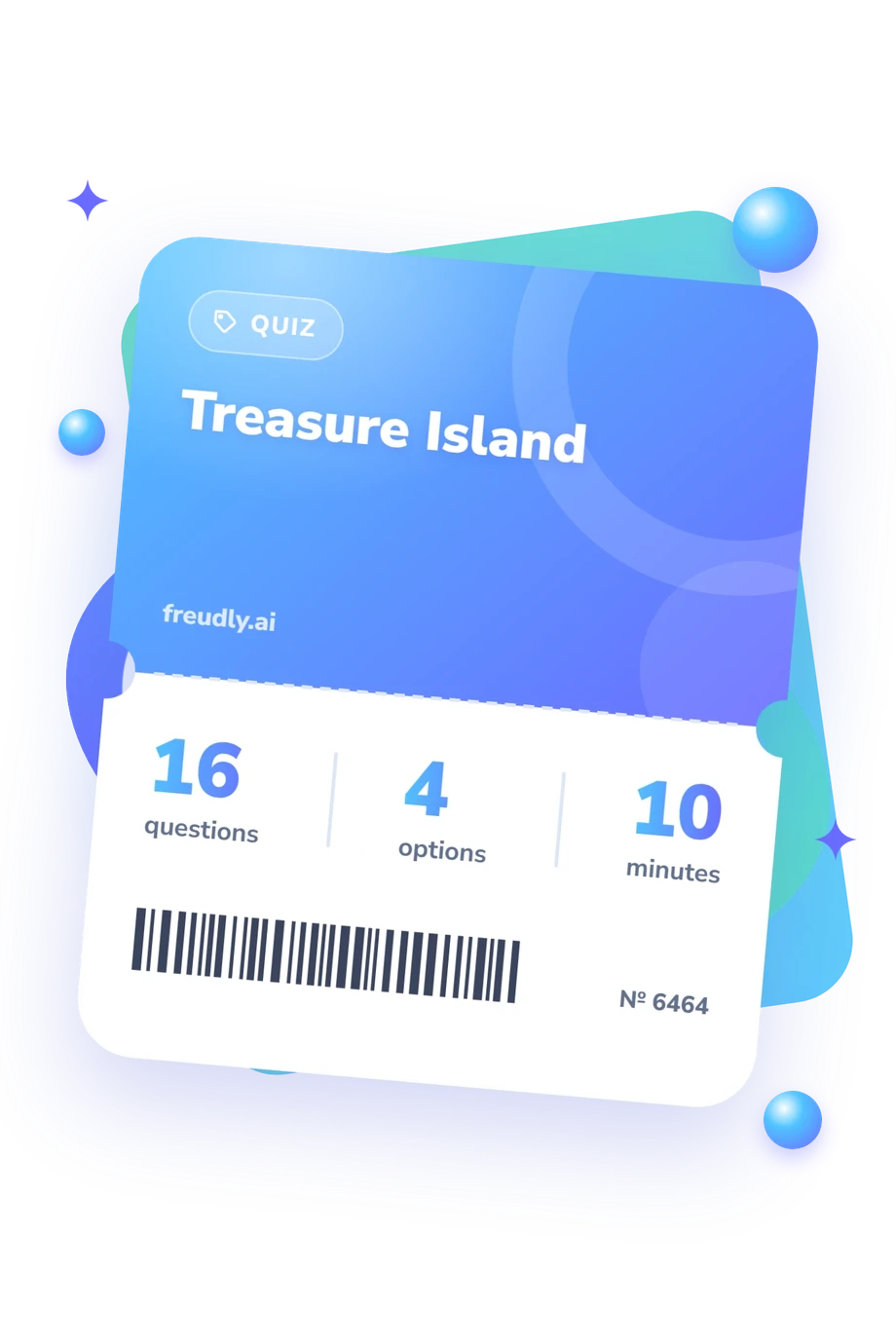
The questionnaire uses 16 four-option multiple-choice items. Each asks for the best answer about an event, character, setting, object, or decision. The Treasure Island trivia quiz format emphasizes recognition and recall rather than open-ended interpretation, while plausible distractors make careful reading important.
The score uses the number of correct responses on one knowledge scale, and the displayed band translates that total into a performance description.
Robert Louis Stevenson’s novel Treasure Island supplies the factual content. Peter Hunt’s edited edition provides literary context, while Amy R. Wong’s 2014 study offers a critical lens on dialogue, persuasion, and social performance. These works provide context rather than psychometric evidence for the online result; the questionnaire is conceptually consistent with their subject matter, not an adaptation of either work.
Results can vary with reading recency, memory, edition differences, and uncertainty between plausible options, so a missed answer does not by itself show weak comprehension. Different editions may change wording or presentation, and returning readers may retrieve names, chronology, and reversals less readily. The bands are performance categories for these questions.
- Stevenson, Robert Louis. Treasure Island. London: Cassell & Company, 1883.
- Stevenson, Robert Louis. Treasure Island. Edited with an introduction and notes by Peter Hunt. Oxford World's Classics. Oxford University Press, 2011. 10.1093/owc/9780199560356.001.0001.
- Wong, Amy R. "The Poetics of Talk in Robert Louis Stevenson's Treasure Island." SEL Studies in English Literature, vol. 54, no. 4, 2014, pp. 901-922. 10.1353/sel.2014.0048.
Updated: