
Trivia Quiz for Seniors
How the Scales are Structured
Who Usually Takes This Test?
See How You Compare
Below is a preview of how scores are typically distributed across each scale.
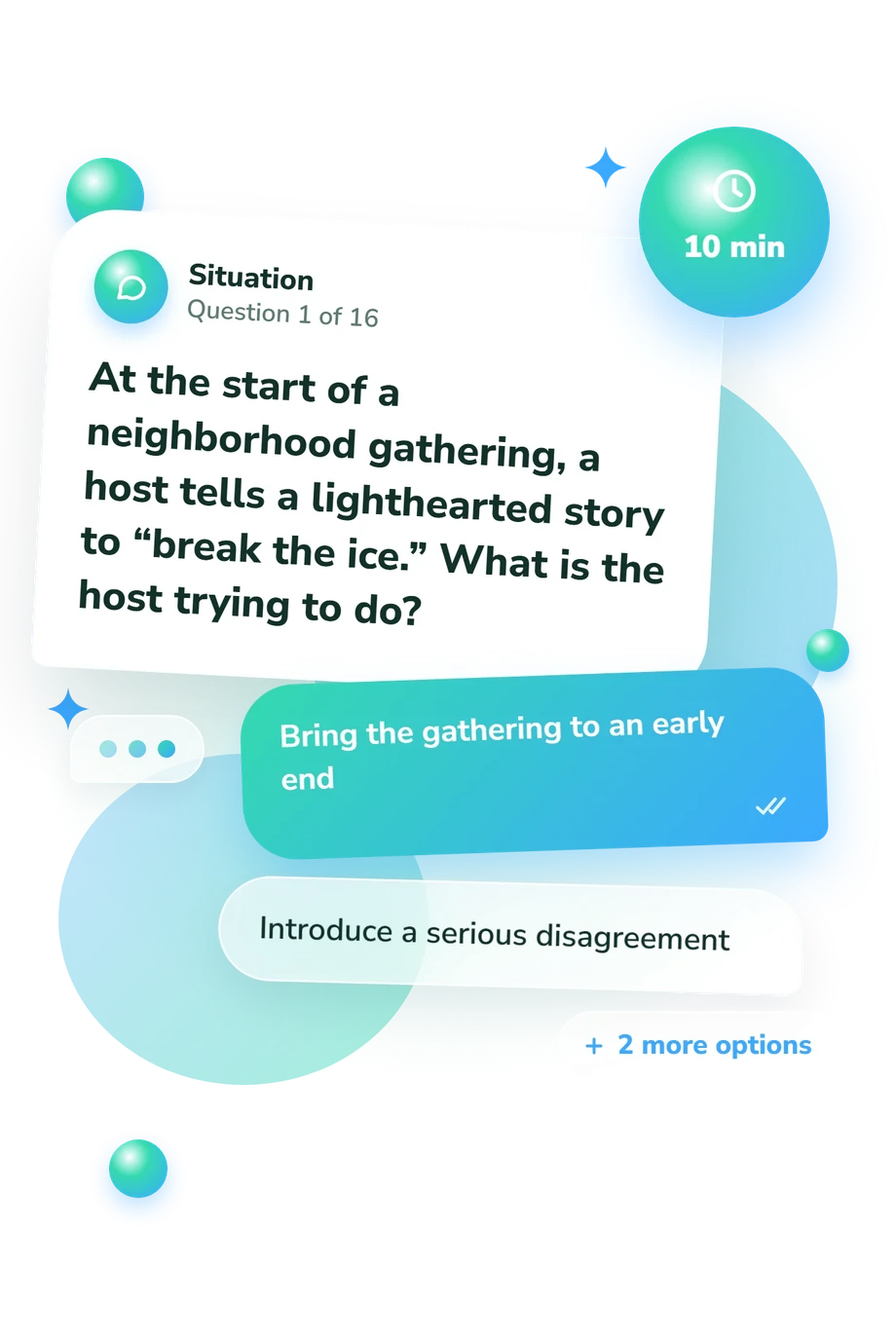
Example Questions From the Test
- Bring the gathering to an early end
- Introduce a serious disagreement
- Help people relax and begin talking
- Move everyone away from the room
- 50
- 45
- 40
- 60
- China
- Japan
- South Korea
- India
Trivia Quiz for Seniors - Description and methodology of the test
For older adults who enjoy recalling facts and solving practical problems, this assessment offers a focused look at broad general knowledge. The trivia quiz for seniors uses varied prompts rather than specialist material, showing how one total score summarizes performance across its topics and where curiosity may begin. It can also add structure to quiz games for seniors as a friendly conversation starter.
What This Assessment Explores
This questionnaire suits adults who want to explore broad general knowledge through senior trivia questions rather than one academic subject. Questions combine factual recall with practical application in familiar situations, while one total score summarizes performance across these topics.
The questions represent these thematic groups:
- History and civics test recognition of major events and the role of public institutions.
- Science and nature examine basic processes, physical relationships, and likely real-world conditions.
- Culture and language draw on literature, art, music, and familiar expressions.
- Mathematics and reasoning assess proportions, percentages, time, symbols, and direction.
- Everyday knowledge connects common facts with practical understanding.
The displayed scale is Senior Trivia Knowledge, scored from 0-16. Foundations to Refresh (0-6) indicates useful reference points with room to revisit familiar topics; Developing Range (7-12) reflects solid knowledge across several subjects; Strong Range (13-16) indicates broad, reliable knowledge applied to factual and reasoning questions. These categories describe this performance, not a complete intellectual profile.
Methodology and Evidence Base
Methodologically, this is a fixed-choice self-administered questionnaire. Each item presents a short prompt and four options, with one intended answer; prompts ask for recall, recognition, calculation, or basic inference. The result is determined by correct answers, not a personality scale or clinical index.
That design is conceptually consistent with Coane and Umanath (2021), whose work examines general-knowledge performance in older adults, and with Horn and Cattell’s distinction between crystallized knowledge and fluid reasoning. These sources offer conceptual context for combining factual memory with simple reasoning in this online questionnaire.
The displayed bands are descriptive categories for this questionnaire, and the total score summarizes correct answers across its 16 items rather than separate scores for individual topics. As a general knowledge quiz for older adults, it is a snapshot of performance under current conditions. Topic familiarity, language, education, cultural exposure, fatigue, and test-taking style may affect results, and one score cannot represent everything a person knows. Treat the category as a prompt for reflection or discussion.
- Coane, Jennifer H., and Sharda Umanath. “A database of general knowledge question performance in older adults.” Behavior Research Methods, 53, 415-429 (2021). 10.3758/s13428-020-01493-2
- Horn, John L., and Raymond B. Cattell. “Age differences in fluid and crystallized intelligence.” Acta Psychologica, 26(2), 107-129 (1967). 10.1016/0001-6918(67)90011-X
Updated: