
Synonyms and Antonyms Quiz
How the Scales are Structured
Who Usually Takes This Test?
See How You Compare
Below is a preview of how scores are typically distributed across each scale.
Example Questions From the Test
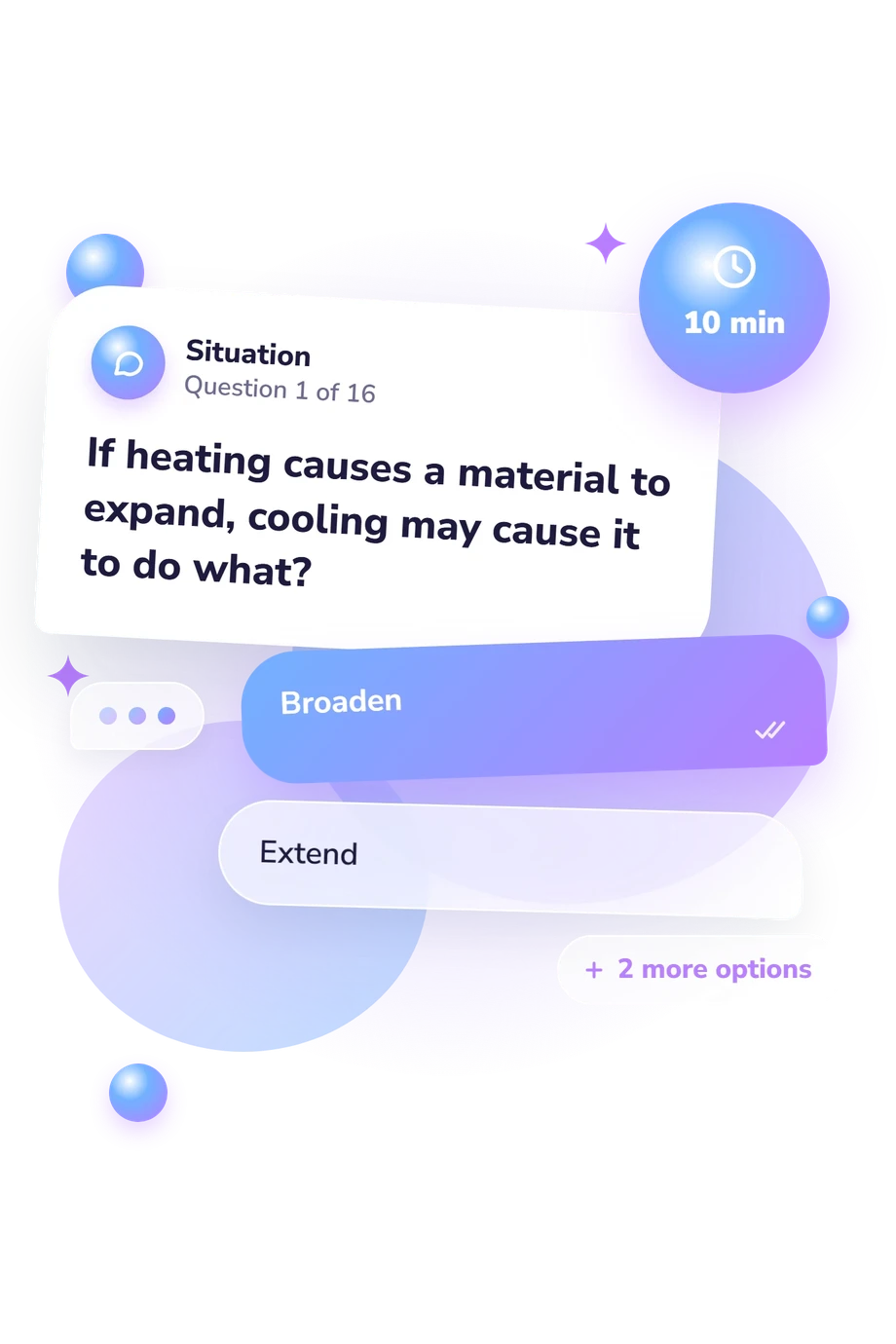
- Broaden
- Extend
- Enlarge
- Contract
- Brief
- Seasonal
- Immediate
- Permanent
- Stable
- Straight
- Fragile
- Flexible
Synonyms and Antonyms Quiz - Description and methodology of the test
For learners, teachers, and curious readers, the synonyms and antonyms quiz offers a focused way to examine vocabulary relationships in context. It is useful when you want a vocabulary quiz that shows whether familiar words remain clear when they appear in sentences, not just in isolation. The result indicates your overall performance level across the tested vocabulary, while general review can reinforce unfamiliar terms and meanings in context.
What This Test Measures
The questions measure receptive knowledge of equivalent and contrasting meanings, plus the ability to use context when several choices seem plausible. Items cover relationships such as expand/contract, obsolete/outdated, lucid/clear, and generous/stingy; others ask what words such as candid, circuitous, or mitigate mean in a sentence. This makes the word meaning quiz a test of practical recognition rather than isolated definition recall.
The overall result is reported as Synonyms and Antonyms Knowledge (0-16), with these bands:
- Building Foundations (0-6) shows that you recognize some relationships and may benefit from reviewing meanings in context.
- Developing Command (7-12) shows understanding of many common synonyms and antonyms, with less familiar distinctions still developing.
- Strong Command (13-16) shows consistent recognition of equivalent, contrasting, and context-dependent meanings.
Together, the bands describe performance on the tested vocabulary rather than general language ability.
Methodology and Evidence Base
Each of the 16 items presents a short sentence or prompt with four answer choices. Depending on the item, you select a synonym, an antonym, or the option that best captures a contextual meaning. As a synonym antonym quiz, it tests receptive vocabulary through these decisions: you identify the intended relationship instead of supplying a word unaided.
A relevant published comparison is the Vocabulary Levels Test, developed by Schmitt, Nation, and Clapham in 2001, a measure of word-meaning knowledge. This Freudly questionnaire is conceptually consistent with that instrument, but it is not an adaptation or standardized administration of it. Schmitt, Nation, and Kremmel emphasize that vocabulary assessment requires careful test development and validation, which supports cautious interpretation of a short online measure.
The displayed total summarizes performance across the item set. Results can vary with reading exposure, prior familiarity with the selected words, attention, and guessing. The questionnaire has no stated norms or clinical status, so it should not be treated as a diagnostic measure.
- Schmitt, Norbert, Diane Schmitt, and Caroline Clapham. 2001. Developing and exploring the behaviour of two new versions of the Vocabulary Levels Test. Language Testing, 18(1), 55-88. 10.1177/026553220101800103
- Schmitt, Norbert, Paul Nation, and Benjamin Kremmel. 2020. Moving the field of vocabulary assessment forward: The need for more rigorous test development and validation. Language Teaching, 53(1), 109-120. 10.1017/S0261444819000326
Updated: