
What Singer Am I Quiz
How the Scales are Structured
Who Usually Takes This Test?
See How You Compare
Below is a preview of how scores are typically distributed across each scale.
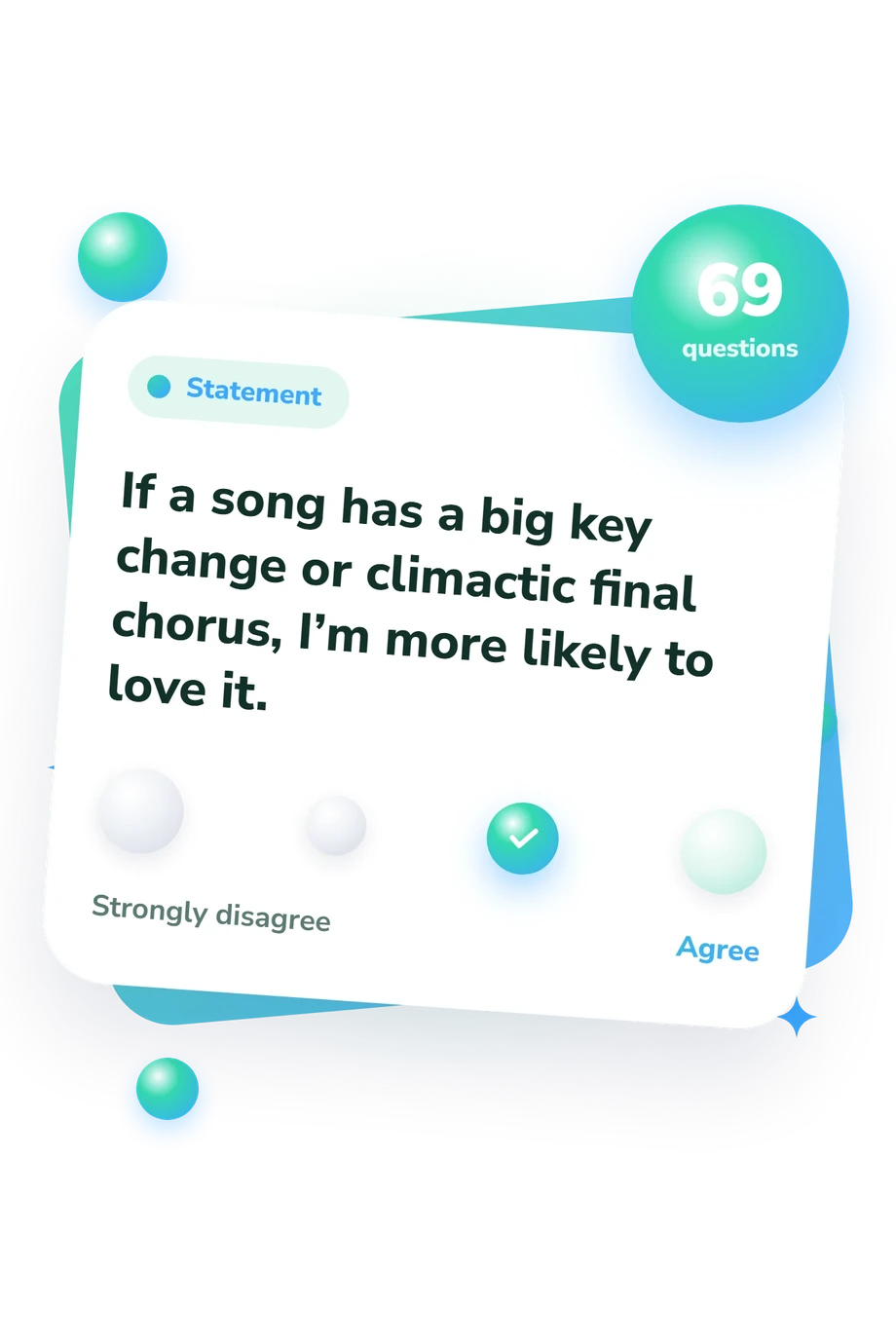
Example Questions From the Test
- Strongly disagree
- Disagree
- Not sure
- Agree
- Strongly disagree
- Disagree
- Not sure
- Agree
- Strongly disagree
- Disagree
- Not sure
- Agree
What Singer Am I Quiz - Description and methodology of the test
People who enjoy singing, songwriting, performing, or thinking about their musical identity can use this singer personality quiz to turn preferences into a readable artistic profile. The What Singer Am I Quiz offers playful self-reflection, showing whether your choices point toward original creation, visible performance energy, or a high-impact vocal approach. The result connects musical preferences with a recognizable style, helping you see what kind of singer you are.
What This Assessment Measures
The questionnaire examines the singer-artist profile suggested by your preferences, so this singer type quiz highlights patterns in lyric writing, signature sound, experimentation, live confidence, audience awareness, projection, range, resonance, and vocal control. It shows whether your choices lean toward interpretation, creation, frontperson energy, or a powerhouse approach.
The three displayed result dimensions are:
- Songwriting & Originality (0-20) reflects creativity and personal identity: Interpreter-leaning (0-7), Balanced creator (8-13), or Indie storyteller (14-20).
- Stage Presence (0-20) reflects performance energy and audience engagement: Low-key Presence (0-7), Balanced Presence (8-14), or Commanding Presence (15-20).
- Vocal Power (0-20) reflects bold, controlled, high-impact singing: Soft & Subtle (0-6), Balanced Presence (7-13), or Powerhouse (14-20).
Methodology and Evidence Base
Statements use four response options-Strongly disagree, Disagree, Not sure, and Agree-to capture preferences and imagined performance situations as self-report indicators. Responses form the displayed totals, but the format does not establish how many points an individual answer contributes.
As a what singer are you quiz, this questionnaire aligns conceptually with research on musical identity, singer self-concept, performance self-efficacy, and songwriting creativity. O'Bryan (2015) connects singer identity with the body, voice, experience, and social meaning of singing. Burland, Bennett, and López-Íñiguez (2022) treat musical identity as measurable across musicians. Lewis and Hendricks (2022) address performance self-efficacy, while Garfrerick (2003) supports attention to creativity and songwriting outcomes. This questionnaire is consistent with those studies, not a direct adaptation of them.
As an online self-report profile, it has no stated population norms or clinical cutoffs. The result can shift with current confidence, recent listening, performance experience, and answer candor. Use it to reflect on preferences and possible strengths, not to establish vocal style, creative achievement, or professional identity.
- O'Bryan, Jessica. (2015). 'We ARE our instrument!': Forming a singer identity. Research Studies in Music Education, 37(1), 123-137. DOI 10.1177/1321103X15592831
- Burland, Karen, Dawn Bennett, and Guadalupe López-Íñiguez. (2022). Validation of the Musical Identity Measure: Exploring musical identity as a variable across multiple types of musicians. Musicae Scientiae, 26(4), 704-728. DOI 10.1177/10298649221108576
- Lewis, Megan C., and Karin S. Hendricks. (2022). 'It's your body, it's part of who you are!': Influences upon collegiate vocalists' performance self-efficacy beliefs. International Journal of Music Education, 40(4), 514-529. DOI 10.1177/02557614221074057
- Garfrerick, Robert A. (2003). The Relationship Between Creativity Score and Creative Outcome in Popular Songwriting. Journal of the Music & Entertainment Industry Educators Association, 3(1), 13-21. DOI 10.25101/3.1
Updated: