
What Dinosaur Am I Quiz
How the Scales are Structured
Who Usually Takes This Test?
See How You Compare
Below is a preview of how scores are typically distributed across each scale.
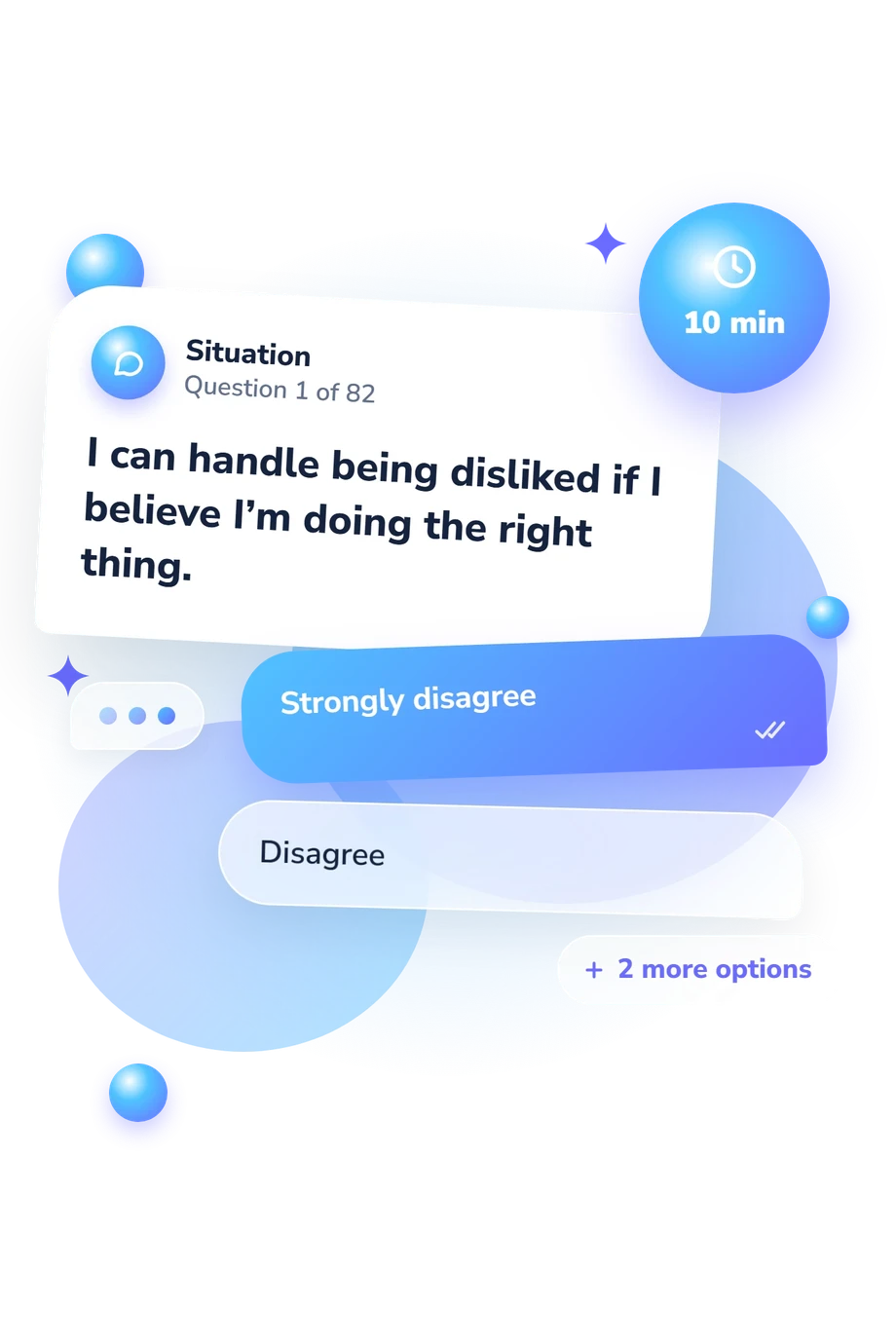
Example Questions From the Test
- Strongly disagree
- Disagree
- Not sure
- Agree
- Strongly disagree
- Disagree
- Not sure
- Agree
- Strongly disagree
- Disagree
- Not sure
- Agree
What Dinosaur Am I Quiz - Description and methodology of the test
For curious readers, this dinosaur personality quiz explores how they approach leadership, pressure, learning, and change. The What Dinosaur Am I Quiz translates everyday preferences and reactions into a profile of boldness, emotional steadiness, and cleverness. It offers a light, structured way to notice how these tendencies appear in everyday choices and reactions.
What This Assessment Explores
Presented as a playful what-dinosaur-are-you quiz, its questions touch on assertiveness, stress, curiosity, flexible thinking, planning, and adaptation. It produces a three-part profile showing whether answers lean toward taking charge, staying grounded, or solving problems strategically.
The displayed dimensions are:
- Boldness (0-30) shows assertiveness, risk tolerance, and readiness to take charge: Cautious 0-10, Balanced 11-20, and Apex Energy 21-30.
- Calm & Steady (0-30) reflects emotional steadiness, patience, and grounded stress responses: Reactive 0-10, Moderately Steady 11-20, and Calm & Grounded 21-30.
- Cleverness (0-30) reflects strategic thinking, curiosity, and adaptable problem-solving: Steady & Routine 0-10, Flexible Thinker 11-20, and Raptor-Like Strategist 21-30.
Together, the scores describe tendencies in the situations covered, not a fixed identity or a universal ranking of personality styles.
Methodology and Scientific Basis
Statements use first-person descriptions of speaking up, taking initiative, handling criticism, settling under pressure, learning unfamiliar systems, comparing options, and changing tactics after setbacks. The sample uses four response choices, with some items offering Not sure and others using Strongly agree.
The questionnaire reports three scores from the responses but does not publish a per-response weighting formula or population norms, so its bands are descriptive guides for interpreting the profile. Together, they summarize patterns in initiative, emotional steadiness, strategic adaptation, and responses to pressure.
Conceptually, the structure is consistent with Big Five Aspect Scales (DeYoung et al., 2007), especially themes related to assertiveness, exploratory engagement, emotional regulation, curiosity, and strategy. Goldberg (1992) represents the broader Big Five marker tradition. These sources provide a theoretical comparison, not evidence that this online questionnaire is a standardized adaptation or carries the published instruments’ norms.
Self-report can vary with current mood, self-awareness, and impression management. Presented as a dinosaur personality test, the questionnaire keeps its three dimensions approachable while retaining a structured self-report format.
- DeYoung, Colin G., Lena C. Quilty, and Jordan B. Peterson. (2007). Between facets and domains: 10 aspects of the Big Five. Journal of Personality and Social Psychology, 93(5), 880-896. 10.1037/0022-3514.93.5.880
- Goldberg, Lewis R. (1992). The development of markers for the Big-Five factor structure. Psychological Assessment, 4(1), 26-42. 10.1037/1040-3590.4.1.26
Updated: