
Unit Circle Quiz
How the Scales are Structured
Who Usually Takes This Test?
See How You Compare
Below is a preview of how scores are typically distributed across each scale.
Example Questions From the Test
- Cosine negative; sine positive
- Cosine negative; sine negative
- Cosine positive; sine positive
- Cosine positive; sine negative
- Negative one-half, written -1/2
- Positive square root of three over two, written √3/2
- Positive one-half, written 1/2
- Negative square root of three over two, written -√3/2
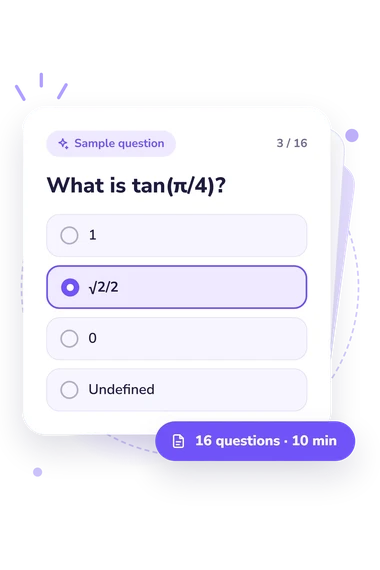
- 1
- √2/2
- 0
- Undefined
Unit Circle Quiz - Description and methodology of the test
Students and independent learners who want to strengthen trigonometric fluency can use this unit circle quiz to connect formulas with positions, signs, and angles. The result shows how confidently you retrieve and apply core relationships, making the activity useful before coursework, tutoring, or focused review. For targeted study, a unit circle practice quiz can reveal whether difficulty comes from recall, quadrant reasoning, or translating between representations.
What This Assessment Explores
The questions sample connected skills rather than a single memorized table. They ask about quadrant signs, exact values, coordinates, coterminal angles, degree-radian conversion, identities, and arc length. This makes the assessment useful for learners who want to know whether recall transfers to short calculations and unfamiliar wording. It can serve as a unit circle memorization quiz while still highlighting reasoning gaps.
The displayed Unit Circle Knowledge scale describes three result levels:
- Foundations to reinforce (0-6) shows that angle-coordinate links and sine/cosine relationships need review.
- Developing knowledge (7-12) indicates that many core values are available, while signs, transformations, or multi-step reasoning may still need practice.
- Strong knowledge (13-16) indicates accurate recall and application across varied unit-circle tasks.
Methodology and Evidence Base
Each prompt uses four-option multiple choice. The learner identifies a point, sign, angle, identity, or value and selects the answer that fits; several tasks require a short chain of reasoning rather than simple recall. The score follows the displayed rule of one point per correct answer, with no percentile comparison or external norm shown. In that sense, this unit circle assessment gives a criterion-based snapshot within the questionnaire.
Conceptually, the questionnaire is consistent with Mickey and McClelland (2017), who describe the unit circle as a structure linking angles, coordinates, and trigonometric functions. Martínez-Planell and Cruz Delgado (2016) connect movement around the circle with understanding sine, cosine, and their inverses, while Weber (2005) emphasizes connections among representations and meanings. These works support the mathematical framing; they do not make this online questionnaire a reproduction or adaptation of their studies.
Performance can shift with guessing, concentration, prior instruction, notation familiarity, and current study context. Treat the result as a guide to what to review next, not a fixed measure of mathematical ability.
- Mickey, Kevin W., and James L. McClelland. 2017. "The Unit Circle as a Grounded Conceptual Structure in Precalculus Trigonometry." In Acquisition of Complex Arithmetic Skills and Higher-Order Mathematics Concepts, edited by David C. Geary, Daniel B. Berch, Robert Ochsendorf, and Kathleen Mann Koepke, 247-269. Academic Press. 10.1016/B978-0-12-805086-6.00011-4
- Martínez-Planell, Rafael, and Angel Cruz Delgado. 2016. "The Unit Circle Approach to the Construction of the Sine and Cosine Functions and Their Inverses: An Application of APOS Theory." The Journal of Mathematical Behavior, 43, 111-133. 10.1016/j.jmathb.2016.06.002
- Weber, Keith. 2005. "Students’ Understanding of Trigonometric Functions." Mathematics Education Research Journal, 17(3), 91-112. 10.1007/BF03217423
Updated: