
Umpire Quiz
How the Scales are Structured
Who Usually Takes This Test?
See How You Compare
Below is a preview of how scores are typically distributed across each scale.
Example Questions From the Test
- When an umpire grants the request and calls time
- As soon as any player verbally requests time
- When the pitcher hears the request and stops moving
- Only after every defensive player has returned to position
- Ball four, and the batter is awarded first base
- The batter remains at bat with the count reset to 3-0
- Strike three because a full count requires the batter to swing
- The pitch must be repeated because the count was full
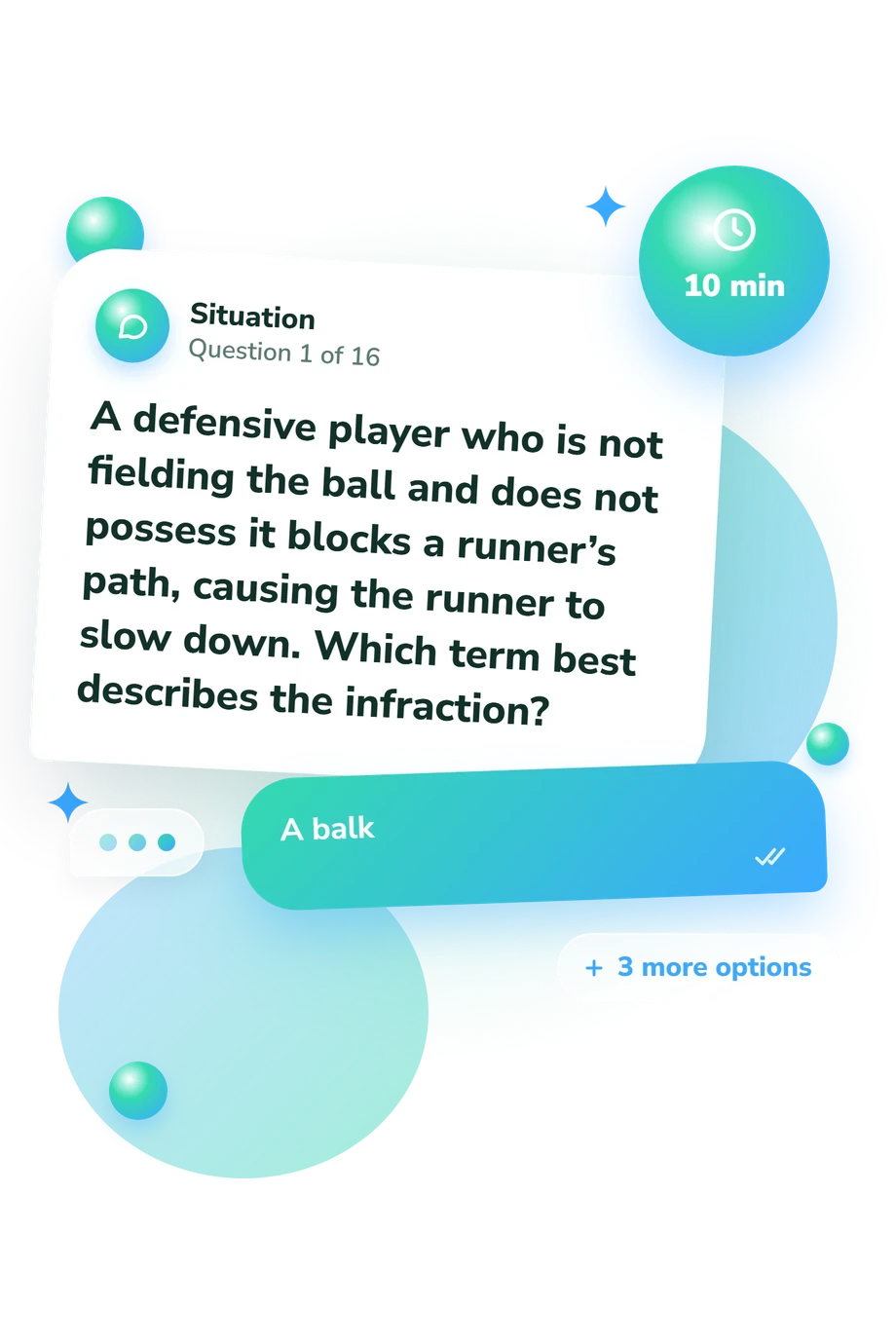
- Obstruction by the fielder
- Interference by the runner
- A legal collision because the runner has priority everywhere
- A balk by the pitcher
Umpire Quiz - Description and methodology of the test
People learning baseball officiating and umpires refreshing familiar rulings will encounter situations involving runners, force plays, fair and foul balls, catches, interference, appeals, and the strike zone. The umpire quiz gives a broad indication of accuracy on the presented rulings. As a quiz for baseball umpires, it offers a focused set of situations to consider before working from the applicable rulebook during actual games.
What This Assessment Explores
The questions test whether a respondent can distinguish related rulings and apply them in changing game situations. Topics include obstruction, interference, appeals, force plays, scoring before a third out, hit-by-pitch rulings, fair and foul balls, catches, tagging up, infield fly, the strike zone, and foul tips. The focus is rule recognition, not personality or physical performance.
The Umpire Knowledge scale runs from 0-16, with one point for each correct answer. Results fall into three bands:
- Foundations to Review (0-6) means core concepts need review.
- Developing Command (7-12) shows many standard rules are understood, with less familiar applications to practise.
- Strong Command (13-16) indicates solid command of broadly recognized rules, while local codes may differ.
As an umpire knowledge test, it gives a broad rule-knowledge level; specific study priorities require examining individual rulings, not inferring them from the total score.
Methodology and Evidence Base
Each item presents a baseball situation and four answer choices. The respondent selects the ruling that best fits the facts, and the score counts correct responses at one point each. This raw total reflects performance on the presented items and the specific rulings they sample.
The rules addressed are conceptually consistent with Official Baseball Rules (2026), which defines appeals, force plays, dead-ball decisions, catches, the strike zone, and related judgments. Stewart and Blomberg’s practical question book offers a comparable scenario-based approach to examining rule knowledge.
Official Baseball Rules (2026) supplies the relevant framework: this online baseball rules quiz asks respondents to recognize written rulings rather than make perceptual judgments about pitch-calling difficulty. The displayed score is a raw correct-answer total interpreted through the descriptive bands above; items sample appeals, force plays, catches, the strike zone, and related judgments. Interpret it as a snapshot of rule knowledge: performance can vary with prior study, item wording, attention, and the rule code used in a particular league. During an actual game, the applicable governing rulebook remains authoritative.
- Office of the Commissioner of Baseball. Official Baseball Rules, 2026 Edition. Chicago: Triumph Books, 2026.
- Stewart, Wayne, and Ron Blomberg. You're the Umpire: Mind-Boggling Questions to Test Your Baseball Knowledge. 3rd ed. New York: Skyhorse Publishing, 2019.
- Flannagan, Kevin S., Brian M. Mills, and Robert L. Goldstone. "The psychophysics of home plate umpire calls." Scientific Reports 14, no. 1 (2024): 2735. 10.1038/s41598-024-52402-y
Updated: