
Tudor Quiz
How the Scales are Structured
Who Usually Takes This Test?
See How You Compare
Below is a preview of how scores are typically distributed across each scale.
Example Questions From the Test
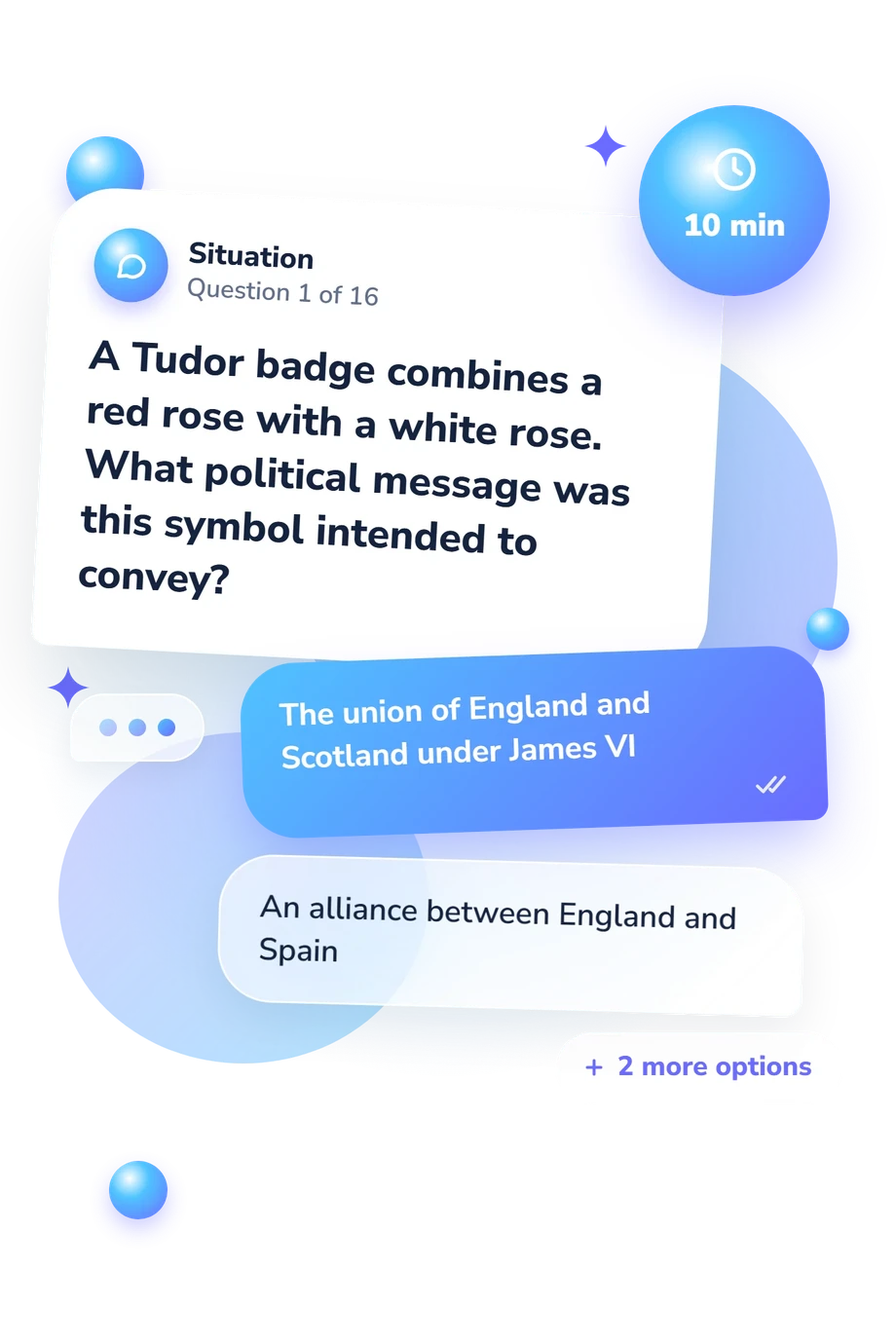
- The union of England and Scotland under James VI
- An alliance between England and Spain
- The separation of England from Rome
- The union of the Lancastrian and Yorkist claims
- She ordered the execution of Mary, Queen of Scots
- Protestants were burned for heresy during her reign
- She led English troops at Bosworth Field
- Catholic monasteries were dissolved during her reign
- Catherine of Aragon
- Margaret Beaufort
- Anne Neville
- Elizabeth of York
Tudor Quiz - Description and methodology of the test
Readers who want to understand Tudor England can use this focused assessment to check how securely they connect rulers, succession, religion, politics, and culture. The Tudor Quiz is suited to curious learners, students, and anyone revisiting the period. As a Tudor history quiz, it shows which parts of the dynasty’s story are already familiar and which topics may reward more reading.
What This Assessment Explores
Rather than measuring personality or opinion, the assessment checks factual and connective knowledge. Prompts ask the respondent to identify monarchs and writers, order reigns, interpret symbols, associate policies with consequences, and recognize changes in worship and literary culture. Because the Tudor history questions link facts with brief situations, the result reflects performance on the material represented here, not general intelligence.
These categories explain the displayed outcome:
- Tudor Knowledge (0-16) measures understanding of key figures, chronology, succession, religious change, and historical connections.
- Foundations to build (0-6) indicates recognition of some people or events, while core chronology and context still need review.
- Developing knowledge (7-12) indicates a sound grasp of major events, with causes, consequences, and reigns needing finer connections.
- Strong knowledge (13-16) indicates accurate understanding of most key figures, developments, and connections covered by the quiz.
Methodology and Historical Basis
Each item presents a prompt with four answer choices. Some require recall; others test chronology or ask the reader to connect a person, policy, or event with its context. The selected option is compared with the answer key, and correct performance is translated into the displayed band. No personality score is involved.
Conceptually, this Tudor knowledge test is consistent with Bucholz and Key (2020), whose account supplies the chronological and political frame. Haigh supports the treatment of religious change as contested, while Pincombe and Shrank support Tudor literary culture. More’s Utopia provides the reference point for the imagined society item. These works support the content and interpretation; this online questionnaire is not an adaptation of any one published instrument.
The assessment has educational rather than standardized psychometric status. It offers no published norms or independent validation, so a band describes performance on these selected topics, not overall historical expertise. Prior study, familiarity with examples, and momentary uncertainty can affect results. Used as a study prompt, it guides further reading without resolving every historical debate.
- Bucholz, Robert, and Newton Key. Early Modern England 1485-1714: A Narrative History. 3rd ed. Wiley, 2020. 10.1002/9781394266517.
- Haigh, Christopher. English Reformations: Religion, Politics, and Society under the Tudors. Oxford University Press, 1993. 10.1093/oso/9780198221630.001.0001.
- Pincombe, Mike, and Cathy Shrank, eds. The Oxford Handbook of Tudor Literature: 1485-1603. Oxford University Press, 2009. 10.1093/oxfordhb/9780199205882.001.0001.
- More, Thomas. More: Utopia. Edited by George M. Logan and Robert M. Adams. Revised ed. Cambridge University Press, 2002.
Updated: