
Tuck Everlasting Quiz
How the Scales are Structured
Who Usually Takes This Test?
See How You Compare
Below is a preview of how scores are typically distributed across each scale.
Example Questions From the Test
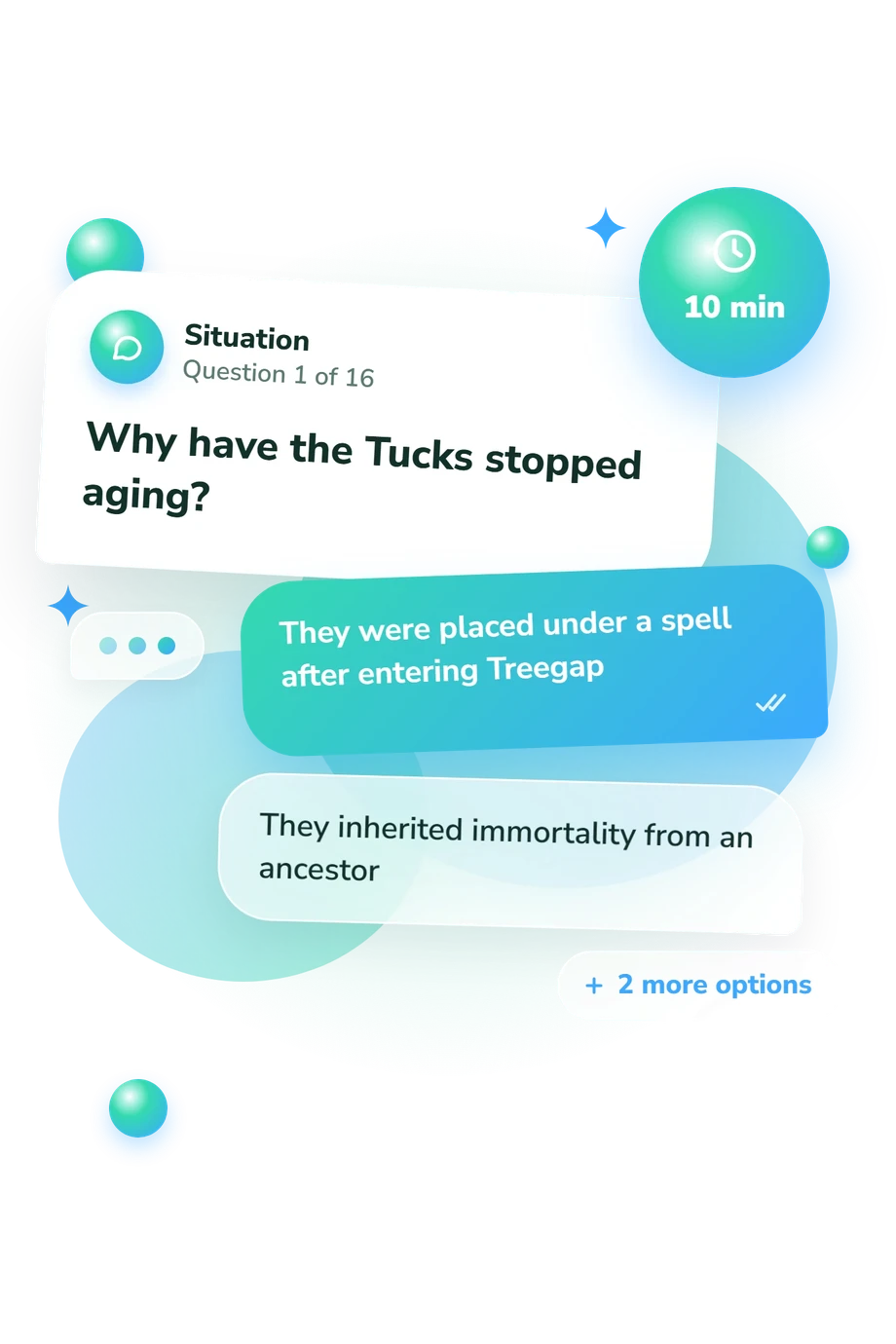
- They were placed under a spell after entering Treegap
- They inherited immortality from an ancestor
- They all drank water from the same spring
- They discovered a medicine made by Angus Tuck
- She drank the water but continued using a mortal identity
- She chose a mortal life, married, and eventually died
- She left Treegap to guard another magical spring
- She joined Jesse but kept it secret from the other Tucks
- Miles refused to settle permanently in one town
- His failure to age frightened her and made her suspicious of him
- She learned that Miles planned to sell the spring water
- She discovered that he had concealed the Tucks’ fortune
Tuck Everlasting Quiz - Description and methodology of the test
For readers checking their understanding of Natalie Babbitt’s novel, the Tuck Everlasting Quiz offers a focused reading check rather than a general impression. It suits students, book-club members, and anyone revisiting Winnie Foster’s story. A tuck everlasting book quiz can connect remembered events with the choices, conflicts, and ideas that shape the novel, giving readers a clear sense of what deserves another look.
What This Quiz Measures
The assessment examines plot events, characters, motives, symbols, and the conflict over whether immortality is desirable. The questions and answers about Tuck Everlasting ask not only who did what, but why choices matter and how later events clarify earlier ones. The result reflects knowledge of this novel’s story and themes, not general intelligence or reading ability.
The displayed result uses one knowledge scale, with bands that describe recall of the narrative and its central ideas:
- Beginning Recall (0-6) shows recognition of some elements of Winnie’s story, while major events or relationships may need review.
- Developing Knowledge (7-12) shows understanding of the central plot and themes, with some details or implications worth revisiting.
- Strong Knowledge (13-16) shows clear command of characters, turning points, motives, and central ideas.
Methodology and Evidence Base
The format uses four-option multiple-choice items. The tuck everlasting multiple choice quiz reports the number of correct responses, making it a content-based reading check rather than a rating of personality or general literary ability.
Items draw on Tuck Everlasting (Babbitt, 1975), covering the Tucks’ immortality, Winnie’s decisions, the man in the yellow suit, Mae’s crisis, the spring, and the tension between natural change and endless life. Babbitt and Mitchell (2004) support attention to plot, relationships, and themes, while Milner (1995) adds context for the story’s religious and philosophical questions. These sources support the content focus; the questionnaire is conceptually consistent with them, but remains an online content check rather than a standardized published instrument.
Quiz answers for Tuck Everlasting are best used to guide rereading and discussion. The descriptive bands indicate performance on this novel, not population norms or clinical cutoffs. Memory, guessing, fixed choices, and differing interpretations can affect the result, so it is most useful as a focused knowledge check alongside engagement with the book.
- Babbitt, Natalie. Tuck Everlasting. Farrar, Straus and Giroux, 1975.
- Babbitt, Natalie, and Hannah Mitchell. Scholastic BookFiles: A Reading Guide to Tuck Everlasting by Natalie Babbitt. Scholastic Inc., 2004. ISBN 0-439-53821-1.
- Milner, Joseph O. “Hard Religious Questions in Knee-Knock Rise and Tuck Everlasting.” The ALAN Review, vol. 22, no. 2, 1995, pp. 18-19. 10.21061/alan.v22i2.a.6
Updated: