
Transitive and Intransitive Verbs Quiz
How the Scales are Structured
Who Usually Takes This Test?
See How You Compare
Below is a preview of how scores are typically distributed across each scale.
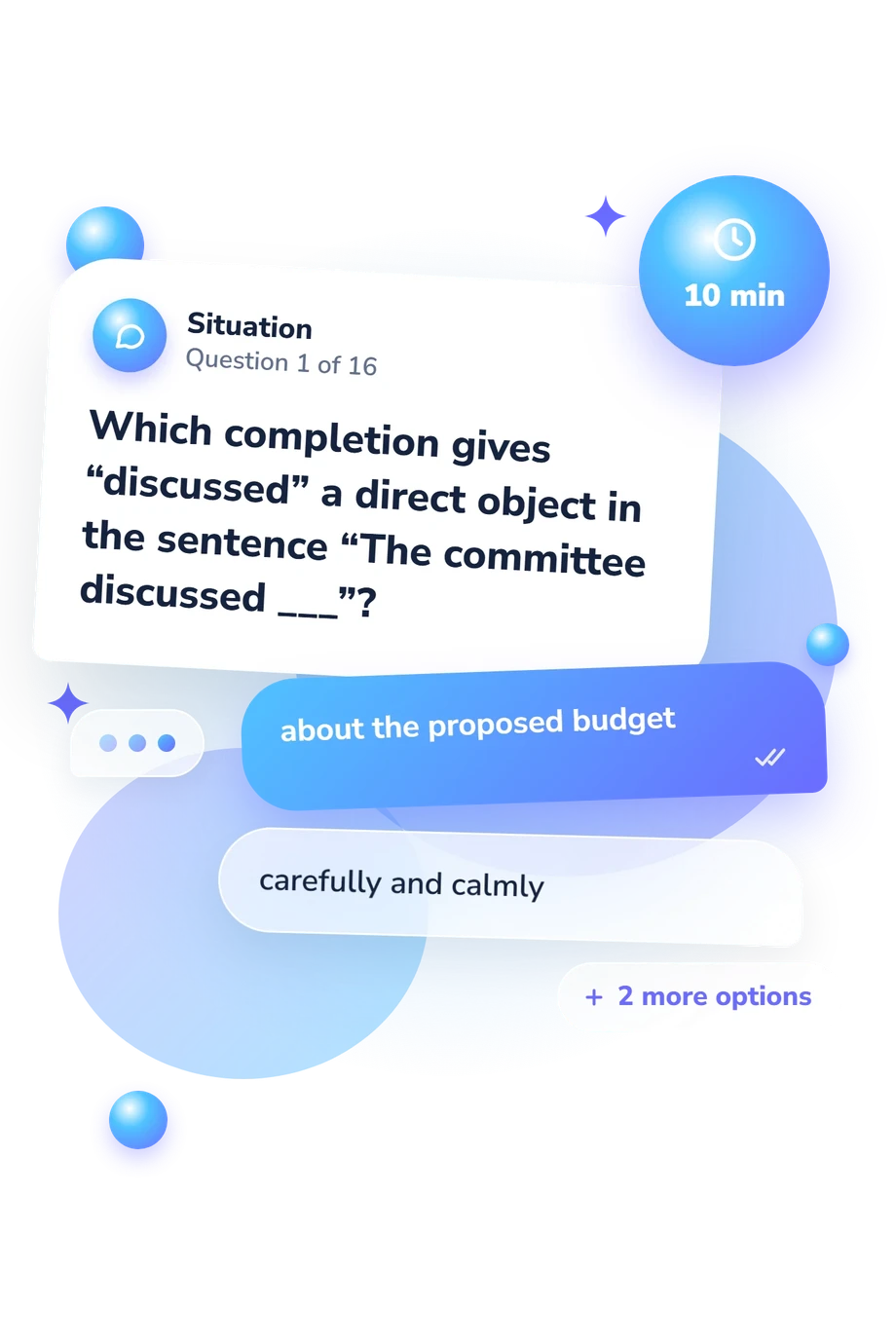
Example Questions From the Test
- about the proposed budget
- carefully and calmly
- the proposed budget
- during the afternoon meeting
- It appears in the past tense.
- It does not act upon a direct object.
- Its subject is a person.
- It is followed by an adverb.
- The birds flew above the lake.
- The pilot flew the plane through the storm.
- The kite flew high in the wind.
- We flew to Madrid in June.
Transitive and Intransitive Verbs Quiz - Description and methodology of the test
Students, teachers, and independent learners who want to check sentence analysis can use this transitive and intransitive verbs quiz to examine how verbs relate to direct objects in context. As a transitive and intransitive quiz, it is useful when a familiar verb changes function across sentences or when a following phrase looks like an object. The result gives a picture of grammar command and suggests what to review next.
What This Assessment Explores
The questionnaire tests sentence analysis rather than vocabulary recall. In a transitive verbs quiz of this kind, classification depends on how a verb functions in context, not on a permanent label. The items cover direct objects, prepositional phrases, passive-voice clues, and verbs that alternate between object-taking and objectless uses.
The main abilities it examines are:
- Direct-object recognition shows whether a noun phrase receives the verb's action.
- Contextual verb use shows whether the same verb changes classification across sentences.
- Phrase analysis separates a direct object from a noun phrase governed by a preposition.
- Constructional reasoning uses passive and double-object patterns to support a judgment.
The displayed scale, Transitive and Intransitive Verbs Knowledge (0-16), reflects how consistently the respondent makes these distinctions. Results are labelled Foundational Review (0-6), Developing Command (7-12), or Strong Command (13-16).
Methodology and Evidence Base
Each item presents a sentence or sentence pair with four answer choices. The respondent selects the analysis that identifies a direct object, explains an intransitive use, or separates a prepositional object from a verb's object. Contrastive items test verbs that alternate between object-taking and objectless uses; others use passive-voice or double-object evidence.
An intransitive verbs quiz is most useful when syntax guides the answer rather than shortcuts about movement or sound verbs. The result is reported as a single total and interpreted through its bands; no separate weighting, norm table, or reliability estimate accompanies this online version.
Conceptually, the questionnaire is consistent with Levin (1993), which analyzes verb classes through patterns of use and alternation, and with Huddleston and Pullum's treatment of complementation, objects, and related clause structures. It is not presented as an adaptation or validation of either published work.
Because responses are self-recorded multiple-choice judgments, performance can reflect attention, prior instruction, and uncertainty about a sentence. The score is best read as a focused learning indicator: it shows which distinctions the respondent handles reliably here, while broader proficiency requires additional contexts.
- Levin, Beth. English Verb Classes and Alternations: A Preliminary Investigation. University of Chicago Press, 1993.
- Huddleston, Rodney, and Geoffrey K. Pullum. The Cambridge Grammar of the English Language. Cambridge University Press, 2002. 10.1017/9781316423530
Updated: