
The Summer I Turned Pretty Character Quiz
How the Scales are Structured
Who Usually Takes This Test?
See How You Compare
Below is a preview of how scores are typically distributed across each scale.
Example Questions From the Test
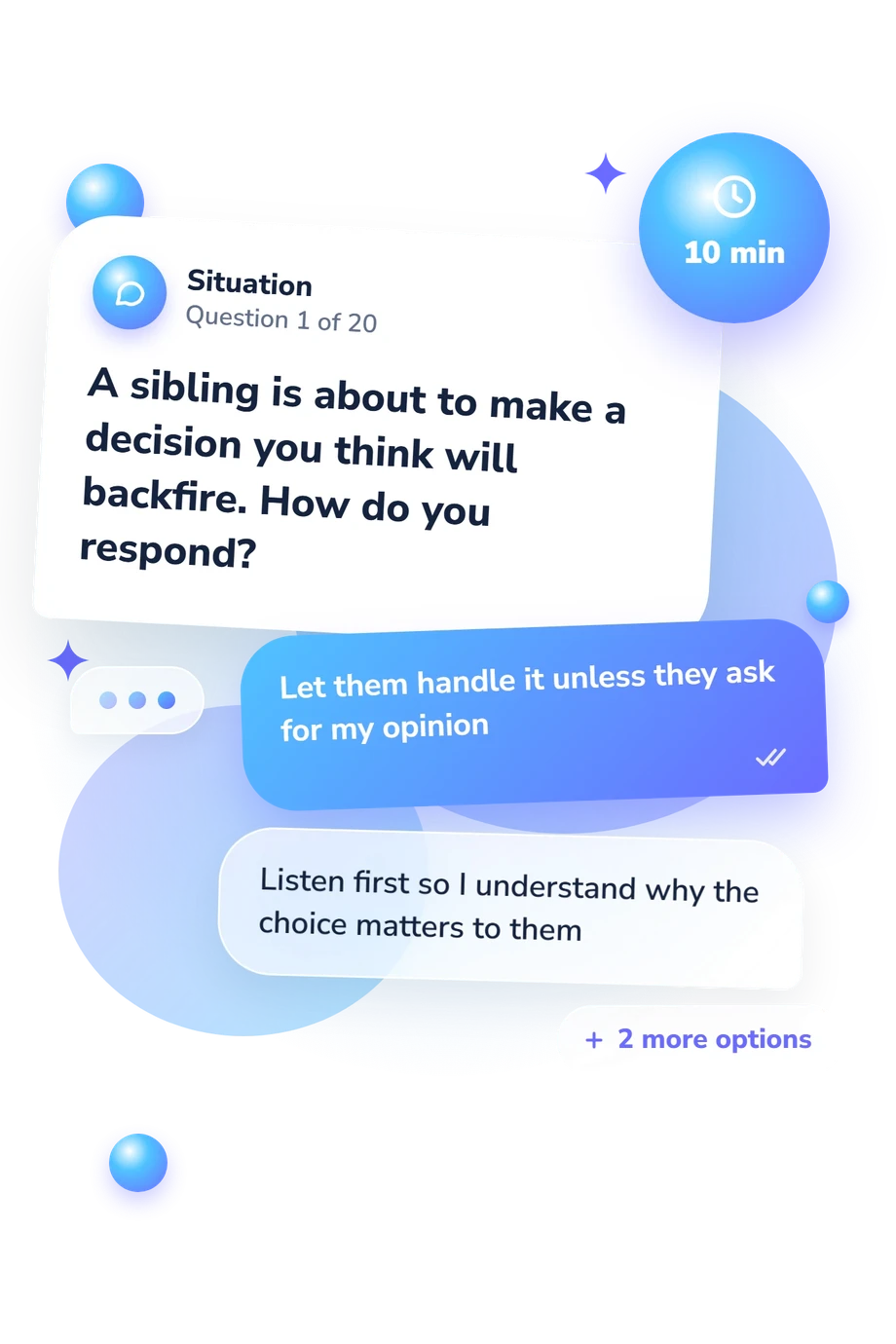
- Let them handle it unless they ask for my opinion
- Listen first so I understand why the choice matters to them
- Explain my concern directly and seriously
- Tease them a little, then offer a practical way out
- I appreciate it briefly, then return to what I am doing
- I send a photo of it to someone who would find it funny
- I place it somewhere useful so it stays part of my life
- I linger over the memory and what that season meant to me
- I choose something classic that will suit almost any setting
- I prioritize comfort while adding one personal detail
- I coordinate loosely with the group's overall vibe
- I pick something bold that makes the entrance part of the fun
The Summer I Turned Pretty Character Quiz - Description and methodology of the test
Readers who want to reflect on their reactions in relationships, family situations, and social settings can use The Summer I Turned Pretty Character Quiz as a prompt for self-observation. This TSITP character quiz explores how you handle uncertainty, changing relationships, conflict, responsibility, memory, and self-expression. Those situations make it easier to examine your interpersonal instincts and the ways you approach emotionally complicated moments.
What This Assessment Explores
Five affinities connect choices about relationships, memory, conflict, responsibility, and social energy with fictional personalities. For fans, this Summer I Turned Pretty personality quiz describes tendencies in recognizable situations, not fixed types.
The displayed dimensions and bands are:
- Belly Affinity (0-12) reflects memory, belonging, and emotional reflection: Different Current 0-4; Cousins Connection 5-8; Belly Resonance 9-12.
- Conrad Affinity (0-12) reflects guarded loyalty, restraint, and private processing: More Open Waters 0-4; Quiet Undertow 5-8; Conrad Resonance 9-12.
- Jeremiah Affinity (0-12) reflects warmth, spontaneity, openness, and shared joy: Quieter Spark 0-4; Golden-Hour Connection 5-8; Jeremiah Resonance 9-12.
- Steven Affinity (0-12) reflects strategy, ambition, problem-solving, and protective humor: Different Game Plan 0-4; Strategic Streak 5-8; Steven Resonance 9-12.
- Taylor Affinity (0-12) reflects candid support, confidence, and taking charge: Softer Spotlight 0-4; Loyal Edge 5-8; Taylor Resonance 9-12.
Methodology and Scientific Basis
Each prompt presents a situation with four response options. The scenarios cover uncertainty, care, conflict, memory, competition, planning, self-presentation, and repair, comparing choices across everyday contexts.
This is a comparative self-report exercise. Responses contribute to five character-affinity totals, interpreted together: the highest score indicates the strongest match, while any score within one point contributes to a blended result. The labels describe resemblance to fictional styles, not universal personality categories.
Conceptually, this Summer I Turned Pretty character test is consistent with the Identification scale described by Huang and Fung, which treats connection with characters as measurable. Cohen’s framework defines identification as an audience relationship with a media character, while Tal-Or and Cohen’s model distinguishes identification from transportation and involvement. The questionnaire is conceptually consistent with these identification frameworks, but it is not an adaptation of the published Identification scale or a validated administration of it.
As an online self-reflection tool, interpretation can shift with mood, current relationships, familiarity with the characters, and the appeal of answers. The cited publications do not establish psychometric properties for this online questionnaire, so its profile is best read as a self-report snapshot rather than a diagnostic conclusion.
- Huang, Kate Y., and Helene H. Fung. "Measuring identification with narrative characters: the development and validation of a new scale." Current Psychology, 43, 24835-24849 (2024). 10.1007/s12144-024-06191-2
- Cohen, Jonathan. "Defining Identification: A Theoretical Look at the Identification of Audiences With Media Characters." Mass Communication and Society, 4(3), 245-264 (2001). 10.1207/S15327825MCS0403_01
- Tal-Or, Nurit, and Jonathan Cohen. "Understanding audience involvement: Conceptualizing and manipulating identification and transportation." Poetics, 38(4), 402-418 (2010). 10.1016/j.poetic.2010.05.004
Updated: