
The Great Gatsby Chapter 4 Quiz
How the Scales are Structured
Who Usually Takes This Test?
See How You Compare
Below is a preview of how scores are typically distributed across each scale.
Example Questions From the Test
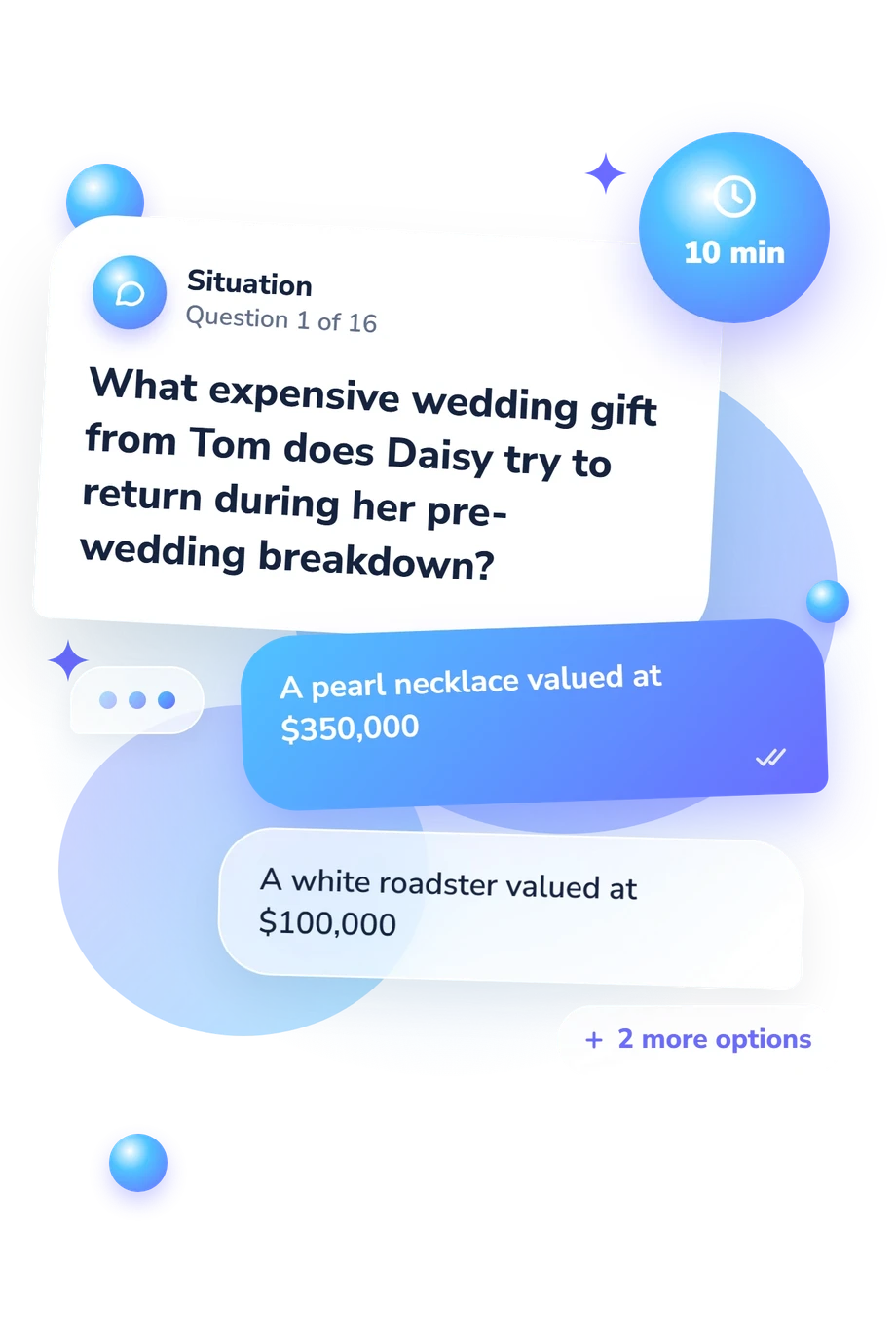
- A pearl necklace valued at $350,000
- A white roadster valued at $100,000
- A diamond bracelet valued at $50,000
- A sapphire ring valued at $500,000
- She leaves Louisville to search for Gatsby.
- She postpones the wedding and travels to New York.
- She puts on the pearls and marries Tom as planned.
- She marries Tom but refuses to wear his gift.
- Ivory chess pieces
- Human molars
- Polished animal claws
- Carved pearl shells
The Great Gatsby Chapter 4 Quiz - Description and methodology of the test
Readers preparing for a class or book-club discussion can use The Great Gatsby Chapter 4 Quiz to decide whether Chapter 4 is secure enough for conversation or merits review. It offers a focused check of chapter mastery through questions about evidence, motives, social connections, and the plan bringing Gatsby and Daisy toward reunion. This makes it useful when checking Great Gatsby Chapter 4 quiz answers against the novel.
What This Test Measures
Questions connect Daisy’s crisis, Gatsby’s history, Wolfsheim, the party crowd, and the reunion plan, so the result tests recall and links between scenes. It suits readers checking understanding rather than broad literary judgment.
The result can be read through these connected areas:
- Daisy’s past links the letter, wedding, and earlier bond with Gatsby.
- Gatsby’s story tests his claims, evidence, and contradictions.
- Social clues measure recall of parties, Wolfsheim, and his access.
- The reunion plan checks Nick’s role in arranging Daisy’s tea.
As a Chapter 4 reading comprehension quiz, it reports The Great Gatsby Chapter 4 Knowledge (0-16). Foundation to revisit (0-6) signals that rereading may be useful; Developing command (7-12) indicates overall command is still developing; Strong command (13-16) indicates strong overall command of the chapter. The scale measures chapter knowledge, not general literary ability.
Methodology and Evidence Base
Fitzgerald’s novel supplies the textual basis for the events, objects, conversations, and disclosures tested here. Each item uses multiple-choice recall: four alternatives are presented, and responses are summarized by the displayed 0-16 knowledge score. The bands describe overall performance rather than separate literary skills.
Item groups connect Daisy’s wedding crisis, Gatsby’s Oxford evidence, Jordan’s reconstruction, Wolfsheim’s role, and Nick’s restaurant observation. These Gatsby Chapter 4 study questions are most useful when an uncertain response sends the reader back to the relevant scene rather than isolated-name guessing.
Hogue’s analysis addresses Gatsby’s presentation and Nick’s changing understanding; Berman’s work situates the novel’s social world and 1920s tensions. Zheng and Zhang’s work supports caution about Nick’s reliability because events reach the reader through his perspective. These works provide context, not evidence that the questionnaire adapts a published instrument.
The bands are descriptive labels for performance on these Chapter 4 items rather than norm-referenced estimates. Results may vary with memory, rereading history, and familiarity with details; a strong band indicates accurate responses to questions about the chapter’s revelations, relationships, and plans, not a complete interpretation.
- Fitzgerald, F. Scott. The Great Gatsby. Charles Scribner's Sons, 1925.
- Hogue, W. Lawrence. "Chapter Four - Nick Carraway's Complicated Retreat from Modernity and the Construction of the Modern Gatsby in Fitzgerald's The Great Gatsby." In A Theoretical Approach to Modern American History and Literature: An Issue of Reconfiguration and Re-representation, pp. 99-124. Anthem Press, 2020.
- Berman, Ronald. "The Great Gatsby and the Twenties." In The Cambridge Companion to F. Scott Fitzgerald, edited by Ruth Prigozy, pp. 79-94. Cambridge University Press, 2001. 10.1017/CCOL0521624479.005
- Zheng, Dongxia, and Ruwen Zhang. "Interpretation on the Reliability of Nick Carraway in The Great Gatsby." Studies in Literature and Language, vol. 23, no. 1, 2021, pp. 80-83. 10.3968/12261
Updated: