
Synovial Joint Quiz
How the Scales are Structured
Who Usually Takes This Test?
See How You Compare
Below is a preview of how scores are typically distributed across each scale.
Example Questions From the Test
- The synovial membrane lining the capsule
- A tendon connecting muscle to bone
- A ligament connecting bone to bone
- The articular cartilage covering a bone end
- Articular ligament
- Synovial membrane
- Articular cartilage
- Periosteum
- Ball-and-socket joint
- Plane joint
- Pivot joint
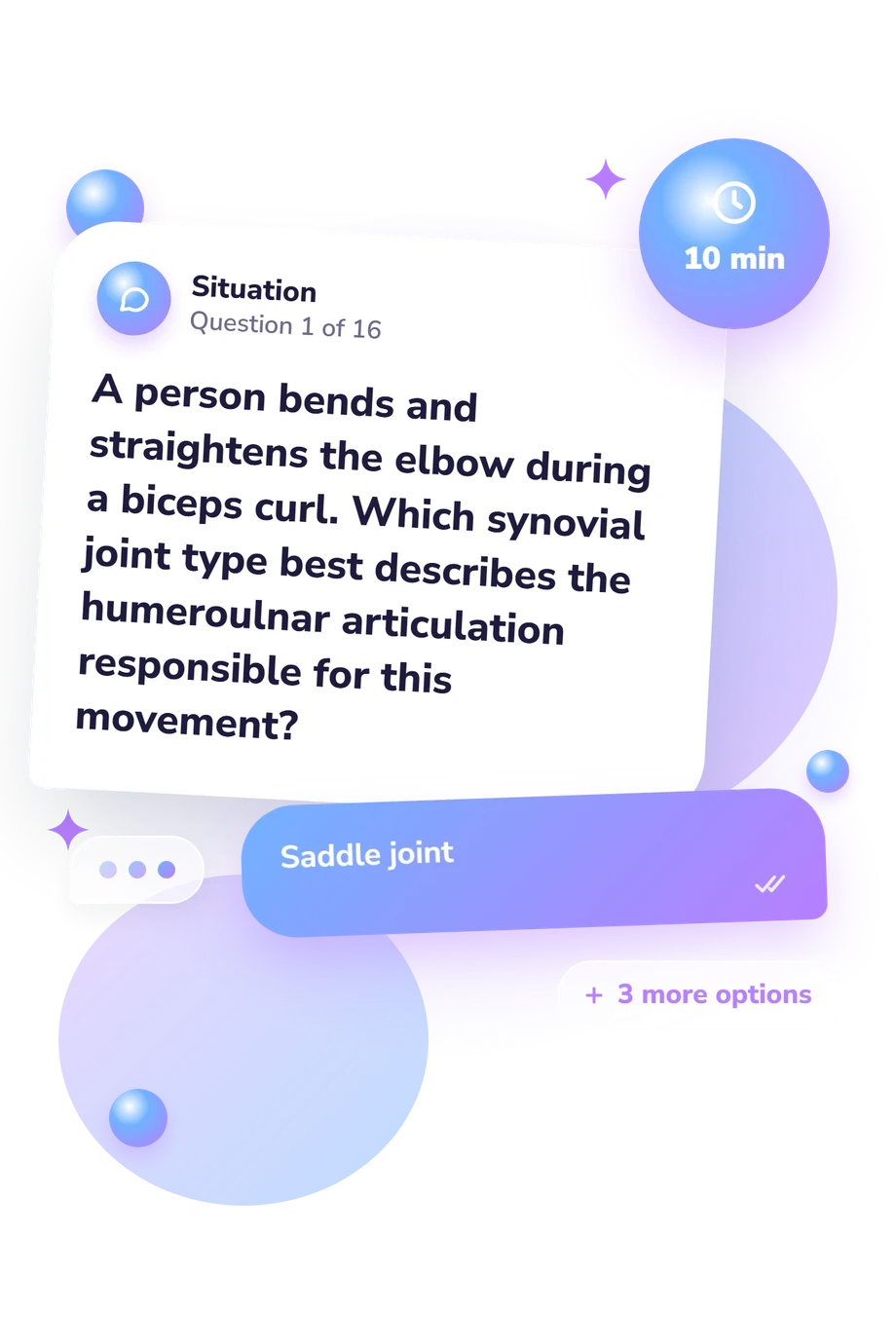
- Saddle joint
Synovial Joint Quiz - Description and methodology of the test
Students reviewing anatomy, instructors checking foundational understanding, and curious learners can use this synovial joint quiz to connect textbook terms with recognizable movements and structures. It also works as a synovial joint anatomy test, showing which concepts are secure and which deserve another pass through your notes. Many questions use brief movement or injury situations, while others ask directly about structures, classifications, or functions.
What This Assessment Explores
Rather than asking for subjective impressions, the assessment checks the anatomy of freely movable joints and the relationships that make movement possible. It suits learners reviewing flexion, abduction, rotation, joint axes, and surrounding tissues. Its coverage includes the major types of synovial joints while this practical quiz also tests supporting structures and functional examples.
The main themes are:
- Joint classifications explain how hinge, pivot, saddle, condyloid, plane, and ball-and-socket joints differ in permitted motion.
- Supporting tissues show what the capsule, synovial membrane, cartilage, ligaments, bursae, menisci, and labrum contribute.
- Applied anatomy connects structures with elbow, thumb, wrist, shoulder, and knee situations.
The single displayed scale is Synovial Joint Knowledge (0-16). Foundation-building covers 0-6, Developing knowledge covers 7-12, and Strong knowledge covers 13-16. These bands describe performance on the tested concepts, not physical joint health.
Methodology and Scientific Basis
Each prompt presents a short anatomy question followed by four answer choices, so the respondent must select the best classification, structure, movement, or function. The format tests recognition and application of core terms rather than confidence ratings or personal experience. The displayed result is a single knowledge score; higher performance corresponds to stronger command of the tested material, and no separate weighting rule is stated.
The content is conceptually consistent with Benjamin and McGonagle (2013), who describe normal joint anatomy and the structures involved in movement. Core terminology also agrees with the work of Betts and colleagues (2022), Drake, Vogl, and Mitchell (2020), and Dalley and Agur (2023). The questions use standard anatomical distinctions also described in these sources, including joint classifications, movement capacity, and the roles of supporting tissues. The online questionnaire has no stated validation as an adaptation of any one source.
As a synovial joint classification test, the questionnaire is best read as an educational self-check. No standardized norms, reliability estimate, or clinical cutoff is stated for this questionnaire. Results can also be affected by memory, attention, and current study context, so one attempt is a snapshot of knowledge rather than a fixed measure of ability.
- Mike Benjamin and Dennis McGonagle. Normal functional anatomy of joints. In: Oxford Textbook of Rheumatology. 4th ed. Oxford University Press, 2013, pp. 345-349. 10.1093/med/9780199642489.003.0046
- Betts, J. Gordon, Kelly A. Young, James A. Wise, Eddie Johnson, Brandon Poe, Dean H. Kruse, Oksana Korol, Jody E. Johnson, Mark Womble, and Peter DeSaix. Anatomy and Physiology 2e. Chapter 9: Joints. OpenStax, 2022.
- Richard L. Drake, A. Wayne Vogl, and Adam W. M. Mitchell. Gray's Anatomy for Students. 4th ed. Elsevier, 2020.
- Arthur F. Dalley II and Anne M. R. Agur. Moore's Clinically Oriented Anatomy. 9th ed. Wolters Kluwer, 2023.
Updated: