
Stomach Flu or Food Poisoning Quiz
How the Scales are Structured
Who Usually Takes This Test?
See How You Compare
Below is a preview of how scores are typically distributed across each scale.
Example Questions From the Test
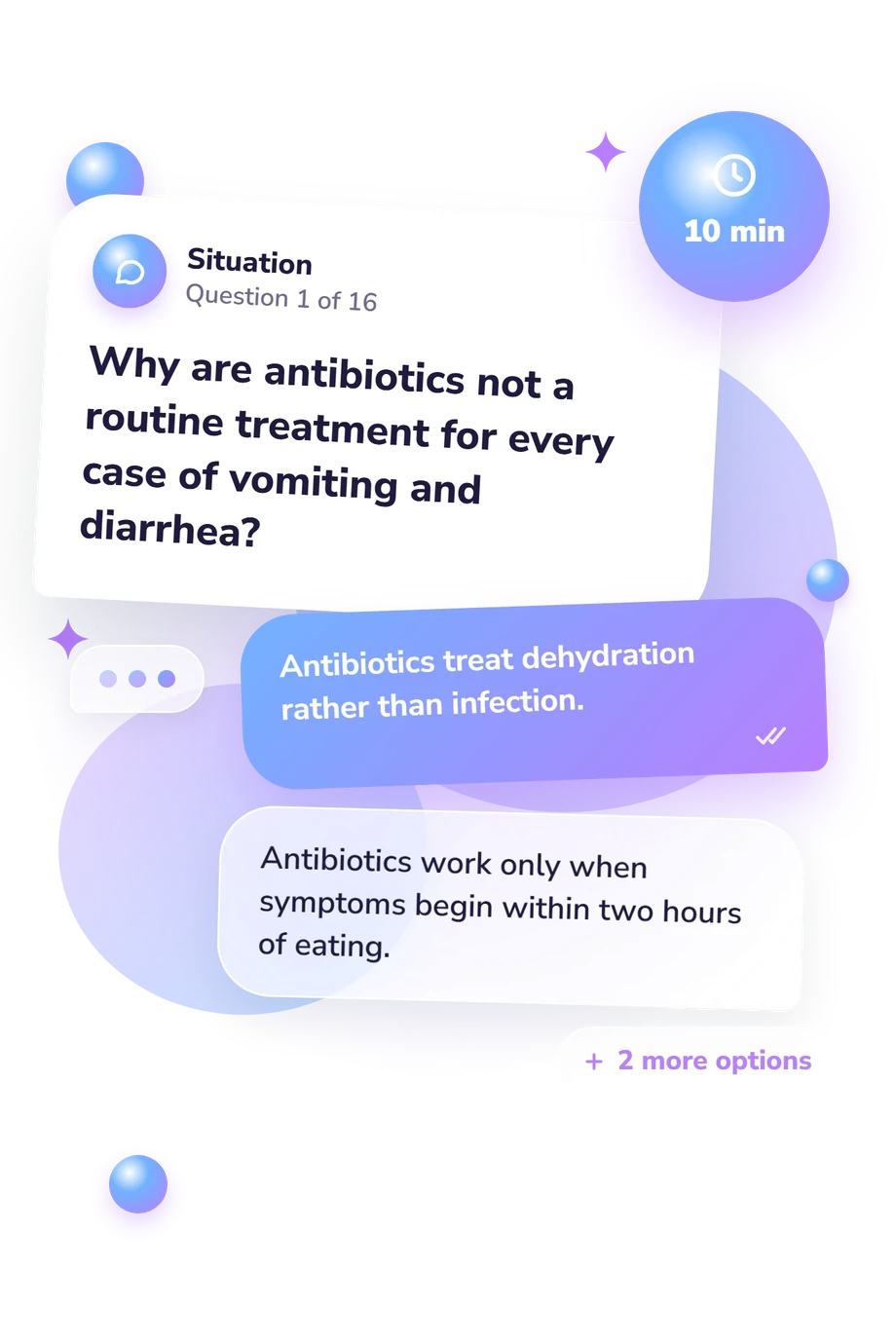
- Antibiotics treat dehydration rather than infection.
- Antibiotics work only when symptoms begin within two hours of eating.
- Antibiotics prevent all infected people from spreading illness immediately.
- Many cases are viral or self-limited, and antibiotics may be unnecessary or inappropriate for some infections.
- Increased urination, watery eyes, and greater appetite.
- Sneezing, nasal congestion, and an itchy throat.
- Mild hunger, normal urination, and brief hiccups.
- Very little urine, a dry mouth, and dizziness when standing.
- Only after they have cooled on the counter overnight.
- Within about two hours, or sooner in unusually hot conditions.
- Within six hours, regardless of room temperature.
- Whenever their smell begins to change.
Stomach Flu or Food Poisoning Quiz - Description and methodology of the test
Readers who want a clearer basis for thinking about vomiting, diarrhea, and foodborne illness can use the stomach flu or food poisoning quiz to decide whether their current knowledge is sufficient for safer responses. It is intended for general readers who want foodborne illness guidance and need to decide when everyday advice is sufficient and when further review is needed, rather than identifying the cause or severity of symptoms.
What This Assessment Explores
The questionnaire checks knowledge about viral gastroenteritis, foodborne illness, and safer responses rather than interpreting symptoms. It suits general readers considering timing, shared meals, household spread, and symptom overlap. Questions cover norovirus prevention and transmission, not whether the respondent currently has norovirus.
The questions cover four practical knowledge areas:
- Symptom overlap shows why digestive complaints do not identify one cause.
- Exposure and transmission show how meals or household spread affect interpretation.
- Hydration and warning signs identify safer fluid strategies and when to seek care.
- Prevention and food handling cover handwashing, cross-contamination, leftovers, and kitchen routines.
The single displayed scale is Stomach Flu or Food Poisoning Knowledge: 0-16. It reflects general knowledge, not the cause or severity of symptoms. Its result bands are Foundations to build (0-6), Developing knowledge (7-12), and Strong knowledge (13-16); these are educational, not clinical cutoffs.
Methodology and Evidence Base
Each item presents a health or food-safety scenario with four answer choices. The respondent selects the most accurate explanation or safest action across symptom overlap, exposure timing, hygiene, hydration, vulnerable groups, food handling, and warning signs. Together, the items form a structured knowledge exercise spanning viral gastroenteritis prevention, food safety, and appropriate responses.
The reported score summarizes recognition of practical distinctions and appropriate responses rather than estimating a cause.
The content is conceptually consistent with the Food Safety Knowledge Instrument developed by Byrd-Bredbenner and colleagues, particularly its food-handling and prevention emphasis; this questionnaire is not an adaptation of that instrument. Norovirus prevention themes correspond to work by Cates and colleagues, while assessment and warning-sign content is consistent with work by Shane and colleagues.
Because the items are multiple-choice knowledge questions, results may vary with prior knowledge, attention, and interpretation of the scenarios. Severe, persistent, or worsening symptoms call for medical attention.
- Byrd-Bredbenner, C., Wheatley, V., Schaffner, D., Bruhn, C., Blalock, L., and Maurer, J. (2007). Development and Implementation of a Food Safety Knowledge Instrument. Journal of Food Science Education, 6(3), 46-55. DOI 10.1111/j.1541-4329.2007.00029.x
- Cates, S. C., Kosa, K. M., Brophy, J. E., Hall, A. J., and Fraser, A. (2015). Consumer Education Needed on Norovirus Prevention and Control: Findings from a Nationally Representative Survey of U.S. Adults. Journal of Food Protection, 78(3), 484-490. DOI 10.4315/0362-028X.JFP-14-313
- Shane, A. L., Mody, R. K., Crump, J. A., Tarr, P. I., Steiner, T. S., Kotloff, K., Langley, J. M., Wanke, C., Warren, C. A., Cheng, A. C., Cantey, J., and Pickering, L. K. (2017). 2017 Infectious Diseases Society of America Clinical Practice Guidelines for the Diagnosis and Management of Infectious Diarrhea. Clinical Infectious Diseases, 65(12), e45-e80. DOI 10.1093/cid/cix669
Updated: