
Sun or Moon Quiz
How the Scales are Structured
Who Usually Takes This Test?
See How You Compare
Below is a preview of how scores are typically distributed across each scale.
Example Questions From the Test
- Space for them to explore the feelings beneath their hesitation.
- Questions that help them notice what their intuition is saying.
- A balanced view of what could work and what may need adjustment.
- Warm encouragement that helps them see their strengths and act.
- Spend more time considering what the group may be overlooking.
- Privately ask a few people what direction feels right to them.
- Summarize the strongest options and invite a quick decision.
- Propose a clear direction and build momentum around it.
- Keep it close until I have fully understood what it means to me.
- Share it with one trusted person whose response matters to me.
- Show it to a small circle once I feel it is ready.
- Present it openly and enjoy letting my enthusiasm show.
Sun or Moon Quiz - Description and methodology of the test
People who want to understand how they balance visibility, privacy, initiative, and reflection can use the sun or moon quiz as a guided self-reflection exercise. It suits readers who notice different sides of themselves across relationships, work, or changing circumstances. For readers asking whether they are the sun or moon, the profile compares tendencies rather than forcing a permanent label and points to a leading or blended affinity.
What This Assessment Explores
Rather than assigning a single pole, the questionnaire examines outward expression, inward awareness, and the capacity to combine contrasting modes. In this sun and moon quiz, scenarios about support, recovery, social settings, tension, decisions, changing plans, and meaningful expression show which responses feel most natural.
The three displayed dimensions are:
- Sun Affinity (0-15) reflects visible expression, decisive momentum, steady energy, and activating social presence; Gentle Glow (0-5), Emerging Radiance (6-10), and Full Radiance (11-15) mark increasing alignment.
- Moon Affinity (0-15) reflects introspection, intuition, privacy, emotional nuance, and changing inner rhythms; Distant Moonlight (0-5), Waxing Insight (6-10), and Deep Moonlight (11-15) mark increasing alignment.
- Eclipse Affinity (0-15) reflects integration of visibility and privacy, action and reflection, steadiness and change; Separate Orbits (0-5), Crossing Paths (6-10), and Eclipse Alignment (11-15) mark increasing alignment.
Methodology and Scientific Basis
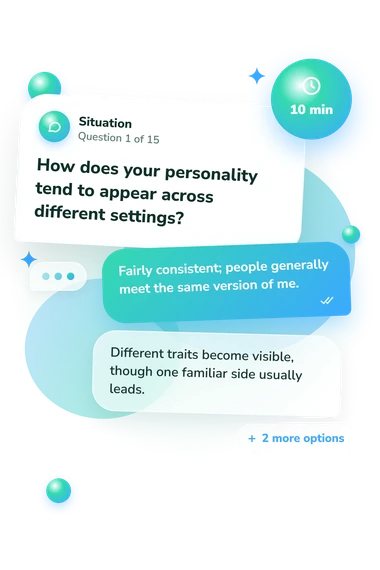
Each prompt presents a familiar situation with four response options. Choices range from direct action and practical balance to inward reflection and integration, so the respondent selects the statement that fits best. The format asking whether you are the sun or moon helps compare patterns across situations rather than assign a type.
Scoring compares the three totals. The highest is the strongest affinity; scores within one point of it form a blended result, with no tie-breaker or forced winner.
Jungian typology supplies a frame for outward and inward orientation. Loomis and Singer (1980) questioned whether Jungian dimensions are strictly bipolar, while Arnau and colleagues (2003) examined categories versus continua. Jung's work and these studies make the questionnaire conceptually consistent with that framework; it is not a standardized adaptation of those publications.
As a sun or moon personality quiz, this tool is descriptive and self-report based. Its bands are labels for this questionnaire, not population norms, and mood, context, self-awareness, or response style can influence the pattern. The profile is best read as a structured prompt for noticing how tendencies coexist.
- Loomis, Mary, and June Singer. (1980). Testing the Bipolar Assumption in Jung's Typology. Journal of Analytical Psychology, 25(4), 351-356. 10.1111/j.1465-5922.1980.00351.x
- Arnau, Randolph C., Brian A. Green, David H. Rosen, David H. Gleaves, and Joseph G. Melancon. (2003). Are Jungian preferences really categorical?: An empirical investigation using taxometric analysis. Personality and Individual Differences, 34(2), 233-251. 10.1016/S0191-8869(02)00040-5
- Jung, C. G. (1971). Psychological Types. In H. Read, M. Fordham, G. Adler, and W. McGuire (Eds.), The Collected Works of C. G. Jung (Vol. 6, 2nd ed.). Princeton University Press.