
Logic Quiz
How the Scales are Structured
Who Usually Takes This Test?
See How You Compare
Below is a preview of how scores are typically distributed across each scale.
Example Questions From the Test
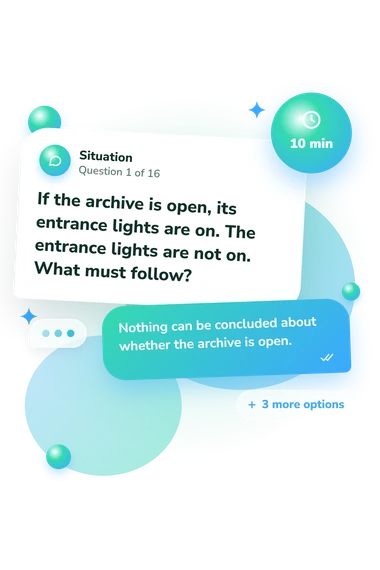
- Nothing can be concluded about whether the archive is open.
- The archive is open but empty.
- The lights failed while the archive stayed open.
- The archive is not open.
- No poets in the club are robots.
- Some robots in the club are poets.
- Every writer in the club is a poet.
- No club members are robots.
- Every breakable kitchen item is a ceramic mug.
- Every kitchen item is breakable.
- Some breakable objects are not kitchen items.
- Some kitchen items are breakable.
Logic Quiz - Description and methodology of the test
Readers who want to examine how they apply rules, deductions, and patterns can use this logic quiz as a focused reasoning exercise. It suits learners, puzzle enthusiasts, and anyone revisiting formal reasoning. An online quiz about logic can show which principles feel familiar and where deliberate practice may help, while keeping the result tied to the reasoning tasks presented here.
What This Test Measures
The tasks test movement from premises to warranted conclusions, recognition of invalid inferences, and use of conditions, categories, and sequences. They suit learners reviewing formal reasoning; as a fun quiz about logic, the result describes performance here, not intelligence.
The main dimensions represented by the items are:
- Conditional reasoning shows whether you distinguish a rule from its converse.
- Quantifiers and negation show how you handle every, some, no, and either-or statements.
- Argument evaluation reflects your grasp of validity, soundness, fallacies, and counterexamples.
- Ordering, spatial, and numerical reasoning shows how you coordinate constraints.
The displayed scale is Logic Knowledge: 0-16. Foundations to build (0-6) indicates core rules may need review; Developing knowledge (7-12) indicates many sound patterns are recognized, though subtler implications or fallacies may be missed; Strong knowledge (13-16) indicates consistent application of broad logical principles. It frames performance on this quiz built around logic puzzles, not broader ability.
Methodology and Evidence Base
Each item presents a short scenario, rule, sequence, or argument with answer choices. Selecting the required conclusion makes this a selected-response deductive reasoning assessment, not a self-report inventory.
The questions cover conditionals, negation, categorical statements, ordering, spatial relations, number patterns, and exclusive alternatives. The format of a logic puzzle quiz makes the concepts concrete, while correct answers depend on applying stated rules rather than choosing the most believable conclusion.
One point is awarded for each correct answer, so the total is a simple count rather than a weighted profile. Wilhelm and Conrad (1998) provide the closest research connection for its deductive emphasis. Johnson-Laird and Byrne explain how conclusions depend on relations among premises and conclusions, while Copi, Cohen, and McMahon supply classical distinctions behind conditionals, negation, validity, and soundness. The questionnaire is conceptually consistent with these works, not an adaptation.
Markovits and Nantel (1989) help explain why believable content can make a weak conclusion feel persuasive, so reviewing missed answers adds value. Logical questions for quiz practice can support study of rules, quantifiers, and conditionals. The measure is non-normed online; attention, concentration, familiarity with formal terms, and response habits may affect the result.
- Wilhelm, Oliver, and Wolfgang Conrad. "Development and Evaluation of Deductive Reasoning Tests." Diagnostica 44, no. 2 (1998): 71-83.
- Johnson-Laird, Philip N., and Ruth M. J. Byrne. Deduction. Hillsdale, NJ: Lawrence Erlbaum Associates, 1991.
- Copi, Irving M., Carl Cohen, and Kenneth McMahon. Introduction to Logic. 14th ed. Pearson, 2014.
- Markovits, Henry, and Guilaine Nantel. "The Belief-Bias Effect in the Production and Evaluation of Logical Conclusions." Memory & Cognition 17, no. 1 (1989): 11-17. 10.3758/BF03199552