
Star Wars Character Quiz
How the Scales are Structured
Who Usually Takes This Test?
See How You Compare
Below is a preview of how scores are typically distributed across each scale.
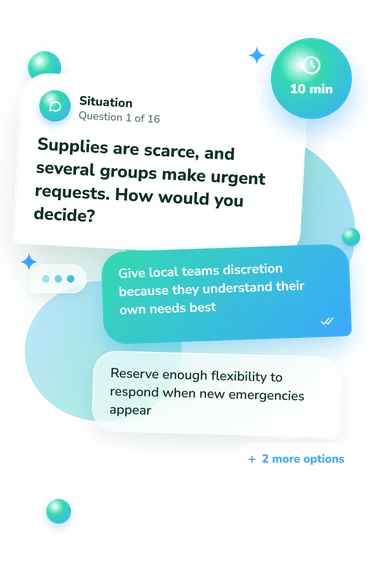
Example Questions From the Test
- Give local teams discretion because they understand their own needs best
- Reserve enough flexibility to respond when new emergencies appear
- Set transparent priorities based on the larger mission and accept responsibility for the tradeoffs
- Seek a compromise that gives each group at least part of what it requested
- Take private time first, then return once I can think clearly
- Acknowledge the loss honestly while giving everyone a concrete next objective
- Bring people together to decide collectively what should happen next
- Support the most affected people before shifting attention back to the mission
- I improvise immediately with whatever route, distraction, or vehicle is available
- I pause long enough to identify the patrol's pattern before making a move
- I ask the group to choose between the two most workable alternatives
- I adapt the original plan while preserving its most important objective
Star Wars Character Quiz - Description and methodology of the test
Fans who enjoy character-based self-reflection can use this questionnaire as a quiz about which Star Wars character you are, examining responses to leadership, loyalty, conflict, pressure, and uncertainty. The Star Wars Quiz What Character Are You translates those choices into a playful profile showing which of four character profiles you most resemble, while allowing overlapping affinities. It suits anyone asking which Star Wars character they are, with attention on everyday decision patterns.
What This Assessment Explores
This quiz explores what Star Wars character I am through situations involving scarcity, loss, conflict, risk, commitment, learning, and responsibility. Ranges move from a contrasting alternative through a partial streak to stronger affinity; close scores may combine. The four scales are:
- Han Solo (0-12) moves from Deliberate operator (0-4), through Maverick streak (5-8), to Solo affinity (9-12), from structure toward improvisation and action-led loyalty.
- Leia Organa (0-12) moves from Personal latitude (0-4), through Commanding streak (5-8), to Organa affinity (9-12), from flexibility toward resilient mission-first leadership.
- Luke Skywalker (0-12) moves from Grounded alternative (0-4), through Hopeful streak (5-8), to Skywalker affinity (9-12), from established plans toward idealism, intuitive courage, and faith in change.
- Obi-Wan Kenobi (0-12) moves from Direct catalyst (0-4), through Jedi steadiness (5-8), to Kenobi affinity (9-12), from immediate instinct toward patience, restraint, and teaching by example.
Methodology and Scientific Basis
Each item presents a situation with four responses. The choices contrast improvisation with planning, mission duty with personal latitude, immediate instinct with disciplined guidance, and private reflection with collective action. There is no correct answer, and the method does not state how many points each option contributes.
Responses produce four character scores. The highest is the strongest affinity; any score within one point of it joins a blended result. Rather than forcing one answer, this quiz considers which Star Wars character I am while displaying overlapping affinities.
Du et al. (2023) offer a values-and-self-esteem context, while Schwartz’s theory of basic human values frames choices as competing priorities. The questionnaire is an online self-report profile whose themes are only conceptually consistent with these works, not an adaptation of either work and not validated by them.
Hall (2019) provides a comparison concerning fictional-character identification, but it does not validate this questionnaire's scoring. Current circumstances, self-awareness, and response style may affect answers, and no stated population norms, reliability estimates, or clinical cutoffs support treating the result as definitive.
- Du, H., Götz, F. M., Chen, A., & Rentfrow, P. J. (2023). Revisiting Values and Self-Esteem: A Large-Scale Study in the United States. European Journal of Personality, 37(1), 3-19. 10.1177/08902070211038805
- Schwartz, S. H. (1992). Universals in the Content and Structure of Values: Theoretical Advances and Empirical Tests in 20 Countries. In M. P. Zanna (Ed.), Advances in Experimental Social Psychology (Vol. 25, pp. 1-65). Academic Press. 10.1016/S0065-2601(08)60281-6
- Hall, A. E. (2019). Identification and Parasocial Relationships With Characters From Star Wars: The Force Awakens. Psychology of Popular Media Culture, 8(1), 88-98. 10.1037/ppm0000160