
Should I Move On from My Crush Quiz
How the Scales are Structured
Who Usually Takes This Test?
See How You Compare
Below is a preview of how scores are typically distributed across each scale.
Example Questions From the Test
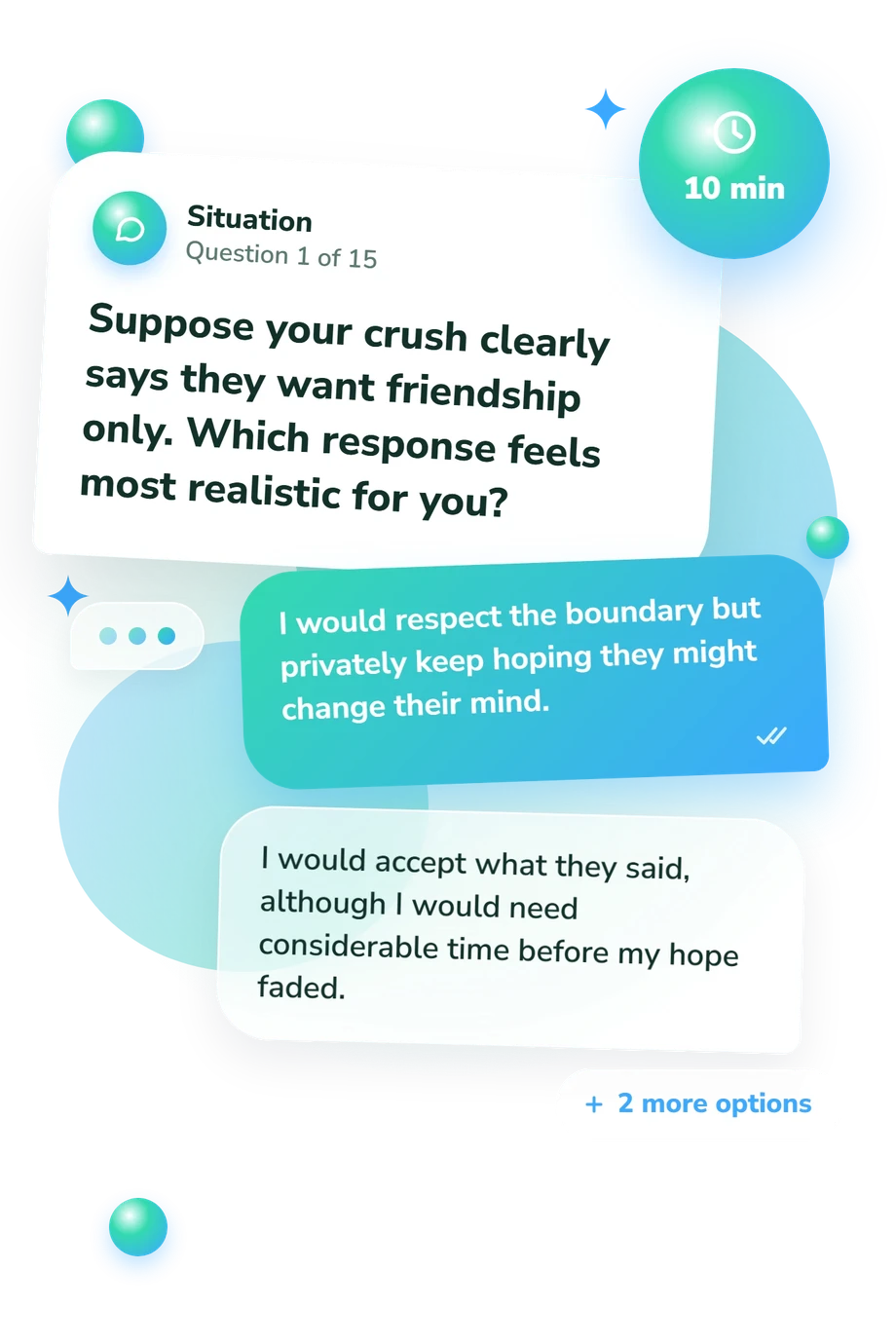
- I would respect the boundary but privately keep hoping they might change their mind.
- I would accept what they said, although I would need considerable time before my hope faded.
- I would allow myself to grieve and begin adjusting how much romantic energy I invest.
- I would accept the answer and feel ready to make space for other parts of my life.
- They engage warmly and often initiate another conversation later.
- They respond with interest, although I usually initiate.
- Their replies are generally polite but brief or difficult to build on.
- They often do not respond, end the exchange quickly, or appear to avoid it.
- We are both available, and there are no major practical barriers I know of.
- There is some uncertainty, but it appears manageable if the interest is mutual.
- Distance, timing, conflicting goals, or another major constraint makes it unlikely right now.
- They are in a committed relationship or have otherwise made their unavailability explicit.
Should I Move On from My Crush Quiz - Description and methodology of the test
People considering an uncertain attraction can use the Should I Move On from My Crush Quiz to organize feelings, observable signals, and readiness for a change of direction. It suits anyone deciding whether continued hope is helping or keeping life on hold. For a reader wondering how to move on from a crush, the result shows whether pressure comes from the situation, its emotional cost, or reluctance to redirect.
What This Assessment Explores
Items connect observable signals with impact, covering boundaries, responsiveness, availability, follow-through, hope, reminders, mood, concentration, self-worth, and openness. The questionnaire suits anyone deciding whether a crush is mutual, costly, or too central to daily life. It can clarify when to let go of a crush by separating evidence about the person from the cost of continued hope.
The result uses three dimensions:
- Emotional Cost (0-15) shows attention, mood, and self-worth consumed by the crush: Contained Impact (0-5), Noticeable Strain (6-10), or Heavy Emotional Load (11-15).
- Mutuality and Availability (0-15) shows whether behavior and circumstances support romance: Encouraging Mutuality (0-5), Mixed Evidence (6-10), or Strong Release Signal (11-15).
- Openness to Moving Forward (0-15) shows willingness to release the hoped-for outcome: Still Holding On (0-5), In Transition (6-10), or Ready to Redirect (11-15).
Together, the dimensions separate external evidence from internal cost.
Methodology and Evidence Base
Each item presents a situation or self-observation with four ordered options. Choices move from stronger attachment, strain, or ambiguous hope toward clearer evidence, acceptance, and redirected attention. Scoring summarizes response patterns across the three dimensions rather than dictating a decision.
The work by Bringle et al. (2013) provides context for unrequited love, reciprocity, and availability. Baumeister et al. (1993) helps frame distress when interest is not returned; Senkans et al. (2016) offers a comparison for relationship-focused rumination; and Strizhitskaya (2019) connects with perceived stress, locus of control, and self-acceptance. The questionnaire is conceptually consistent with these works, not a documented adaptation of them; none created or validated this online version.
Read the profile as a snapshot of responses. A clear refusal or request for distance should be respected regardless of the total, and readiness can change. No standardized norms or diagnostic cutoffs are stated, so bands are not clinical thresholds. Self-report varies with mood, memory, self-awareness, and interpretation of ambiguous behavior. For someone learning how to get over a crush, the result highlights where boundaries, attention, or acceptance need adjustment.
- Bringle, Robert G., Terri Winnick, and Robert J. Rydell. “The Prevalence and Nature of Unrequited Love.” SAGE Open, vol. 3, no. 2, 2013, pp. 1-15. 10.1177/2158244013492160
- Baumeister, Roy F., Sara R. Wotman, and Arlene M. Stillwell. “Unrequited Love: On Heartbreak, Anger, Guilt, Scriptlessness, and Humiliation.” Journal of Personality and Social Psychology, vol. 64, no. 3, 1993, pp. 377-394. 10.1037/0022-3514.64.3.377
- Senkans, Svenja, Troy E. McEwan, Jason Skues, and James R. P. Ogloff. “Development of a Relational Rumination Questionnaire.” Personality and Individual Differences, vol. 90, 2016, pp. 27-35. 10.1016/j.paid.2015.10.032
- Strizhitskaya, Olga Yuryevna. “Perceived Stress, the Locus of Control and Self-Acceptance: Theoretical and Empirical Approaches.” Vestnik of Saint Petersburg University. Psychology, vol. 9, no. 1, 2019, pp. 21-31. 10.21638/11701/spbu16.2019.102
Updated: