
Sea Animal Quiz
How the Scales are Structured
Who Usually Takes This Test?
See How You Compare
Below is a preview of how scores are typically distributed across each scale.
Example Questions From the Test
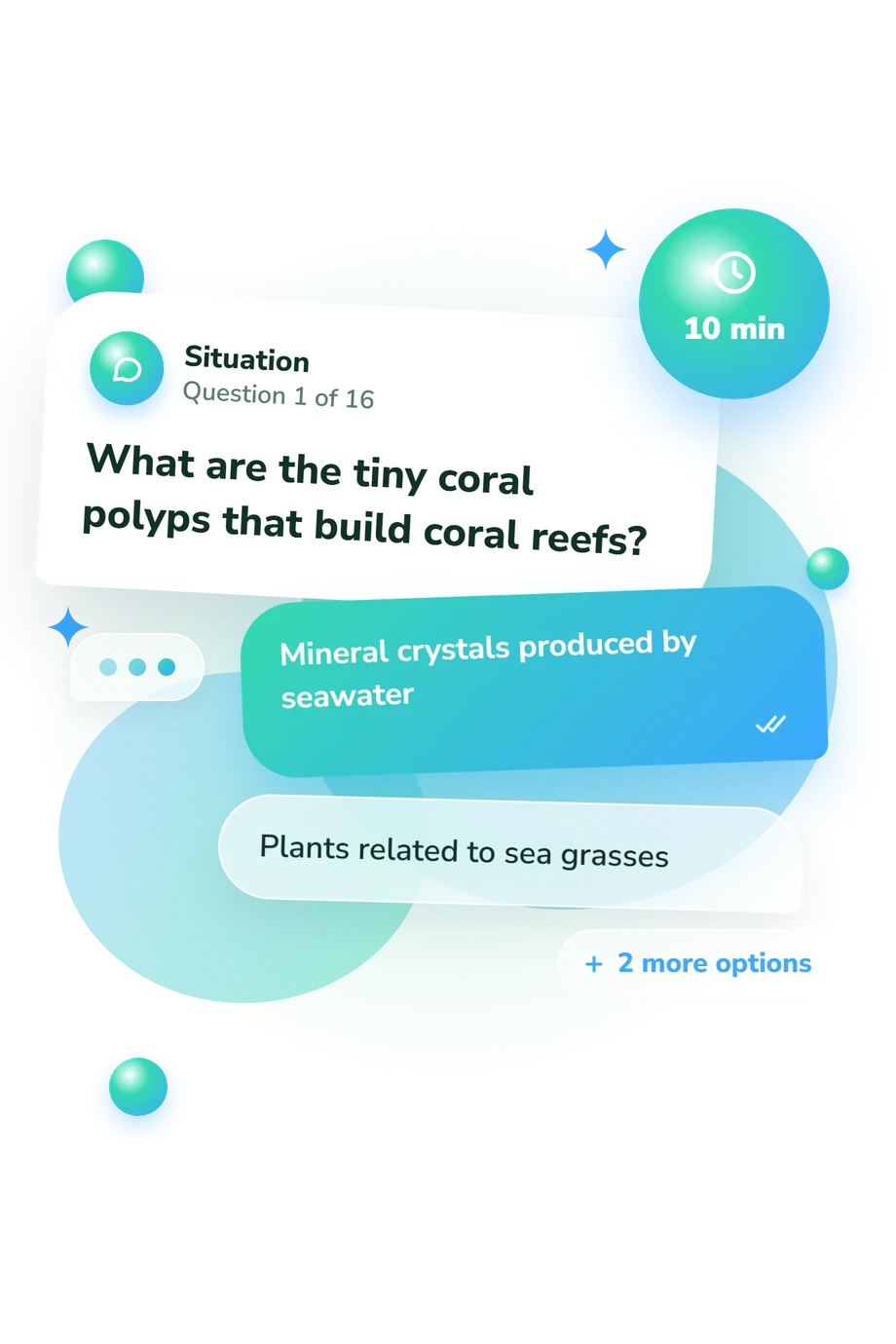
- Mineral crystals produced by seawater
- Plants related to sea grasses
- Fungi that grow on submerged rocks
- Animals related to jellyfish and sea anemones
- Cartilage
- Calcium-rich bone
- Keratin
- Chitin
- Osmoregulation
- Metamorphosis
- Echolocation
- Bioluminescence
Sea Animal Quiz - Description and methodology of the test
People who want a structured way to check their understanding of marine life can use the sea animal quiz as a focused, learning-oriented assessment. It is intended for curious readers, students, and anyone revisiting basic ocean science. The questionnaire is an ocean animal quiz that checks how confidently you recognize anatomy, adaptations, behavior, food webs, and ecological processes across familiar and less familiar marine animals.
What This Assessment Explores
The questions test biological knowledge, not personality or preferences. They ask you to identify structures, explain body processes, recognize adaptations, and predict ecological effects. The questions in this sea creature quiz offer a broad factual snapshot of marine biology.
Results appear as Sea Animal Knowledge (0-16): Emerging Explorer (0-6) marks developing familiarity; Developing Ocean Naturalist (7-12) reflects a useful foundation; Strong Knowledge (13-16) indicates broad, dependable understanding of marine animals and their interactions.
The questions examine these connected areas:
- Anatomy and physiology connect gills, lungs, cartilage, chromatophores, and tube feet with their functions.
- Adaptations explain echolocation, bioluminescence, osmoregulation, camouflage, and other survival features.
- Ecology and behavior show how feeding, reproduction, predator-prey relations, habitats, and stress shape marine life.
Methodology and Scientific Basis
Each item presents a short marine-biology situation or knowledge question with four answer choices. Selecting the best-supported option makes the result reflect recognition and application rather than opinion. In this marine animal quiz, the score can suggest topics to review, but one score cannot represent every part of a person’s knowledge.
The content is conceptually consistent with the International Ocean Literacy Survey by Fauville, Strang, Cannady, and Chen, which treats ocean literacy partly as knowledge assessed across biological and ecological topics. This questionnaire is not an adaptation of that survey. Castro and Huber’s marine-biology text and Levinton’s text provide scientific context for osmoregulation, food webs, coral bleaching, and animal form and function.
Scoring summarizes performance across the displayed items and assigns the corresponding result band. These bands organize the questionnaire’s feedback; they are not population norms, reliability coefficients, or clinical cutoffs. Interpretation is strongest when you review which concepts felt secure and which required guessing.
Prior education, language, attention, and chance can affect a knowledge score, while the online format cannot show long-term retention or practical field skill. Use the result as a learning checkpoint rather than a diagnostic or clinical measure.
- Fauville, Géraldine, Craig Strang, Matthew A. Cannady, and Ying-Fang Chen. “Development of the International Ocean Literacy Survey: measuring knowledge across the world.” Environmental Education Research 25, no. 2 (2019): 238-263. 10.1080/13504622.2018.1440381
- Castro, Peter, and Michael E. Huber. Marine Biology. 12th ed. New York: McGraw Hill, 2023.
- Levinton, Jeffrey S. Marine Biology: Function, Biodiversity, Ecology. 6th ed. New York: Oxford University Press, 2022.
Updated: