
Relationship Satisfaction Quiz
How the Scales are Structured
Who Usually Takes This Test?
See How You Compare
Below is a preview of how scores are typically distributed across each scale.
Example Questions From the Test
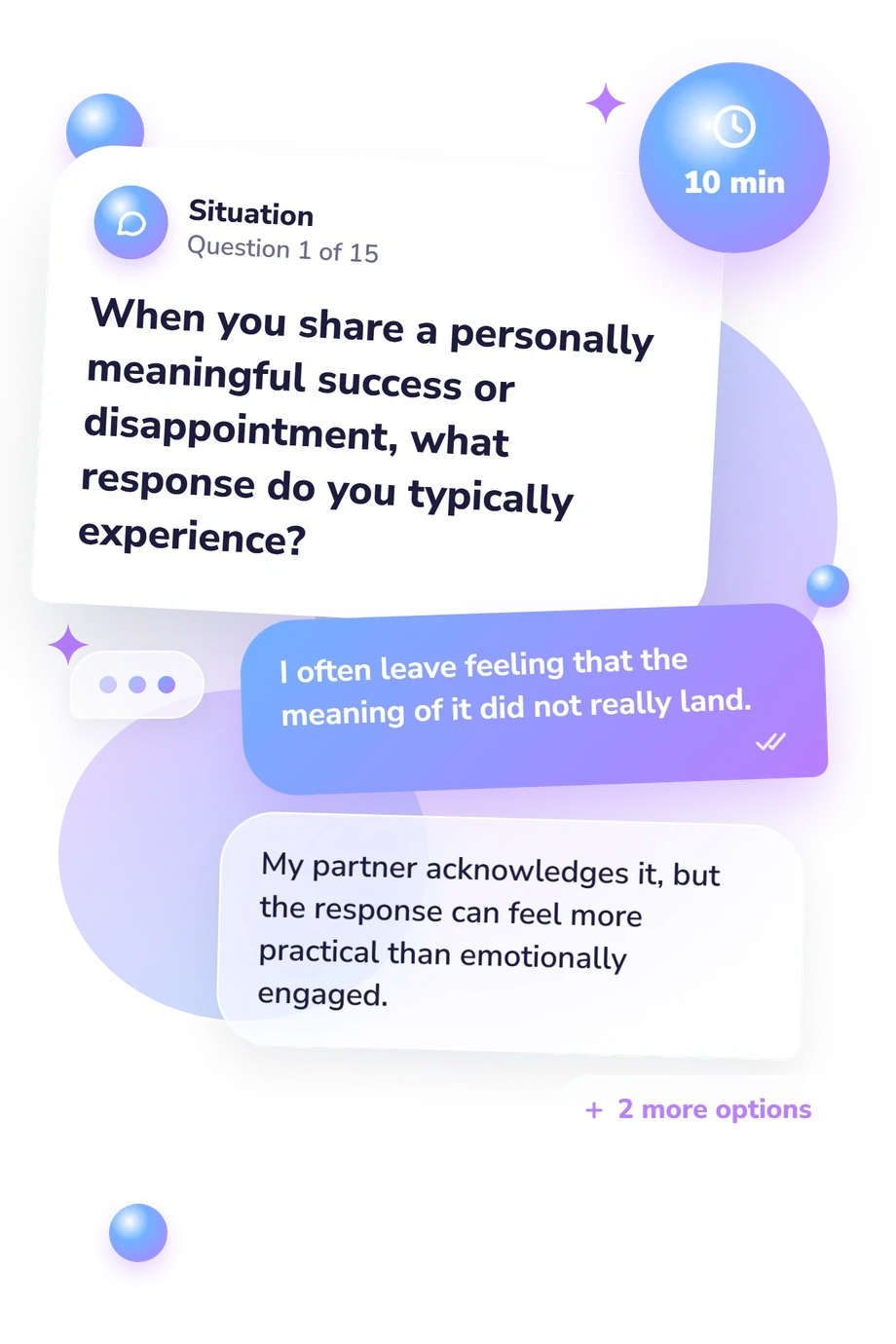
- I often leave feeling that the meaning of it did not really land.
- My partner acknowledges it, but the response can feel more practical than emotionally engaged.
- I usually feel supported, even if my partner does not fully understand at first.
- I generally feel that my emotions are noticed, understood, and taken seriously.
- One preference usually prevails, leaving the other person dissatisfied or detached.
- We split the difference, but the result often feels unsatisfying to both of us.
- We usually reach a workable compromise, even if neither gets everything wanted.
- We explore what matters beneath each preference and make a decision that feels genuinely shared.
- The balance regularly leaves at least one of us feeling crowded, lonely, or disconnected.
- We make room for both, but it often feels like an uncomfortable trade-off.
- The balance usually works, with occasional periods of too much distance or too little space.
- Togetherness and independence generally complement each other and support both of us.
Relationship Satisfaction Quiz - Description and methodology of the test
People who want a clearer picture of how their partnership currently functions can use this relationship satisfaction quiz to organize reflection around everyday experiences rather than a single overall impression. It suits partners examining recurring patterns in closeness, conflict, support, and shared life. This relationship evaluation quiz gives you language for strengths, friction points, and conversations that deserve attention.
What This Assessment Explores
Rather than judging whether a relationship should continue, the questionnaire examines communication, emotional responsiveness, affection, shared decisions, practical cooperation, autonomy, and future direction. Four ordered response options move from strained patterns toward supportive functioning. Answers in this relationship assessment quiz are most useful when they reflect regular experience, not one unusually good or difficult day.
The three result dimensions are:
- Communication and Repair (0-15) shows whether concerns are heard and disagreements repaired: Stuck conversations (0-5), Mixed communication (6-10), Constructive communication (11-15).
- Emotional Connection and Affection (0-15) reflects warmth, understanding, vulnerability, and closeness: Connection needs attention (0-5), Uneven connection (6-10), Strong connection (11-15).
- Shared Partnership and Fit (0-15) reflects support, responsibilities, priorities, autonomy, and future alignment: Partnership strained (0-5), Partial fit (6-10), Strong fit (11-15).
Together, the results describe current perceived patterns, not certainty about the relationship’s future.
Methodology and Scientific Basis
Each item asks the respondent to choose one of four statements describing a familiar pattern, from greater difficulty to greater responsiveness or fit. The items cover communication, closeness, affection, shared decisions, responsibilities, support, autonomy, and future alignment. The questionnaire displays three domain scores, but it does not specify a standardized item-level scoring rule; the ranges should not be reverse-engineered into point values.
The format makes this relationship satisfaction test a snapshot of perceived functioning. Results may differ between partners in the same relationship, so the profile is best read alongside concrete examples from daily life rather than as a complete verdict.
Its structure is conceptually consistent with the Dyadic Adjustment Scale (Spanier, 1976), which treats dyadic quality as multidimensional. It also overlaps with the Couples Satisfaction Index (Funk and Rogge, 2007) and Hendrick’s generic measure (1988). This questionnaire is not presented as an adaptation or online administration of those instruments, so their norms, reliability estimates, and cutoffs cannot be transferred to it.
As a self-report tool, results can shift with current stress, selective recall, and willingness to describe difficult experiences honestly. Use the profile to identify patterns and discussion topics.
- Spanier, G. B. (1976). Measuring Dyadic Adjustment: New Scales for Assessing the Quality of Marriage and Similar Dyads. Journal of Marriage and the Family, 38(1), 15-28. 10.2307/350547
- Funk, J. L., & Rogge, R. D. (2007). Testing the Ruler With Item Response Theory: Increasing Precision of Measurement for Relationship Satisfaction With the Couples Satisfaction Index. Journal of Family Psychology, 21(4), 572-583. 10.1037/0893-3200.21.4.572
- Hendrick, S. S. (1988). A Generic Measure of Relationship Satisfaction. Journal of Marriage and the Family, 50(1), 93-98. 10.2307/352430
Updated: