
Radicals Quiz
How the Scales are Structured
Who Usually Takes This Test?
See How You Compare
Below is a preview of how scores are typically distributed across each scale.
Example Questions From the Test
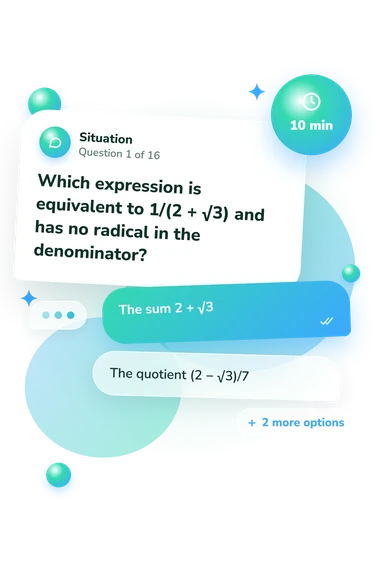
- The sum 2 + √3
- The quotient (2 − √3)/7
- The difference 2 − √3
- The difference √3 − 2
- Between 19 and 20 units
- Between 5 and 6 units
- Between 7 and 8 units
- Between 6 and 7 units
- Positive 4
- Negative 4
- Negative 8
- No real value exists
Radicals Quiz - Description and methodology of the test
For learners reviewing algebraic foundations, this radicals quiz offers a focused way to see how confidently they apply root rules in context. It suits students, teachers, and independent learners who want to locate secure skills before advancing. As a radical math quiz, it turns common operations, equations, and interpretation of expressions into a concise profile for targeted practice.
What This Assessment Explores
These questions test square, cube, and fourth roots through perfect-power factors, like radicals, products, rational exponents, comparisons, domains, and equivalent forms. Side-length and equation items show whether rules transfer to applications.
The profile covers dimensions:
- Radical notation shows whether you identify radicands, indices, roots, and conditions.
- Simplification shows whether you extract factors, combine like radicals, multiply roots, and rewrite powers.
- Equations and comparisons show how you test values, locate irrational numbers, and apply restrictions.
- Rationalization and conjugates show whether you preserve value while removing denominator radicals.
For learners checking understanding, it works as a radical expressions quiz and helps them choose what to practise next. Radicals Knowledge runs from 0-16: Foundations to review (0-6) marks concepts to revisit; Developing command (7-12) reflects success with room to strengthen multi-step work; Strong command (13-16) reflects consistent rule use across direct and scenario-based problems.
Methodology and Evidence Base
Each item offers four answer choices and asks for a value, equivalent expression, comparison, condition, or notation. Direct calculations alternate with applications involving side lengths, equations, domain restrictions, rational exponents, conjugates, and rationalized denominators. The format checks recognition and procedural reasoning without requiring solutions.
Scoring is presented as one total, and no separate weighting or points-per-answer rule is stated. The result describes performance across the skills rather than a percentile or norm group. For learners directing review toward notation, operations, equations, comparisons, or rationalization, this quiz for simplifying radicals supports focused practice.
Conceptually, the questionnaire is consistent with Proficiency Test in Simplifying Radical Expressions (Mabuti & Ancheta, 2025), but it is not presented as an adaptation. Its treatment of rational exponents connects with Elstak’s 2007 teaching experiment, and progression from roots and powers to applications is compatible with the 2010 mathematics standards.
Because this is an online knowledge check, results can vary with prior instruction, notation familiarity, guessing, and attention. It has no standardized norms, so use the profile to choose practice and confirm progress through independent problem solving.
- Mabuti, Gerald DG., & Ancheta, Cristo Mark D. (2025). Enhancing Learning Achievement and Motivation in Mathematics: The Effect of Online Instruction on Simplifying Radical Expressions. Educational Process: International Journal, 19, e2025540. 10.22521/edupij.2025.19.540
- Elstak, Iwan Rene. (2007). College students' understanding of rational exponents: A teaching experiment. Doctoral dissertation, The Ohio State University, OhioLINK Electronic Theses and Dissertations Center.
- National Governors Association Center for Best Practices, & Council of Chief State School Officers. (2010). Common Core State Standards for Mathematics. Washington, DC: Authors.
Updated: