
Am I Getting Fired Quiz
How the Scales are Structured
Who Usually Takes This Test?
See How You Compare
Below is a preview of how scores are typically distributed across each scale.
Example Questions From the Test
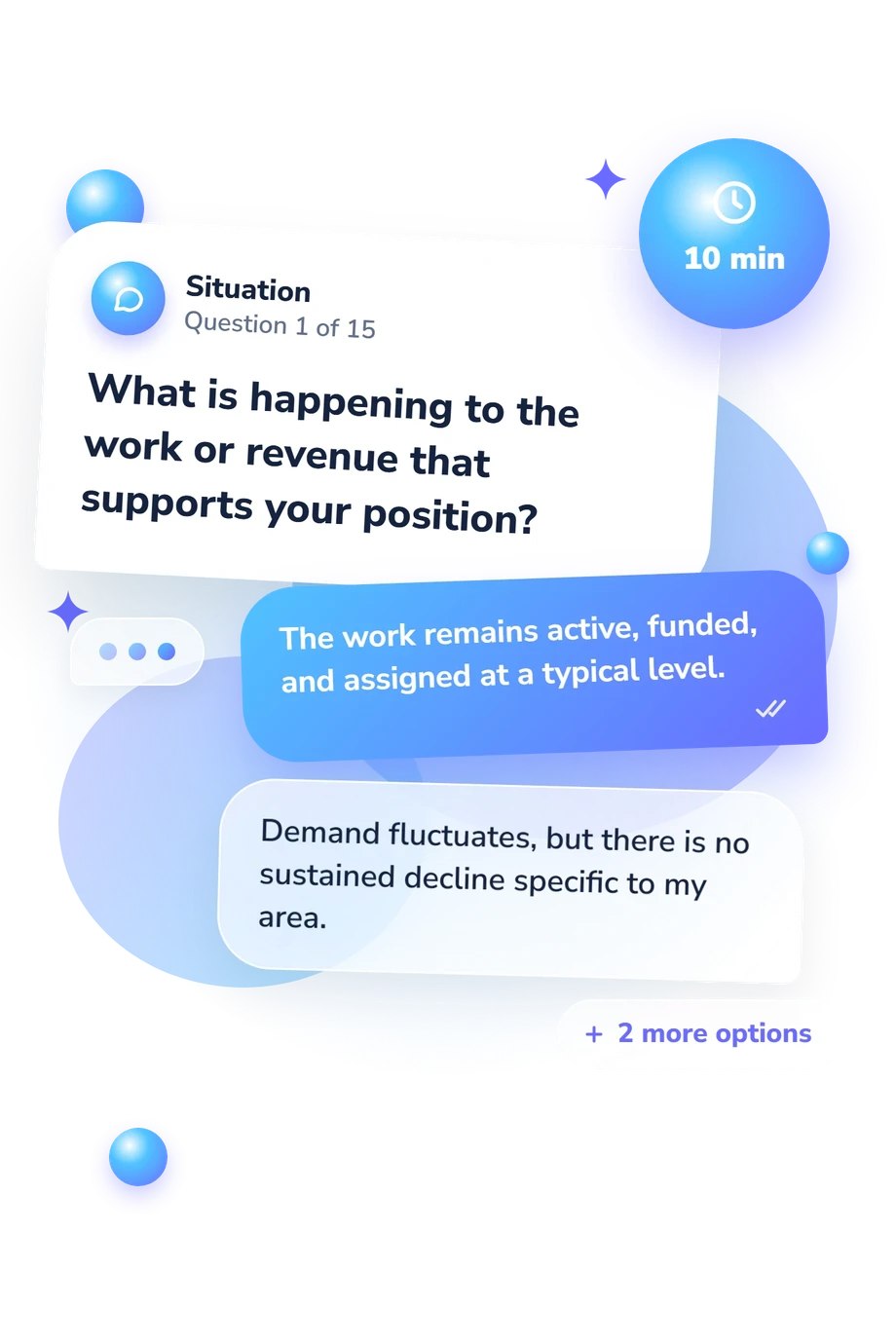
- The work remains active, funded, and assigned at a typical level.
- Demand fluctuates, but there is no sustained decline specific to my area.
- Key projects, clients, or funding sources have ended without clear replacements.
- The function supporting my role is being closed, outsourced, or discontinued.
- Comparable roles remain staffed without an unusual pattern of departures.
- Some people have left voluntarily or moved internally for varied reasons.
- Several similar roles have recently been consolidated, left unfilled, or removed.
- People in substantially the same role have been laid off, and further reductions are underway.
- Normal budget limits apply, but staffing and core work remain supported.
- Discretionary spending or open hiring has been reduced across the organization.
- Projects, contractor hours, or vacant positions on my team have been cut because of financial pressure.
- Leadership has said the team must eliminate positions or substantially reduce headcount.
Am I Getting Fired Quiz - Description and methodology of the test
Employees facing unclear feedback, shifting responsibilities, or unsettling workplace changes can use the Am I Getting Fired Quiz to distinguish employer-linked performance concerns from organization-wide disruption and role-specific contraction. Readers assessing employment risk encounter a profile organized around explicit performance communication, wider organizational change, and changes affecting their own role. This framing helps them read the result without treating every unsettling event as a direct employment warning.
What This Assessment Explores
The questionnaire suits employees sorting warnings, reassigned duties, layoffs, reduced access, or exclusion from planning while separating performance concerns, company-wide disruption, and changes around one role. The result organizes three signals. When readers are weighing signs of getting fired, it separates direct employment-linked performance communication from organizational instability and role/access contraction.
The displayed scales show these dimensions:
- Direct Performance and Employment Signals (0-15) shows how directly performance concerns are linked to continued employment: Limited direct signals (0-5), Meaningful concerns (6-10), or Explicit warning pattern (11-15).
- Organizational Instability (0-15) reflects company conditions affecting positions: Limited disruption (0-5), Active uncertainty (6-10), or Major disruption (11-15).
- Role and Access Contraction (0-15) shows whether your duties, access, and inclusion are shrinking: Stable role pattern (0-5), Noticeable contraction (6-10), or Concentrated contraction (11-15).
Explicit employment statements are the clearest direct signal about job status.
Methodology and Scientific Basis
Each item presents a workplace situation with four ordered choices, from ordinary conditions to clearer performance risk, organizational disruption, or role reduction. Respondents select the description matching recent experience.
Responses produce three displayed scores placed in the stated bands. Item-level weighting, probability estimates, norms, and a rule converting scores into dismissal likelihood are not specified. The bands are reflective summaries, not validated predictions or legal conclusions.
Conceptually, the questionnaire is consistent with the Job Insecurity Measure, which treats insecurity as multidimensional. Research by Vander Elst, De Witte, and De Cuyper provides psychometric context; work by Hellgren, Sverke, and Isaksson distinguishes threats to the job itself from changes in valued job features. This research offers conceptual parallels and distinctions relevant to the questionnaire, but does not validate its displayed scales, bands, or online scoring.
Interpretation of employment-related signals should consider written communication, timing, context, and selected situations. Job security concerns may have several explanations; stress, incomplete information, memory, and current conflict can shape self-report, so the result records perceived signals rather than determining what will happen.
- O'Neill, P., & Sevastos, P. (2013). The development and validation of a new multidimensional Job Insecurity Measure (JIM): An inductive methodology. Journal of Occupational Health Psychology, 18(3), 338-349. 10.1037/a0033114
- Vander Elst, T., De Witte, H., & De Cuyper, N. (2014). The Job Insecurity Scale: A psychometric evaluation across five European countries. European Journal of Work and Organizational Psychology, 23(3), 364-380. 10.1080/1359432X.2012.745989
- Hellgren, J., Sverke, M., & Isaksson, K. (1999). A two-dimensional approach to job insecurity: Consequences for employee attitudes and well-being. European Journal of Work and Organizational Psychology, 8(2), 179-195. 10.1080/135943299398311
Updated: