
Female Anatomy Quiz
How the Scales are Structured
Who Usually Takes This Test?
See How You Compare
Below is a preview of how scores are typically distributed across each scale.
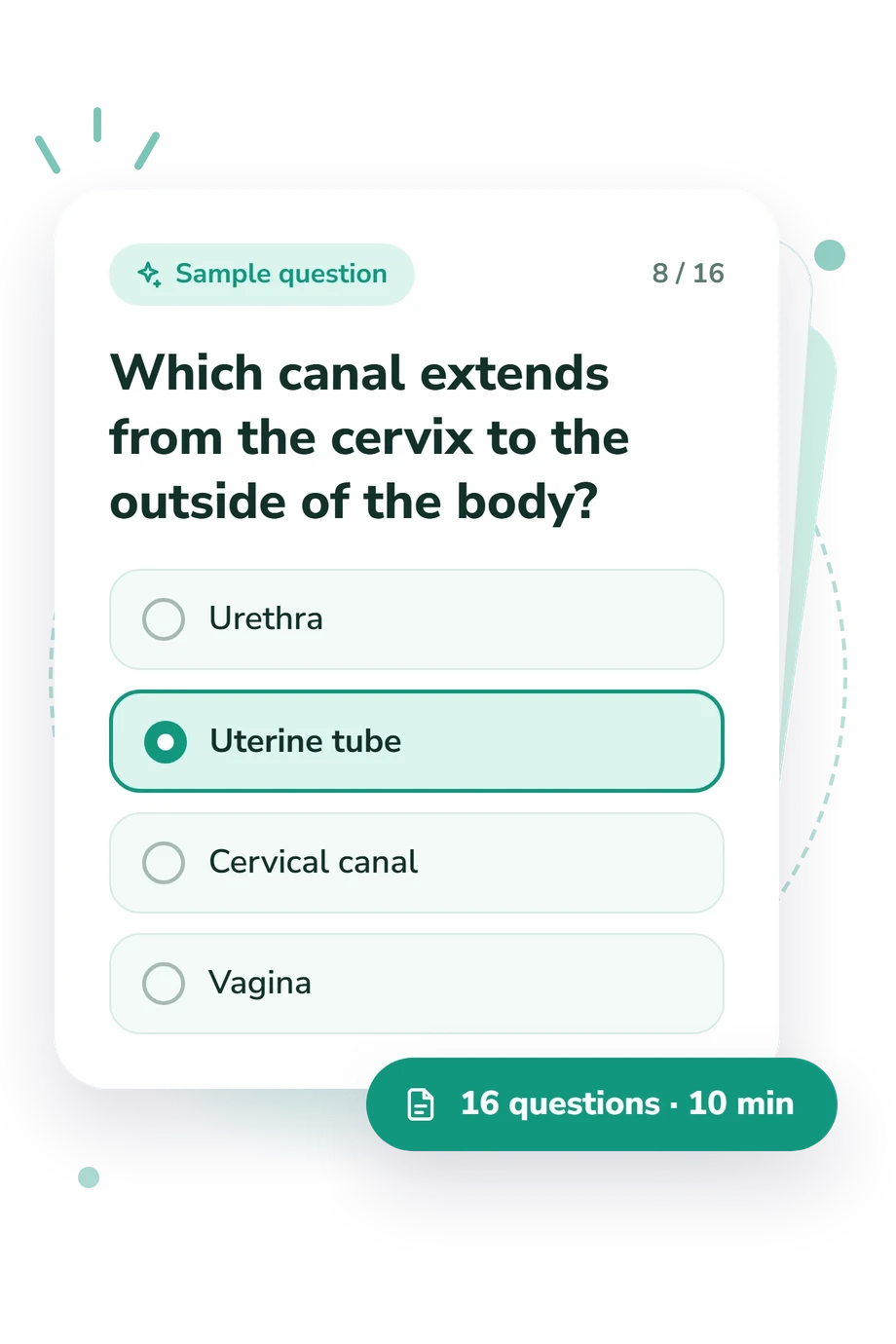
Example Questions From the Test
- Vagina
- Ovary
- Uterus
- Uterine tube
- Production of oocytes in the ovaries
- Production of vaginal lubrication
- Shedding of the endometrium
- The usual meeting of sperm and oocyte in a uterine tube
- Rugae
- Follicles
- Fimbriae
- Ligaments
Female Anatomy Quiz - Description and methodology of the test
Anyone reviewing reproductive structures, studying health science, or preparing for clearer conversations with clinicians can use this female anatomy quiz as a focused learning check. A female body quiz connects anatomical terms with their locations and functions, helping learners identify what they know and choose useful topics for further study. It suits general learners who want to organize their understanding before deeper study.
What This Assessment Explores
The questionnaire treats reproductive anatomy as an interconnected system. Items link reproductive organs, tissues, openings, glands, and muscles with their locations or functions. Scenarios connect anatomy with examinations, implantation, ovulation, menstruation, and hormones.
Three themes shape the questions; one result reflects knowledge across them:
- Structure and location shows whether you can place organs and landmarks correctly.
- Function and process shows whether you connect structures with ovulation, implantation, hormones, menstruation, or childbirth.
- Terminology in context shows whether you can distinguish similar names in examination and health-education situations.
The subject includes intimate vocabulary, so the test can function as a sexual anatomy quiz without assessing sexual behavior. Here, Female Reproductive Anatomy Knowledge: 0-16 is reported as Foundational 0-6, Developing 7-12, or Strong 13-16. Foundational indicates basic recognition to review; Developing reflects useful knowledge with connections to strengthen; Strong reflects broad, accurate understanding.
Methodology and Evidence Base
Each item presents four choices and asks for the best answer to a concrete anatomy problem. People learning female anatomy can use it; guys may approach the test as an anatomy quiz for men, using direct identification and short applications.
Results appear in the displayed bands; no weighting system or population norms are documented. The result is an educational snapshot of knowledge about organs, tissues, openings, and reproductive processes, not a standardized estimate.
The content is conceptually consistent with the Reproductive Health Knowledge Index (Hess et al., 2021), which organizes reproductive-health knowledge into factual domains. It is not an adaptation or validated digital version of that instrument. Harmanli et al. (2014) and Ayoola et al. (2016) support the coverage of reproductive structures, ovulation, menstruation, and related changes, but do not establish psychometric properties for this questionnaire.
Because this is an educational questionnaire rather than a medical assessment, the score cannot evaluate symptoms or personal anatomy. Prior study, guessing, wording, and unfamiliar terms may affect answers, so use the result to direct review and select concepts for closer study.
- Ariana Hess, Amy Williamson, Jessica Francis, Emma Schnuckle. 50. Development and Validation of the Reproductive Health Knowledge Index (RHKI). Journal of Pediatric and Adolescent Gynecology. 2021;34(2):259. 10.1016/j.jpag.2021.02.054
- Oz Harmanli, Iris Ilarslan, Shamini Kirupananthan, Alexander Knee, An Harmanli. Women's perceptions about female reproductive system: a survey from an academic obstetrics and gynecology practice. Archives of Gynecology and Obstetrics. 2014;289(6):1219-1223. 10.1007/s00404-013-3116-1
- Adejoke B. Ayoola, Gail L. Zandee, Yenupini J. Adams. Women's Knowledge of Ovulation, the Menstrual Cycle, and Its Associated Reproductive Changes. Birth. 2016;43(3):255-262. 10.1111/birt.12237
Updated: