
Business Quiz Questions and Answers
How the Scales are Structured
Who Usually Takes This Test?
See How You Compare
Below is a preview of how scores are typically distributed across each scale.
Example Questions From the Test
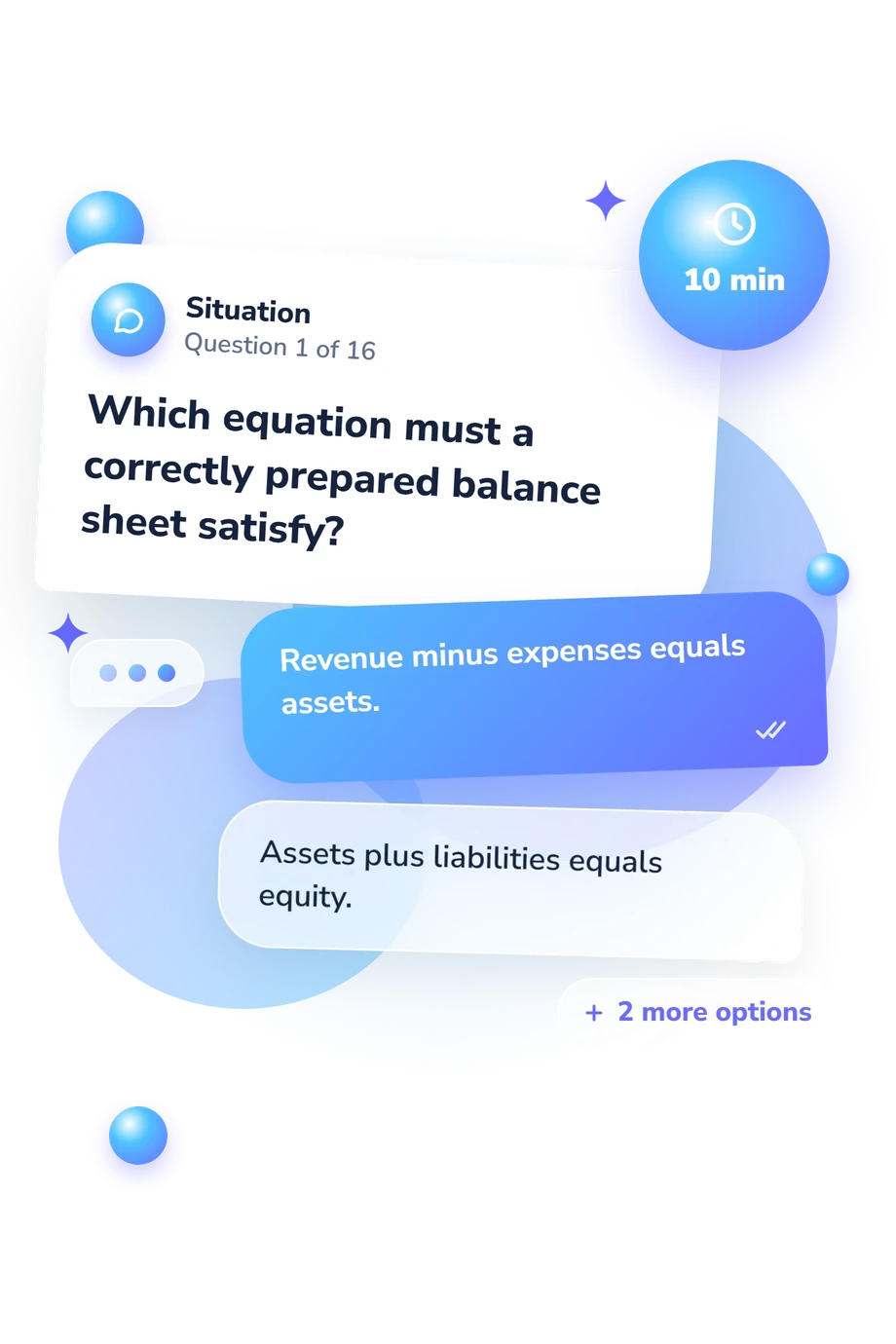
- Revenue minus expenses equals assets.
- Assets plus liabilities equals equity.
- Cash equal revenue plus profit.
- Assets equal liabilities plus equity.
- It guarantees that the company will never make a loss.
- It removes the company's obligation to repay its debts.
- It generally limits an owner's exposure to the amount invested.
- It allows owners to ignore contracts signed by the company.
- $120,000
- $70,000
- $50,000
- $190,000
Business Quiz Questions and Answers - Description and methodology of the test
People seeking a check of business knowledge can use the online questionnaire to see how confidently they handle concepts. The assessment covers business quiz questions and answers pdf content, although the activity remains online. It suits students, applicants, entrepreneurs, and curious learners who want a structured starting point from this online business questionnaire. The result highlights knowledge areas for further study or practice.
What This Assessment Measures
The questionnaire samples applied knowledge across common business decisions rather than specialist expertise. It asks about financial statements, gross profit, working capital, break-even analysis, net present value, customer acquisition cost, market segmentation, demand, operations, ethics, and goal setting.
Four-option questions make this business knowledge assessment useful for checking recognition of familiar terms and application of selected concepts in calculations and short scenarios.
Your single Business Knowledge result is reported on a 0-16 scale and places performance in one of three catalogue-defined bands:
- Foundational (0-6) indicates that you recognize some business ideas but would benefit from reviewing core financial, marketing, economic, and operational concepts.
- Developing (7-12) shows useful general business knowledge, with room to strengthen accuracy and application.
- Strong (13-16) reflects broad, accurate use of established business concepts across calculations and scenarios.
Methodology and Evidence Base
Each item presents four answer choices, and the total reflects the number of correct responses across the sixteen questions. The result is a compact knowledge score rather than a profile of separate specialties. The displayed band gives the practical interpretation of that total.
Content coverage is conceptually consistent with Scott's work on business-domain assessment and the ETS Major Field Test in Business. This questionnaire is not presented as an adaptation of either source; they offer a comparison point for its broad mix of finance, marketing, economics, operations, and management content. Research by Ling on broad assessments highlights why fine-grained subscore claims require caution.
Used as a revision checkpoint, this business knowledge test shows whether sampled concepts are handled accurately, while a lower result may indicate that broader review is useful. Results may vary with prior coursework, terminology familiarity, and concentration. The score is not a complete measure of professional judgment or real-world business performance; interpretation follows the displayed catalogue bands.
- Scott, Richard, Judith Scott, and Norm Pence. "Transhemispheric Disparities In The General Knowledge Of Business Majors: By Major Population Segments." International Business & Economics Research Journal, vol. 1, no. 8, 2002. 10.19030/iber.v1i8.3961
- Educational Testing Service. Major Field Tests: Business. Test Description, 2021.
- Ling, Guangming. "Why the Major Field Test in Business Does Not Report Subscores: Reliability and Construct Validity Evidence." ETS Research Report RR-12-11, 2012. 10.1002/j.2333-8504.2012.tb02293.x
Updated: