
Thermodynamics Quiz
How the Scales are Structured
Who Usually Takes This Test?
See How You Compare
Below is a preview of how scores are typically distributed across each scale.
Example Questions From the Test
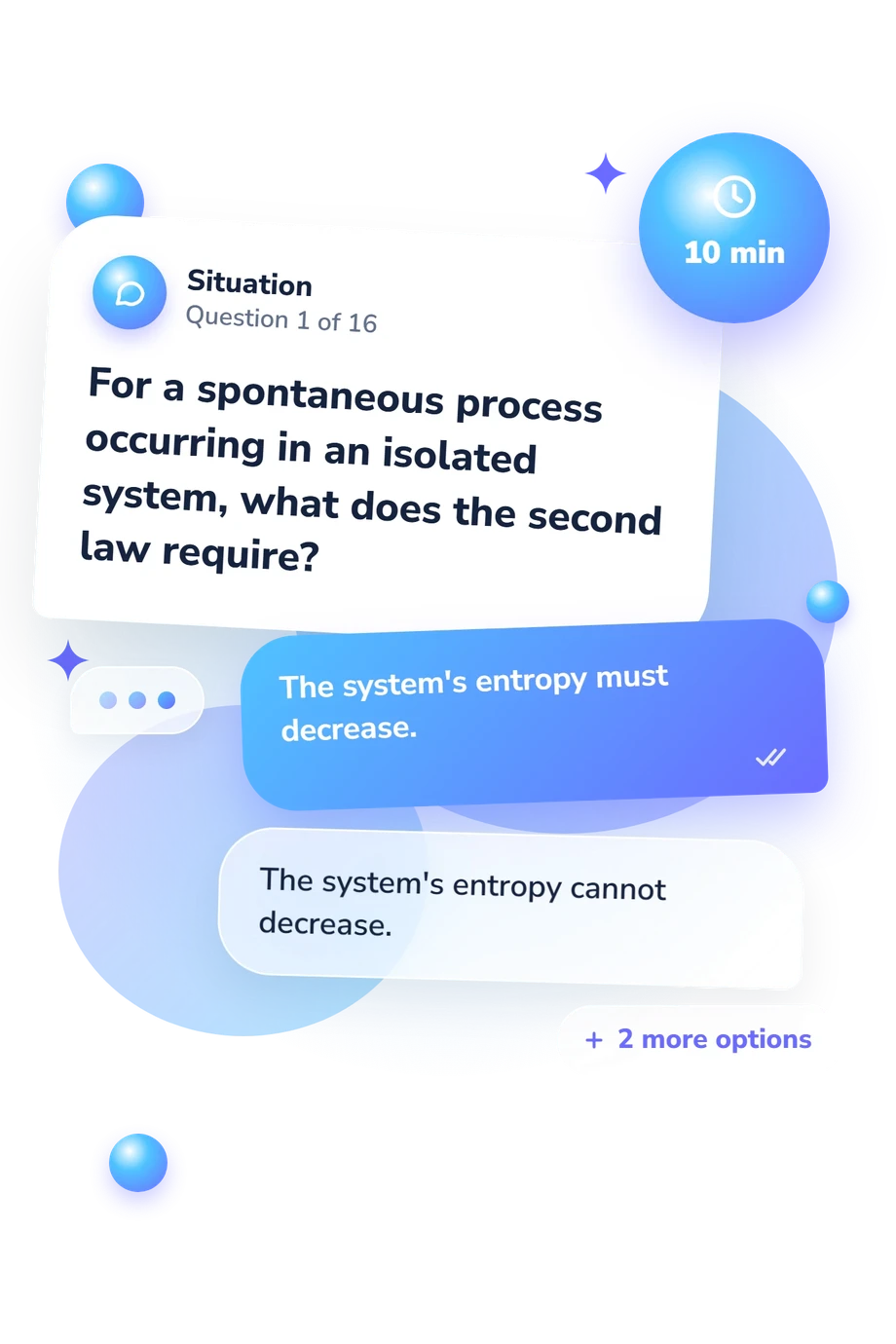
- The system's entropy must decrease.
- The system's entropy cannot decrease.
- The system's internal energy must increase.
- The system's temperature must remain constant.
- Its internal energy and temperature remain unchanged.
- The gas cools because it performs expansion work.
- Its internal energy rises because its volume increases.
- Heat enters the gas to fill the empty chamber.
- Heat transferred to a system
- Work performed along a process path
- Enthalpy of a system
- Distance traveled by a piston during a cycle
Thermodynamics Quiz - Description and methodology of the test
Designed for students, instructors, and independent learners, this thermodynamics quiz combines recognition of core principles with application and calculation in familiar physical situations. It suits anyone reviewing introductory physics or engineering thermodynamics who wants a focused snapshot of current understanding. The thermodynamics questions in this quiz connect laws, properties, processes, heat transfer, phase changes, engines, refrigerators, and energy balances.
What This Assessment Explores
The questionnaire measures conceptual command of thermodynamics: recognizing state functions, applying the zeroth, first, and second laws, and reasoning about how heat, work, temperature, pressure, volume, and internal energy change during processes. It also connects these principles with conduction, phase changes, engines, refrigerators, and reversible behavior. The audience is anyone revising introductory physics or engineering thermodynamics.
For a learner, this online assessment functions as a thermodynamics knowledge test, giving a focused snapshot rather than a broad measure of mathematical ability. The Thermodynamics Knowledge scale (0-16) counts correct answers and is interpreted through these bands:
- Foundations to reinforce (0-6) indicates partial recognition and a need to review laws, sign conventions, and process relationships.
- Developing command (7-12) indicates many correct connections with some conceptual gaps.
- Strong command (13-16) indicates accurate links among laws, properties, processes, and energy calculations.
Methodology and Scientific Basis
Each item presents a physical situation, law, or calculation with four answer choices. The respondent selects the option that best fits the governing principle, so the displayed result is a raw total score based on the total number of correct answers rather than a weighted profile. As an introductory thermodynamics test, it emphasizes conceptual reasoning about state changes, energy conservation, entropy, equilibrium, and idealized processes.
Conceptually, the questionnaire is consistent with the Thermodynamics Concept Inventory, a relevant precedent for assessing understanding beyond formula recall. It is not presented as an adaptation of that inventory. The Thermodynamics Conceptual Reasoning Inventory extension by Firetto et al. and the conceptual survey by Brown and Singh offer closely related evidence that multiple-choice items can probe explanations and misconceptions in introductory thermodynamics.
The questionnaire's displayed result is a raw total score interpreted through fixed displayed bands, not a comparison with a norm group. Performance can still be influenced by recent study, guessing, calculation slips, and sign-convention errors, so the result is best used to guide targeted review and compare later attempts.
- K. Clark Midkiff, Thomas A. Litzinger, and D. L. Evans. "Development of engineering thermodynamics concept inventory instruments." Proceedings - Frontiers in Education Conference, vol. 2, article 50, p. F2A/3, 2001. 10.1109/FIE.2001.963691
- Carla M. Firetto, Peggy N. Van Meter, Alexa M. Kottmeyer, Stephen R. Turns, and Thomas A. Litzinger. "An extension of the Thermodynamics Conceptual Reasoning Inventory (TCRI): measuring undergraduate students’ understanding of introductory thermodynamics concepts." International Journal of Science Education, vol. 43, no. 15, pp. 2555-2576, 2021. 10.1080/09500693.2021.1975847
- Benjamin Brown and Chandralekha Singh. "Development and validation of a conceptual survey instrument to evaluate students’ understanding of thermodynamics." Physical Review Physics Education Research, vol. 17, no. 1, article 010104, 2021. 10.1103/PhysRevPhysEducRes.17.010104
Updated: