
Am I Irish Quiz
How the Scales are Structured
Who Usually Takes This Test?
See How You Compare
Below is a preview of how scores are typically distributed across each scale.
Example Questions From the Test
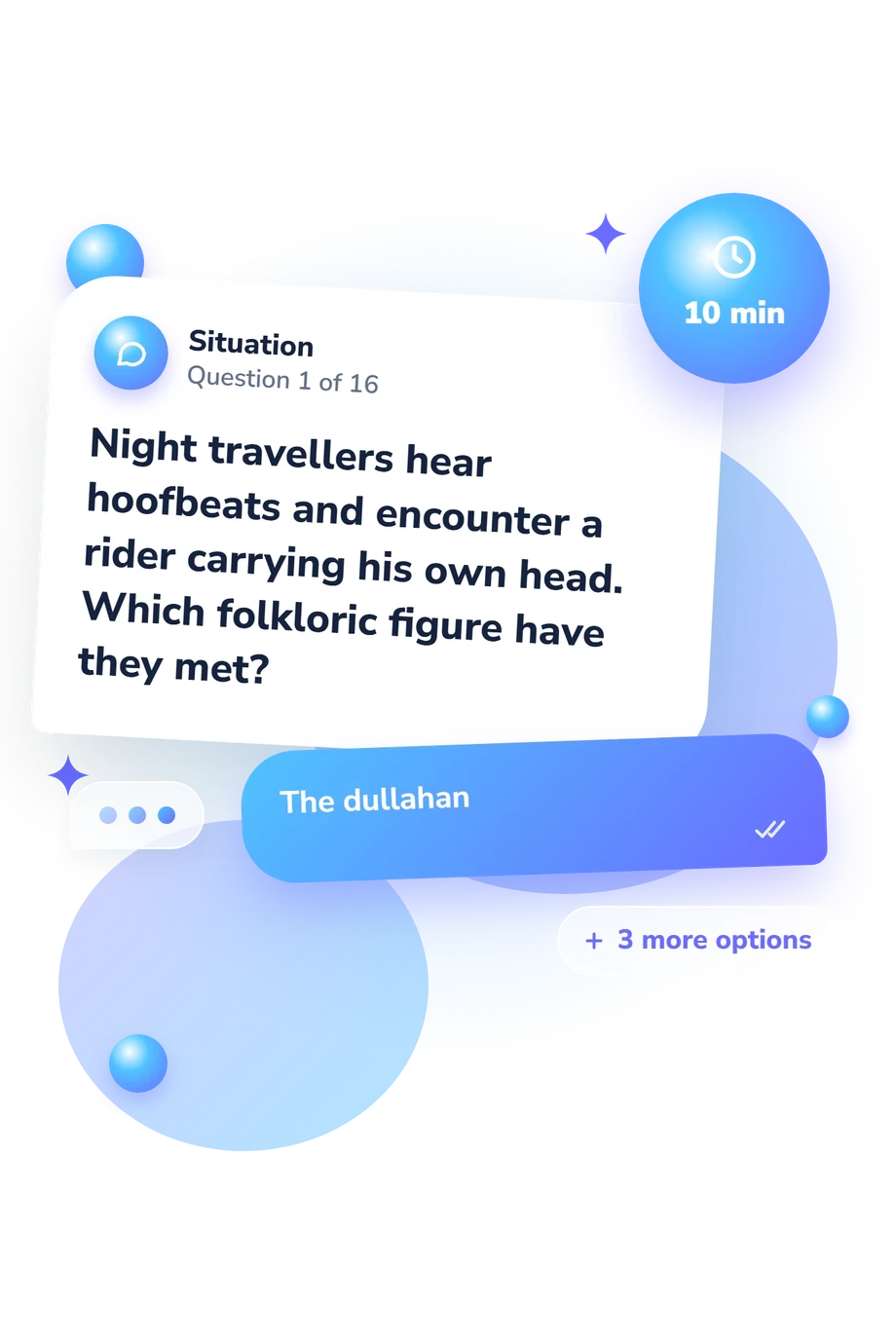
- The dullahan
- A clurichaun
- A pooka in the fixed form of a stag
- A merrow
- As a banshee whose lament foretells a death rather than causes it
- As a selkie calling someone to live beneath the sea
- As the Morrígan guaranteeing victory in battle
- As a leprechaun protecting concealed treasure
- The Voyage of Bran
- Táin Bó Cúailnge
- The Pursuit of Diarmuid and Gráinne
- The Second Battle of Mag Tuired
Am I Irish Quiz - Description and methodology of the test
Readers who want a playful way to check their familiarity with Irish stories, figures, and traditions can take the Am I Irish Quiz as a focused knowledge exercise. It suits curious learners and culture enthusiasts who want a clearer picture of what they recognize. An identity-sounding question gives the test an Are You Irish Quiz frame, while folklore, stories, and traditions-not ancestry, citizenship, or identity-are what it examines.
What This Assessment Explores
The questionnaire measures familiarity with Irish folklore and mythology, not family background. It suits readers who enjoy traditional stories, cultural history, or a light knowledge challenge. As an Irish folklore quiz, it estimates what you recognize rather than who you are.
The main knowledge areas are:
- Folkloric beings are identified through their roles, appearances, and supernatural traits.
- Mythological cycles are distinguished through their heroes, conflicts, and traditions.
- Legendary places are connected with the stories and beliefs attached to them.
- Cultural concepts are interpreted through taboos, seasonal thresholds, and inherited lore.
The Irish Folklore and Mythology Knowledge scale runs from 0-16 and measures knowledge of the traditions covered, not citizenship, ancestry, or cultural identity. Curious Explorer (0-6) signals themes to discover; Developing Storykeeper (7-12) reflects many central connections; Folklore Guide (13-16) indicates wide-ranging knowledge.
Methodology and Scientific Basis
Each question presents a short scenario, definition, or identification task with four answer choices. The respondent selects the best-fitting option, and the result condenses performance across the questionnaire into the displayed knowledge score. This makes the activity an Irish mythology quiz built around recognition and recall, not a self-rating inventory.
Cross and Slover’s edited collection supplies relevant narrative and heroic context for figures and cycles. MacKillop’s work situates distinctions among beings, names, and concepts, while Yeats’s collection represents traditions behind the banshee. O’Kelly and O’Kelly provide context for Newgrange and its winter-solstice setting. These references provide literary and cultural context for subjects covered; the questionnaire adapts none of them.
The result is reported through the displayed knowledge scale and its bands. Their labels interpret performance as levels of knowledge and describe how much of the covered material it represents, without claiming cultural expertise or identity.
Guessing, prior exposure to retellings, and differences in remembered versions can affect performance. Read the outcome as a snapshot of recall in this format, not a comprehensive measure of historical or cultural knowledge.
- Cross, Tom Peete, and Clark Harris Slover, eds. Ancient Irish Tales. New York: Henry Holt and Company, 1936.
- MacKillop, James. Dictionary of Celtic Mythology. Oxford: Oxford University Press, 1998; online reference edition, A Dictionary of Celtic Mythology, Oxford University Press, 2004. 10.1093/acref/9780198609674.001.0001
- Yeats, William Butler, ed. Fairy and Folk Tales of the Irish Peasantry. London: Walter Scott, 1888.
- O'Kelly, Michael J., and Claire O'Kelly. Newgrange: Archaeology, Art and Legend. London: Thames and Hudson, 1982.
Updated: