
Book Quiz for Kids
How the Scales are Structured
Who Usually Takes This Test?
See How You Compare
Below is a preview of how scores are typically distributed across each scale.
Example Questions From the Test
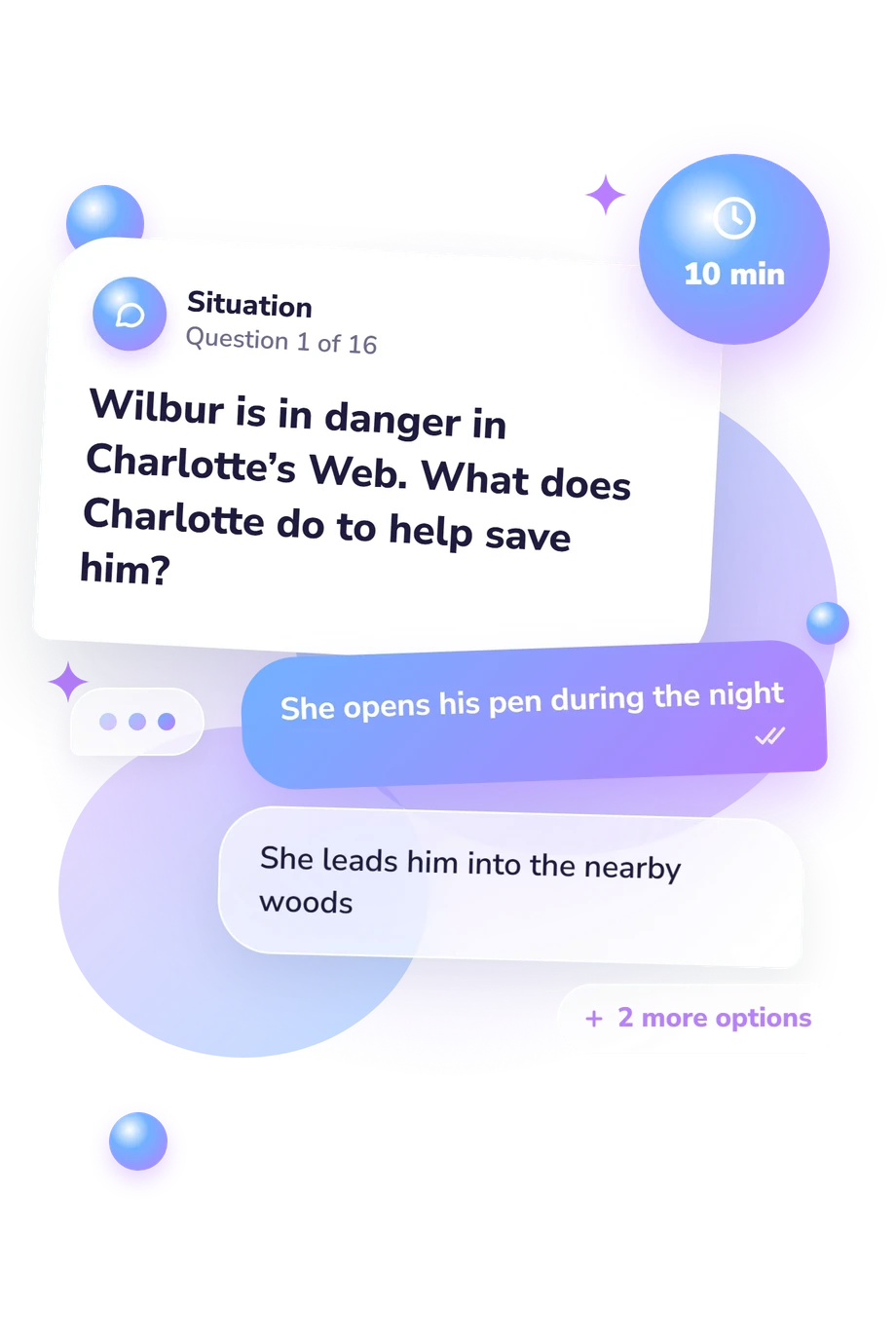
- She opens his pen during the night
- She leads him into the nearby woods
- She hides him beneath the barn floor
- She weaves words praising him into her web
- Monkeys
- Jackals
- Elephants
- Wolves
- A judgment or threat from fellow pirates
- An invitation to divide hidden treasure
- Proof that someone has joined the crew
- The location marked on a treasure map
Book Quiz for Kids - Description and methodology of the test
Readers, families, and educators who want a quick way to revisit or discuss classic children’s literature can use this book quiz for kids. It offers a light activity for shared reading conversations, classroom warm-ups, or quiet reflection. As a literature quiz for kids, it gives a simple performance profile without claiming to represent a reader’s entire experience of books.
What This Assessment Measures
The questionnaire measures recognition of details from classic children’s stories, making it a childrens book quiz that invites readers to revisit familiar books and see what remains in memory. The focus is recall rather than interpretation.
The questions cover three recurring themes.
- Character recognition links names, roles, and actions.
- Setting recognition shows whether important places and journeys remain clear.
- Plot and object recall captures details that move stories forward.
For readers using these book quiz questions for kids, the result uses one scale, Classic Children’s Books Knowledge (0-16). Starting Shelf (0-6) marks recognition of famous stories and room to explore; Growing Reader (7-12) reflects knowledge of central characters, settings, and events; Classic-Book Expert (13-16) indicates strong knowledge across a wide selection. These labels describe performance, not a permanent reading identity.
Methodology and Evidence Base
Each item presents a question with four answer choices. Prompts ask for a character, setting, action, event, or object, so the format tests recognition rather than interpretation. Across several books, the quiz samples recall, keeping the children’s book quiz questions focused on identifiable details.
Responses produce the displayed performance result for this selected question set. It describes performance on these items rather than a general reading level. The quiz can support reading conversations, while broader comprehension and literary judgment extend beyond this format.
It is an online performance quiz rather than a standardized adaptation of a published instrument. Wickstrom (1996) offers limited context on reading-quiz activities and engagement with children’s literature, while Cremin et al. (2008) and Collins and Safford (2008) discuss teachers’ knowledge of children’s literature. These works do not establish this quiz’s scoring, bands, norms, reliability, or validity.
Guessing, prior exposure, memory, and attention can affect quiz performance. The result is descriptive for the selected question set, with no population norms or clinical cutoffs; it should not be read as a standardized measure of children’s-literature knowledge.
- Wickstrom, Polly Jeanne. Quizzes for 220 Great Children's Books: The Quest Motivational Reading Program. Libraries Unlimited, 1996. ISBN 9781563083839.
- Cremin, Teresa, Marilyn Mottram, Eve Bearne, and Prue Goodwin. "Exploring Teachers' Knowledge of Children's Literature." Cambridge Journal of Education, vol. 38, no. 4, 2008, pp. 449-464. DOI 10.1080/03057640802482363.
- Collins, Fiona M., and Kimberly Safford. "The Right Book to the Right Child at the Right Time": Primary Teacher Knowledge of Children's Literature. Changing English, vol. 15, no. 4, 2008, pp. 415-422. DOI 10.1080/13586840802493068.
Updated: