
Am I a Diva Quiz
How the Scales are Structured
Who Usually Takes This Test?
See How You Compare
Below is a preview of how scores are typically distributed across each scale.
Example Questions From the Test
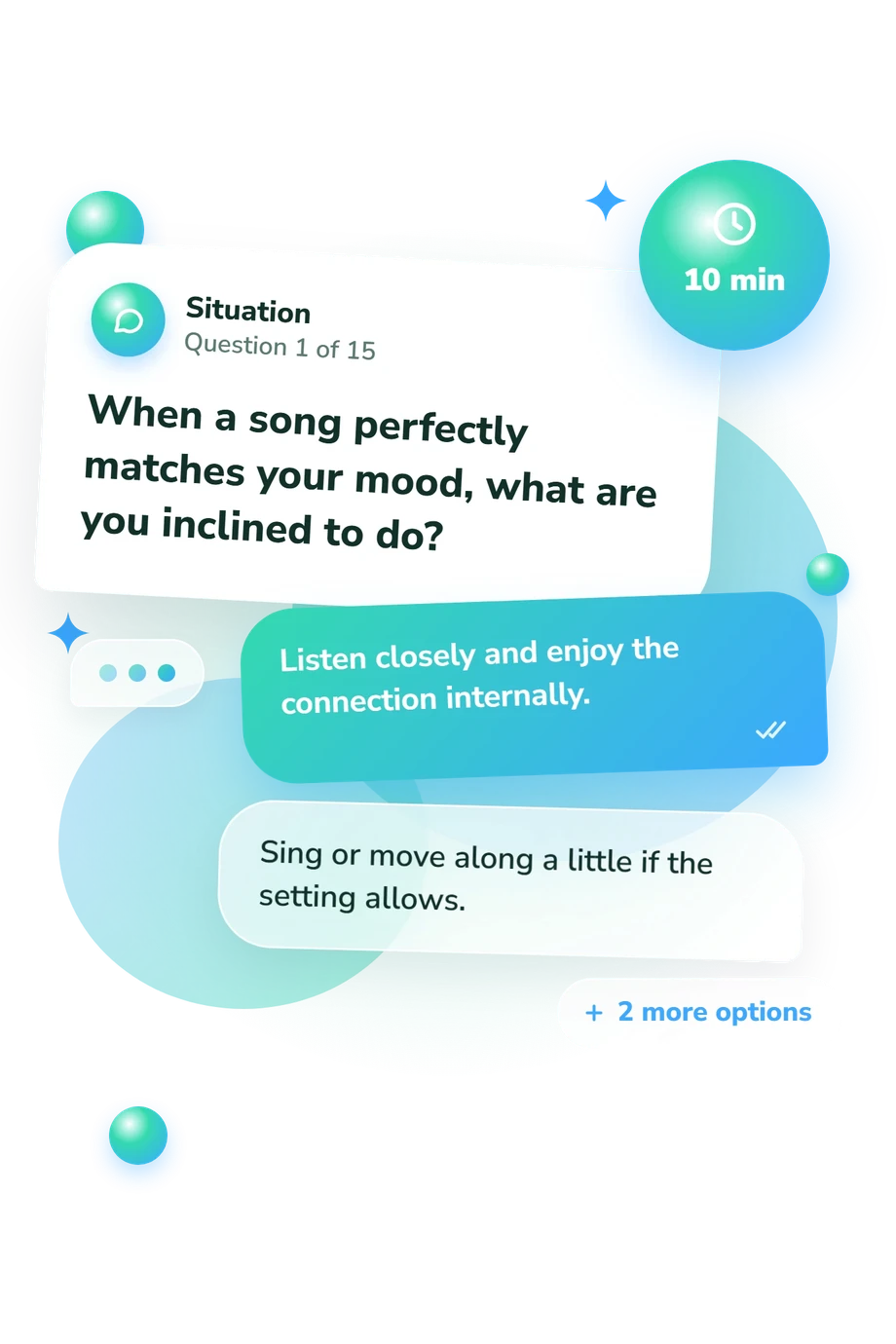
- Listen closely and enjoy the connection internally.
- Sing or move along a little if the setting allows.
- Let the song shape my whole mood and perform along with it.
- Turn it up and express the feeling openly through movement or singing.
- I recount what happened plainly and let the situation speak for itself.
- I add a few expressive details to make the story engaging.
- I use voices, timing, and vivid reactions to bring the event to life.
- I transform it into a full performance with suspense and comic exaggeration.
- Deliver one defined section without becoming the main presenter.
- Organize research or materials behind the scenes.
- Share leadership and speaking time with another person.
- Open, close, and guide the presentation as its main voice.
Am I a Diva Quiz - Description and methodology of the test
Readers who want to examine the everyday diva label can use the Am I a Diva Quiz to add nuance to a familiar stereotype. This playful diva quiz turns ordinary social choices into a light profile, helping a person consider whether the label reflects one style or several different tendencies.
What This Assessment Explores
Rather than asking whether someone is a diva, the questionnaire maps styles that can coexist. Its scenarios cover expression, visibility, reactions to disruption, and firmness about preferred details. The question of which diva someone resembles is only a playful framing device; as a quiz about which diva you are, it produces a dimensional profile rather than a fixed identity.
The three scales are:
- Dramatic Expression (0-15) reflects expressive intensity: Understated (0-5) is contained, Animated (6-10) is clearly expressive, and Theatrical (11-15) is vivid and performance-like without judging feelings' depth or validity.
- Spotlight Presence (0-15) reflects comfort with attention: Quiet Presence (0-5) prefers participation without focus, Selective Spotlight (6-10) enjoys visibility, and Center-Stage Energy (11-15) feels energized by notice; no band is better.
- Standards & Selectivity (0-15) reflects firmness about preferences: Easygoing (0-5) adapts readily, Discerning (6-10) protects key details while compromising elsewhere, and Exacting (11-15) prefers precise outcomes.
Methodology and Scientific Basis
Each scenario offers four response options that vary in emotional intensity, visibility, flexibility, or firmness. Situations include storytelling, praise, changed plans, leadership, and appearance, so the respondent chooses the response closest to a typical instinct.
Responses feed separate profile scores rather than one total label. The displayed ranges and bands organize the result, but no published weighting formula or population norms are stated. This diva-themed questionnaire is therefore best read as a pattern of tendencies across three dimensions.
The closest conceptual reference is the As-If-Scale, associated with Renner and colleagues, which frames expressive self-presentation without making this questionnaire a copy of it. Ferguson and Negy provide a related reference for histrionic personality symptoms; Kring and colleagues support dispositional emotional expressiveness; and Hill and colleagues offer a comparison for firm standards and perfectionistic preferences. The questionnaire is conceptually consistent with these works, not an adaptation of any one.
Because it is an online self-report questionnaire, mood, context, self-awareness, or impression management may shape the snapshot.
- Renner, K.-H., Enz, S., Friedel, H., Merzbacher, G., & Laux, L. (2008). Doing as if: The histrionic self-presentation style. Journal of Research in Personality, 42(5), 1303-1322. 10.1016/j.jrp.2008.04.005
- Ferguson, C. J., & Negy, C. (2014). Development of a brief screening questionnaire for histrionic personality symptoms. Personality and Individual Differences, 66, 124-127. 10.1016/j.paid.2014.02.029
- Kring, A. M., Smith, D. A., & Neale, J. M. (1994). Individual differences in dispositional expressiveness: Development and validation of the Emotional Expressivity Scale. Journal of Personality and Social Psychology, 66(5), 934-949. 10.1037/0022-3514.66.5.934
- Hill, R. W., Huelsman, T. J., Furr, R. M., Kibler, J., Vicente, B. B., & Kennedy, C. (2004). A new measure of perfectionism: The Perfectionism Inventory. Journal of Personality Assessment, 82(1), 80-91. 10.1207/s15327752jpa8201_13
Updated: