
Reincarnation Quiz
How the Scales are Structured
Who Usually Takes This Test?
See How You Compare
Below is a preview of how scores are typically distributed across each scale.
Example Questions From the Test
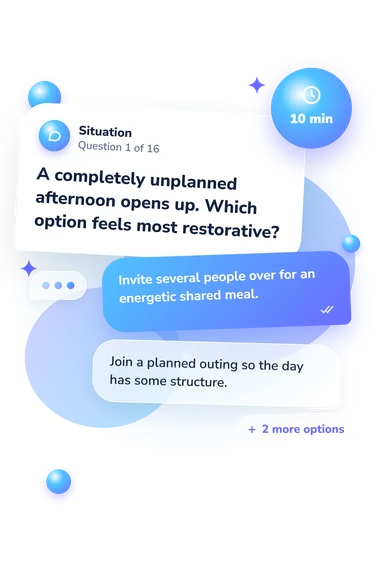
- Invite several people over for an energetic shared meal.
- Join a planned outing so the day has some structure.
- Mix a short social visit with time by myself.
- Disappear into a cozy personal ritual and resurface when ready.
- Introduce myself widely and follow the liveliest conversation.
- Find one welcoming group and stay near it.
- Circulate for a while, then take brief breaks from the crowd.
- Observe first and connect selectively with one intriguing person.
- Keep as much of the original plan as conditions allow.
- Find a structured alternative that still meets the day's purpose.
- Adapt quickly and choose the most practical nearby option.
- Turn the disruption into a playful experiment everyone can shape.
Reincarnation Quiz - Description and methodology of the test
People drawn to symbolic personality profiles can use a reincarnation quiz as an imaginative entry point to explore present-day affinity with cat, dolphin, owl, and wolf styles. It is intended for curious readers who enjoy self-reflection and symbolic ways of considering identity. The format may feel like a past life quiz, but its result measures current preferences rather than a past identity.
What This Assessment Explores
Rather than assigning a past identity, it translates present preferences into four animal metaphors. Scenarios about solitude, contact, flexibility, observation, teamwork, learning, and support reveal a familiar style. Someone asking whether they were reincarnated may find it interesting, but this questionnaire profiles present preferences; calling it an am i reincarnated quiz does not change that.
The dimensions are:
- Cat Affinity (0-12) measures autonomy and selective closeness; Open-Door Spirit (0-4), Independent Streak (5-8), and Cat-Like Core (9-12) mark the bands.
- Dolphin Affinity (0-12) measures playful communication and shared discovery; Steady-Waters Style (0-4), Social Current (5-8), and Dolphin-Like Core (9-12) mark the bands.
- Owl Affinity (0-12) measures observation and pattern-seeking; Action-First Outlook (0-4), Thoughtful Watcher (5-8), and Owl-Like Core (9-12) mark the bands.
- Wolf Affinity (0-12) measures loyalty and close-knit belonging; Free-Ranging Path (0-4), Trusted-Circle Energy (5-8), and Wolf-Pack Core (9-12) show the bands.
Methodology and Evidence Base
Each item presents an everyday situation with four response choices. The alternatives vary social energy, privacy, adaptability, observation, and group commitment, so respondents select the reaction that feels most characteristic. Answers are converted into four affinity totals: the highest is the strongest match, while scores within one point form a blended result.
Scoring is descriptive and relative: the highest affinity is the strongest match, while scores within one point form a blended result. Each scale uses its displayed bands, producing a structured self-reflection profile.
That metaphorical approach is conceptually consistent with Sommer and Sommer (2011), who examined animal imagery in personality description. Nedelcea, Ciorbea, and Ion (2012) provide a rationale for metaphorical items, while Fetterman and Robinson (2013) connect self-location metaphors with personality, emotion, decision-making, and performance. The questionnaire is not presented as an adaptation of these works; they offer conceptual support, not validation of this online format. Calling this questionnaire a was i reincarnated quiz cannot establish whether anyone was reincarnated; its self-report result can shift with current mood, self-awareness, and present preferences.
- Sommer, Robert, and Barbara A. Sommer. “Zoomorphy: Animal Metaphors for Human Personality.” Anthrozoös, vol. 24, no. 3, 2011, pp. 237-248. 10.2752/175303711X13045914865024
- Nedelcea, C., I. D. Ciorbea, and A. G. Ion. “Using Metaphorical Items for Describing Personality Constructs.” Procedia - Social and Behavioral Sciences, vol. 33, 2012, pp. 178-182. 10.1016/j.sbspro.2012.01.107
- Fetterman, Adam K., and Michael D. Robinson. “Do You Use Your Head or Follow Your Heart? Self-Location Predicts Personality, Emotion, Decision Making, and Performance.” Journal of Personality and Social Psychology, vol. 105, no. 2, 2013, pp. 316-334. 10.1037/a0033374