
Question Tag Quiz
How the Scales are Structured
Who Usually Takes This Test?
See How You Compare
Below is a preview of how scores are typically distributed across each scale.
Example Questions From the Test
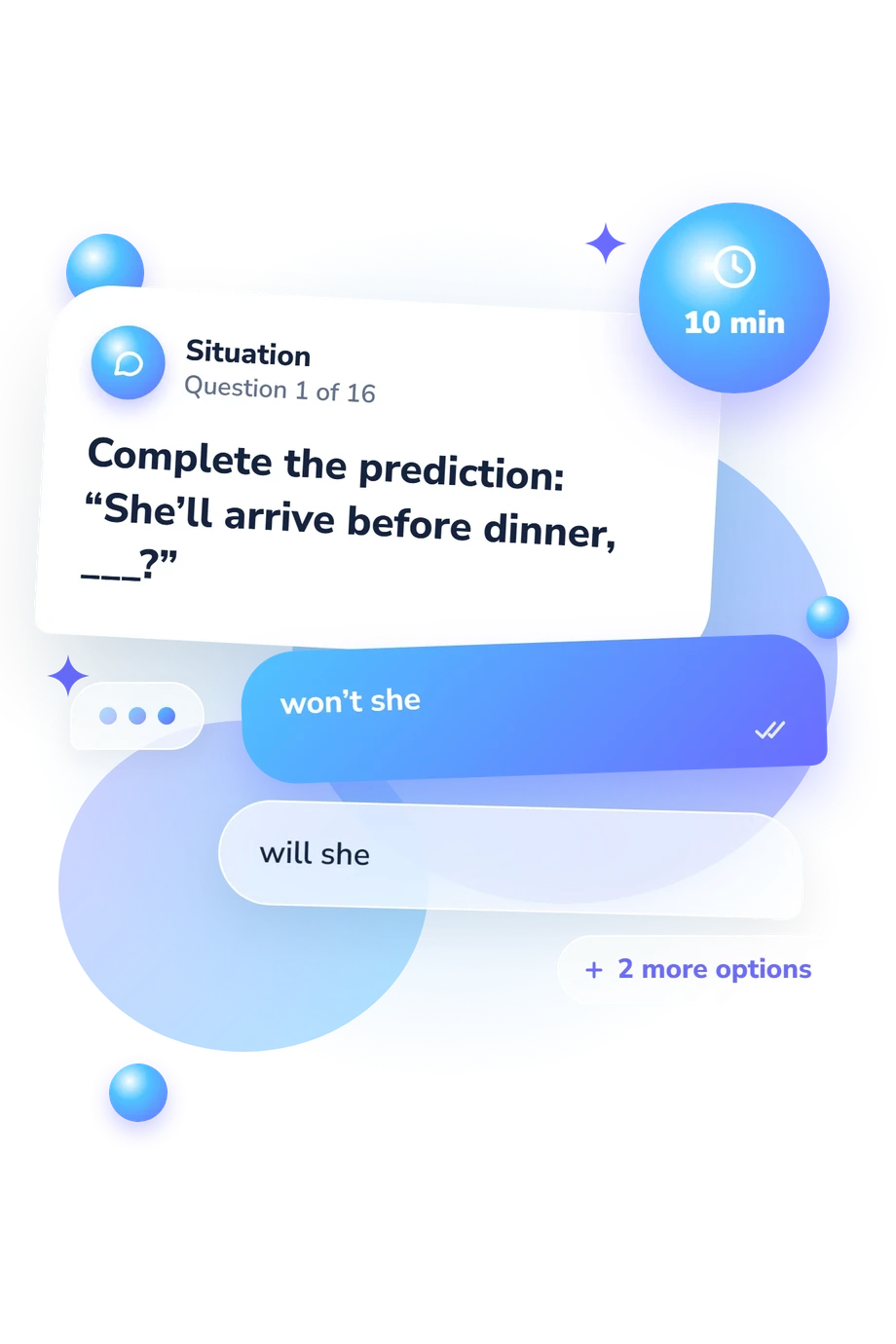
- won’t she
- will she
- isn’t she
- doesn’t she
- haven’t you
- do you
- won’t you
- don’t you
- didn’t you
- do you
- haven’t you
- weren’t you
Question Tag Quiz - Description and methodology of the test
English learners who want to check how confidently they form short follow-up questions can use this question tag quiz to focus on auxiliary choice, polarity, and pronoun matching. A question tag practice activity is especially useful when rules seem familiar in isolation but become harder in context. The result helps identify topics for review without treating one grammar score as a complete picture of communication.
What This Assessment Explores
The assessment checks whether a learner can select a conventional tag that matches the preceding statement. It covers affirmative and negative polarity, auxiliary or modal choice, pronoun reference, and special patterns such as imperatives, Let's, I am, indefinite pronouns, and existential there. It suits anyone reviewing English grammar through controlled examples. In this tag questions quiz with answers, each prompt asks the learner to choose one standard completion from four options.
The result uses one scale, Question Tag Knowledge (0-16), which summarizes accuracy in applying question-tag patterns rather than general fluency. Its bands are:
- Foundations to Review (0-6) indicates that polarity, auxiliary matching, or pronoun choice need targeted revision.
- Developing Control (7-12) shows understanding of many standard forms while less familiar constructions still need practice.
- Strong Command (13-16) reflects accurate application across common and advanced examples.
Methodology and Evidence Base
Each of the 16 items presents a sentence or situation with four answer choices. The task is recognition rather than free production: the learner selects the tag that fits the preceding clause. Items include ordinary statements, negative instructions, nobody and nothing, contractions such as you'd, and patterns including Let's, There were, and I'm. This makes an English question tag test useful for checking rules alongside exceptions.
Scoring appears as one total, with the displayed bands translating performance into levels. No weighting system or norm group is attached, so the result is a learning-oriented indicator rather than a standardized proficiency score.
Algeo (2006) describes tag formation through polarity, operator choice, pronoun selection, and special constructions. Carter and McCarthy (2006) provide a descriptive grammar reference for common and less regular forms. The questionnaire is conceptually consistent with these sources, not an adaptation or reproduction of either work.
Performance can vary with familiarity with formal conventions, attention, and exposure to regional alternatives. The score identifies revision priorities, while overall grammar ability requires evidence beyond selected-response items.
- Algeo, John. 2006. “Tag questions.” In British or American English? A Handbook of Word and Grammar Patterns, 293-304. Cambridge: Cambridge University Press. 10.1017/CBO9780511607240.018
- Carter, Ronald, and Michael McCarthy. 2006. Cambridge Grammar of English: A Comprehensive Guide to Spoken and Written English Grammar and Usage. Cambridge: Cambridge University Press. ISBN: 978-0-521-58846-1
Updated: