
Conditionals Quiz
How the Scales are Structured
Who Usually Takes This Test?
See How You Compare
Below is a preview of how scores are typically distributed across each scale.
Example Questions From the Test
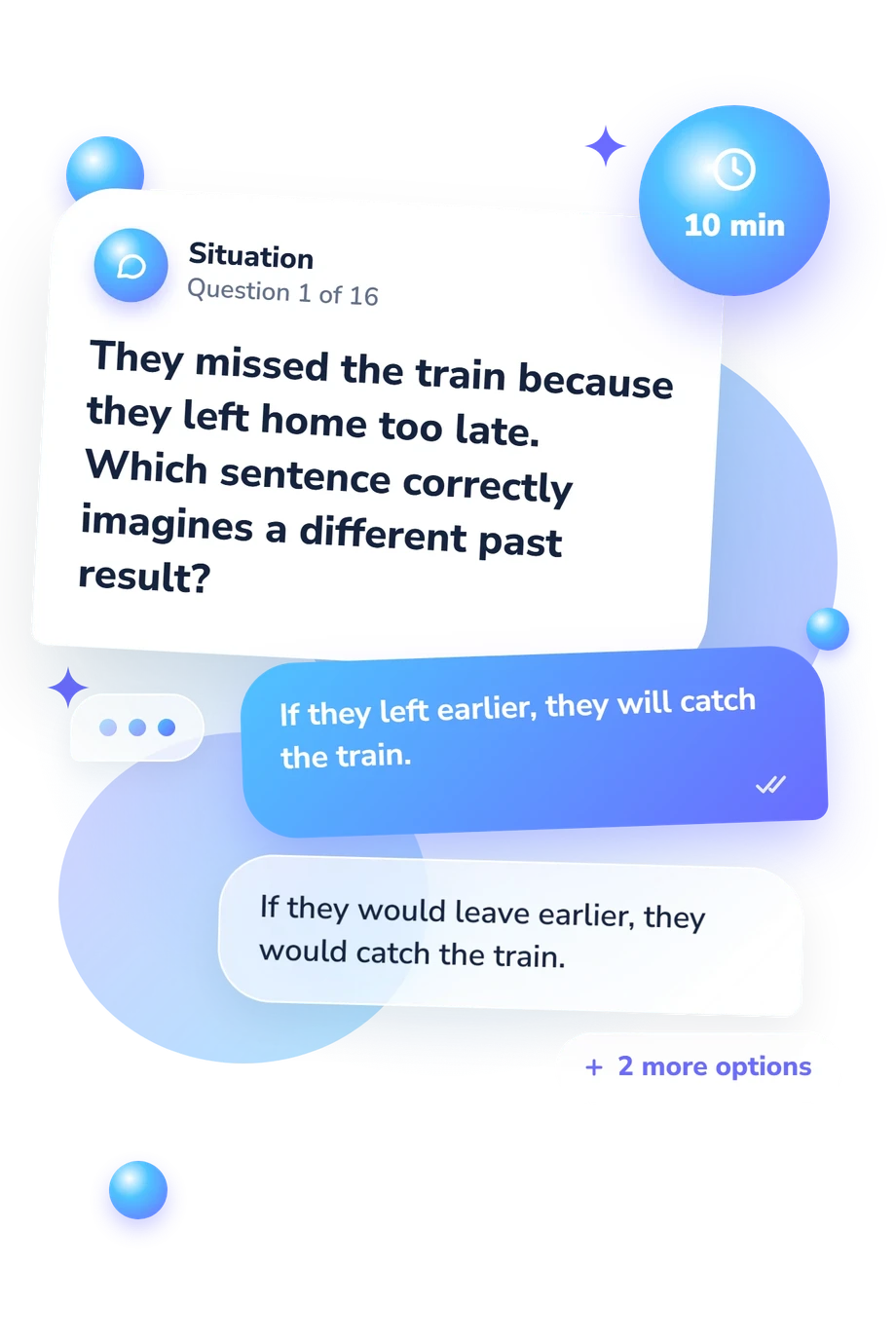
- If they left earlier, they will catch the train.
- If they would leave earlier, they would catch the train.
- If they had left earlier, they would catch the train now.
- If they had left earlier, they would have caught the train.
- Omar forgot the appointment before he could give a reminder.
- Omar did not remind the speaker, so the speaker forgot.
- Omar reminded the speaker, and the speaker did not forget.
- Omar may give a reminder before a future appointment.
- If water reaches 100°C at sea level, it boils.
- If water will reach 100°C at sea level, it boils.
- If water reached 100°C at sea level, it will boil.
- If water had reached 100°C at sea level, it boils.
Conditionals Quiz - Description and methodology of the test
For learners who want to check how confidently they use English conditionals, this conditionals quiz offers a focused knowledge check of form, meaning, and context. As a conditional sentence quiz, it suits students, teachers, and independent learners who want a clear snapshot of strengths and topics that deserve further practice. The result summarizes how consistently the respondent selects and interprets conditional structures in realistic examples.
What This Assessment Explores
This assessment checks whether respondents connect conditional forms with time, likelihood, consequence, and implication. It covers factual rules, realistic future possibilities, present or future hypotheticals, past counterfactuals, and mixed conditionals. Related items address unless, provided that, inversion, modal meaning, and punctuation.
In this if quiz, the question groups focus on these abilities:
- Zero and first conditionals show whether rules and realistic consequences are expressed accurately.
- Second, third, and mixed conditionals show whether hypothetical time relationships are understood.
- Inference and editing items test meaning, modality, inversion, and punctuation in context.
It reports English Conditionals Knowledge: 0-16, with Foundation (0-6), Developing (7-12), and Strong (13-16). Foundation indicates partial recognition and a need to review links between form, time, and likelihood; Developing indicates command of common forms with room to strengthen mixed, inverted, or nuanced structures; Strong indicates reliable contextual control.
Methodology and Evidence Base
Each item presents a sentence, situation, or meaning question with four answer choices. Selecting one option tests recognition and interpretation rather than extended written production. As a conditional grammar quiz, it measures focused knowledge of forms in context. The displayed rule awards one point per correct answer, and the total is placed into the three catalogue-defined bands.
The framework is conceptually consistent with Berent (1985), whose work examines the relationship between conditional meanings and forms in acquisition. Declerck and Reed (2001) offer a broader empirical account of conditional relationships, while Parrott (2010) describes conditional sentences for English-language teaching. These sources support the distinctions tested, but the online questionnaire is not presented as an adaptation, validation, or reproduction of any one source.
Interpretation should remain close to the sampled skills. A Strong result indicates dependable performance on the tested forms and contexts, but it does not establish complete mastery because the questionnaire uses descriptive bands rather than an external norm table. Guessing, attention, and differences between test performance and everyday use can affect scores, so the result guides review and self-assessment.
- Berent, Gerald P. (1985). “Markedness Considerations in the Acquisition of Conditional Sentences.” Language Learning, 35(3), 337-372. 10.1111/j.1467-1770.1985.tb01082.x
- Declerck, Renaat, and Susan Reed. (2001). Conditionals: A Comprehensive Empirical Analysis. Topics in English Linguistics 37. Berlin and New York: Mouton de Gruyter. 10.1515/9783110851748
- Parrott, Martin. (2010). Grammar for English Language Teachers, 2nd ed., Chapter 19, “Conditional Sentences,” pp. 272-288. Cambridge University Press. 10.1017/9781009406536.022
Updated: