
Waves Quiz
How the Scales are Structured
Who Usually Takes This Test?
See How You Compare
Below is a preview of how scores are typically distributed across each scale.
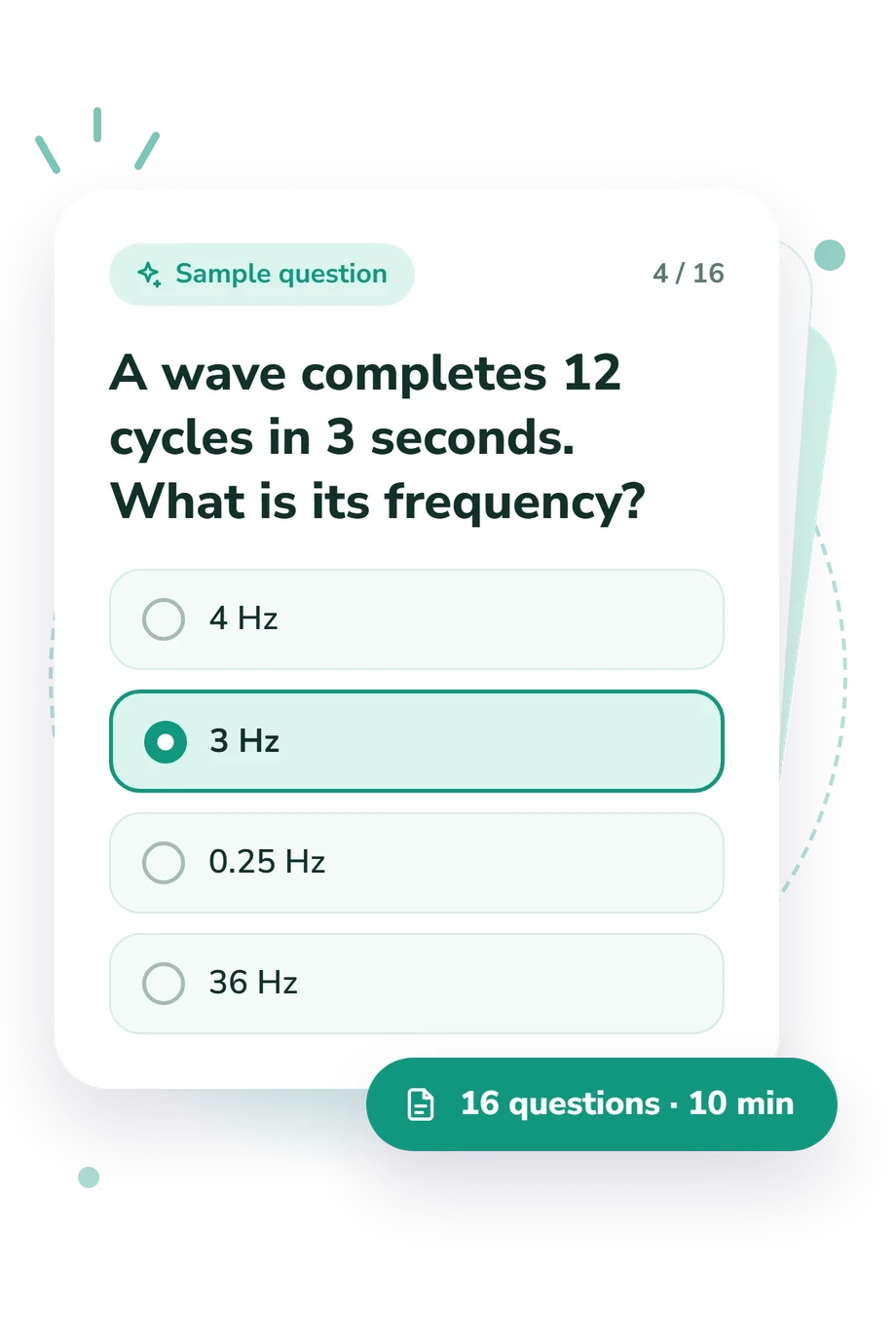
Example Questions From the Test
- The waves stop because the opening absorbs them
- The waves continue only as a perfectly narrow beam
- The waves reverse direction toward their source
- The waves spread noticeably through diffraction
- Refraction
- Reflection
- Diffraction
- Polarization
- The sound’s speed in water
- The vibration rate of the source
- The sound’s wavelength in water
- The density of the receiving material alone
Waves Quiz - Description and methodology of the test
Students, teachers, and curious learners who want to check their grasp of introductory wave physics can use the waves quiz as a focused knowledge check. This physics quiz on waves links familiar situations-echoes, changing depth, moving sources, and overlapping pulses-with the principles needed to explain them. The result indicates overall performance on the assessed fundamentals.
What This Test Measures
Questions connect definitions, equations, and observable behavior. They ask you to identify a wave phenomenon, relate quantities, or choose the explanation that fits a physical situation. This suits learners reviewing introductory physics, checking understanding after a lesson, or preparing for more formal problem solving.
The themes represented by the items are:
- Wave quantities show whether you can relate frequency, wavelength, amplitude, and speed.
- Wave behavior shows how well you recognize reflection, refraction, diffraction, interference, and the Doppler effect.
- Wave types and patterns show whether you can distinguish mechanical and electromagnetic waves, transverse motion, phase, superposition, and nodes.
Used as a wave practice quiz, it indicates performance on assessed fundamentals rather than measuring physics ability. The result is Waves Knowledge (0-16): Foundational (0-6), Developing (7-12), or Strong (13-16). These bands describe performance on the assessed fundamentals and applications.
Methodology and Evidence Base
Each item presents a physics situation or definition with four answer choices. Selecting the best explanation tests recognition and application in a compact multiple-choice format, while a calculation item checks whether the relevant relationship can be used. The displayed score awards one point for each correct answer.
Conceptually, the questionnaire is consistent with Mechanical Waves Conceptual Survey 2 (Barniol & Zavala, 2016), but it is not an adaptation of that published instrument. Its treatment of mechanical-wave concepts overlaps with the conceptual survey reported by Tongchai and colleagues (2009), while Urone and Hinrichs provide the standard introductory definitions and relationships used here.
As a wave knowledge test, it is most useful for locating topics that need clarification, not for estimating standing against a norm group. Its score has no stated population norms or clinical interpretation, and performance can shift with guessing, rushed choices, current study context, and how confidently a learner recognizes the underlying concept.
Use the result to guide review of wave quantities, medium-dependent behavior, or superposition, then return to the explanations behind any missed answer.
- Pablo Barniol and Genaro Zavala, "Mechanical waves conceptual survey: Its modification and conversion to a standard multiple-choice test," Physical Review Physics Education Research 12, no. 1 (2016): 010107. 10.1103/PhysRevPhysEducRes.12.010107
- Apisit Tongchai, Manjula D. Sharma, Ian D. Johnston, Kwan Arayathanitkul, and Chernchok Soankwan, "Developing, evaluating and demonstrating the use of a conceptual survey in mechanical waves," International Journal of Science Education 31, no. 18 (2009): 2437-2457. 10.1080/09500690802389605
- Paul Peter Urone and Roger Hinrichs, College Physics 2e, OpenStax, Houston, Texas, 2022.
Updated: