
Am I Obsessed with My Crush Quiz
How the Scales are Structured
Who Usually Takes This Test?
See How You Compare
Below is a preview of how scores are typically distributed across each scale.
Example Questions From the Test
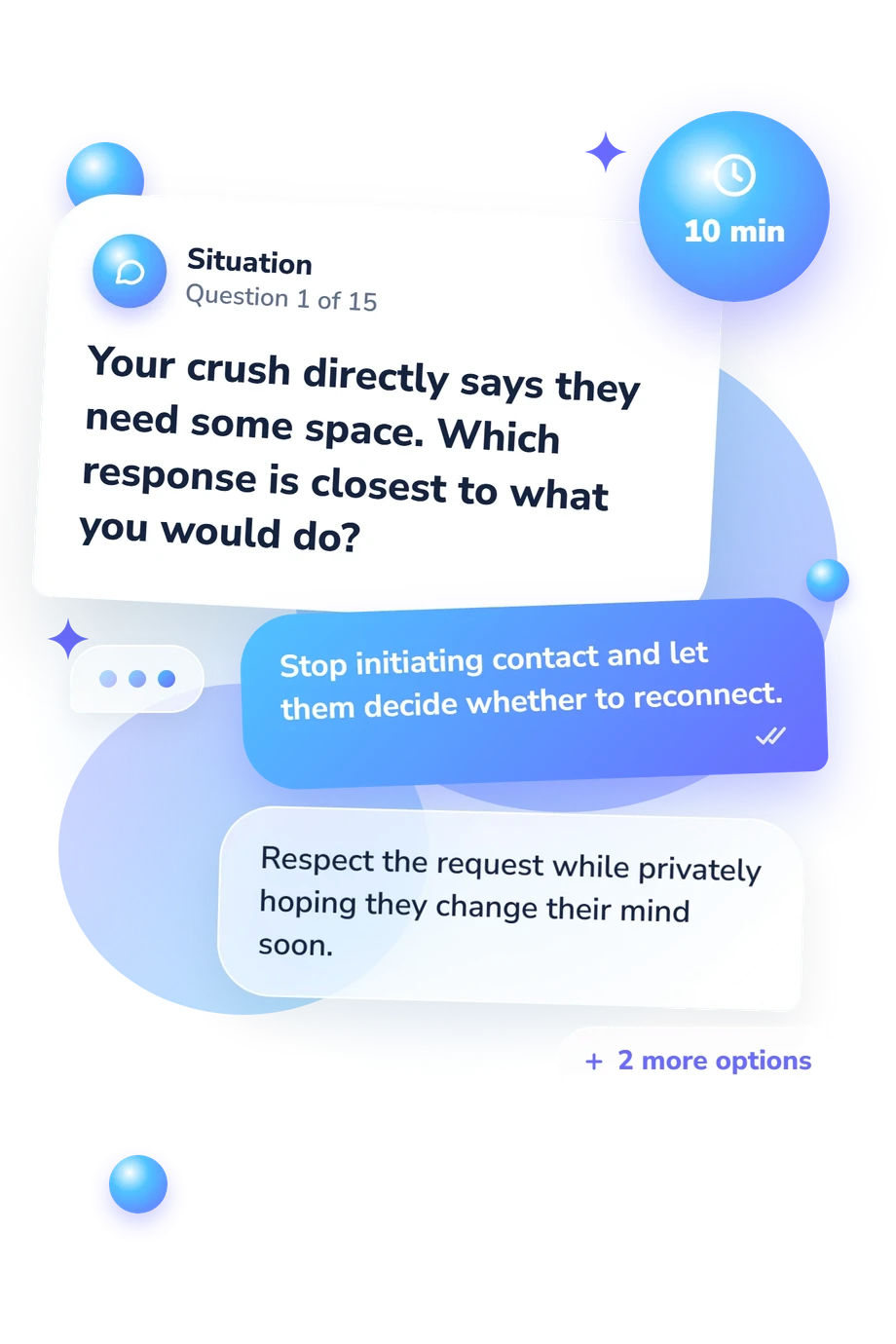
- Stop initiating contact and let them decide whether to reconnect.
- Respect the request while privately hoping they change their mind soon.
- Look for indirect reasons to interact while avoiding an explicit conversation about the request.
- Continue contacting them because staying connected feels more urgent than the request.
- Wait and let them choose whether and when to respond.
- Consider one follow-up later if there is a practical reason.
- Send another message mainly to reduce my uncertainty.
- Keep trying through repeated messages or another channel because waiting feels unbearable.
- I may look when something appears naturally in my feed.
- I sometimes visit their profile out of curiosity.
- I check several times or look for clues about what they are doing and feeling.
- I repeatedly monitor posts, activity, or connections even when I intend to stop.
Am I Obsessed with My Crush Quiz - Description and methodology of the test
People who feel pulled toward a crush and wonder whether interest is crowding out life can use this assessment for structured self-reflection. The Am I Obsessed with My Crush Quiz focuses on patterns and shows where the crush may affect mood, focus, or daily choices. Its three dimensions separate emotional reliance, attention, and boundaries, making this a quiz about whether it is a crush or obsession.
What This Assessment Explores
Current crushes matter when thoughts, mood, checking, contact attempts, or choices feel hard to regulate. The assessment looks at emotional reliance, recurring attention, whether routines and commitments remain intact, and whether privacy and requests for space are respected. Together, this quiz asks whether you are obsessed with your crush by examining attention, mood, and behavior centered on them.
These are the three dimensions in the result:
- Emotional Dependence (0-15) shows how attention or reassurance may shape mood and self-worth: Independent footing (0-5), Emotionally invested (6-10), or Emotionally anchored (11-15).
- Life Balance and Boundaries (0-15) shows whether routines and commitments remain intact and privacy and requests for space are respected: Maintained balance (0-5), Some displacement (6-10), or Significant displacement (11-15).
- Mental Preoccupation (0-15) shows how easily thoughts can be set aside: Flexible focus (0-5), Recurring focus (6-10), or Consuming focus (11-15).
Methodology and Scientific Basis
Each item presents a situation-such as a request for space, an unanswered message, social-media checking, imagined conversations, sleep, or a competing commitment-with four response choices. Options vary in emotional impact, attention capture, contact pressure, and disruption. Answer from typical behavior, not an idealized self-image.
Responses combine into three profile dimensions, giving a separate result for each rather than one global label. Comparing them distinguishes attraction from preoccupation, emotional dependence, and displacement of routines or boundaries, clarifying the central question addressed by this crush or obsession quiz. Do not infer point values from answer order or wording.
LQ-11 is the closest conceptual reference, a published measure of limerence-related experience. Research on limerence and measure validation adds context, while SORI-Q addresses obsessive relational intrusion and boundary-related behavior. This questionnaire is conceptually consistent with those sources, not an adaptation or validation of them.
The bands are unvalidated reflective summaries, and self-report shifts with mood, memory, and self-awareness. A score cannot override another person's request for space; persistent distress or inability to respect boundaries calls for support beyond the result.
- Marshall, Lynn, Daniel Waldeck, Luca Pancani, Susan Churchill, and Ian Tyndall. "Development and Validation of the Limerence Questionnaire (LQ-11)." Psychological Reports, advance online publication, 2025, 1-21. 10.1177/00332941251394980
- Wolf, Noah R. "Investigating Limerence: Predictors of Limerence, Measure Validation, and Goal Progress." Master's thesis, University of Maryland, College Park, 2017. 10.13016/M2X921M0C
- Gamache, Dominick, Claudia Savard, Jonathan Faucher, and Marie-Eve Cloutier. "Development and Validation of the Stalking and Obsessive Relational Intrusions Questionnaire (SORI-Q)." Journal of Interpersonal Violence, 37(21-22), 2022, NP19420-NP19446. 10.1177/08862605211042808
Updated: