
What Do People Think of Me Quiz
How the Scales are Structured
Who Usually Takes This Test?
See How You Compare
Below is a preview of how scores are typically distributed across each scale.
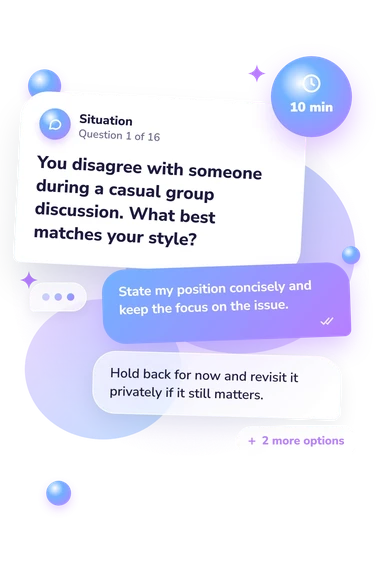
Example Questions From the Test
- Ask a practical question about what happens next.
- Offer a brief but sincere congratulations.
- Mention something specific that makes the achievement meaningful.
- Celebrate openly and encourage them to tell you the full story.
- Shift attention toward the team, circumstances, or another topic.
- Say thank you briefly and move on.
- Accept the compliment and mention one part I enjoyed creating.
- Receive it comfortably and share my enthusiasm about what worked.
- Head toward the activity or task that brought me there.
- Acknowledge the people I already know well.
- Greet whoever is nearby before settling in.
- Start an exchange that makes it easy for several people to join.
What Do People Think of Me Quiz - Description and methodology of the test
People who want to understand the impression their everyday choices create can use the What Do People Think of Me Quiz as a structured self-reflection exercise. It suits anyone curious about how confidence, dependability, attentiveness, and warmth may appear in ordinary interactions. Rather than claiming access to another person's mind, it organizes behavioral tendencies into a readable profile. It offers a concrete way to reflect on what others think of me in recurring situations.
What This Assessment Explores
The scenarios focus on observable choices: speaking up, handling commitments, noticing social shifts, remembering details, entering groups, and making room for others. The result describes social signals, not fixed character or personal worth. It makes what do you think of me a question about four tendencies rather than one global opinion.
The four displayed dimensions organize those patterns as follows:
- Confident & Expressive (0-12) indicates visible assurance and self-expression: Reserved Presence (0-4), Selective Voice (5-8), or Visible Spark (9-12).
- Reliable & Grounded (0-12) reflects consistency and follow-through: Flexible Operator (0-4), Steady Contributor (5-8), or Dependable Anchor (9-12).
- Thoughtful & Observant (0-12) reflects attention to nuance: In-the-Moment Style (0-4), Attentive Balance (5-8), or Quiet Perception (9-12).
- Warm & Approachable (0-12) reflects openness: Quiet Welcome (0-4), Easy Connection (5-8), or Open Invitation (9-12).
Methodology and Scientific Basis
Methodologically, the questionnaire uses 16 situational self-report items with four response options. The choices represent different levels of initiative, planning, observation, or interpersonal openness within each scenario. Responses become four displayed scores; the strongest outcome marks the strongest affinity, while scores within one point form a blended impression. This scoring describes reported habits rather than fixed personality.
Interpretation is conceptually consistent with Funder and Sneed (1993), whose work connects observable behavior with the accuracy of social judgment. Barrett and Pietromonaco (1997) support the relevance of broad personality characteristics to perceptions of daily interactions, and Soto and John (2017) show how broad traits can be organized hierarchically. These sources support the framework, not authorship or validation of this online questionnaire.
Results are best read as tendencies in how people perceive you in the situations described. Self-report can be affected by memory, self-awareness, mood, and the context imagined while answering, and this online version presents no norms or validation statistics. It cannot establish what a particular person thinks, so use it as one perspective alongside lived interactions.
- David C. Funder and Carl D. Sneed (1993). Behavioral manifestations of personality: An ecological approach to judgmental accuracy. Journal of Personality and Social Psychology, 64(3), 479-490. 10.1037/0022-3514.64.3.479
- Lisa Feldman Barrett and Paula R. Pietromonaco (1997). Accuracy of the Five-Factor Model in Predicting Perceptions of Daily Social Interactions. Personality and Social Psychology Bulletin, 23(11), 1173-1187. 10.1177/01461672972311005
- Christopher J. Soto and Oliver P. John (2017). The next Big Five Inventory (BFI-2): Developing and assessing a hierarchical model with 15 facets to enhance bandwidth, fidelity, and predictive power. Journal of Personality and Social Psychology, 113(1), 117-143. 10.1037/pspp0000096