
Japanese Name Quiz
How the Scales are Structured
Who Usually Takes This Test?
See How You Compare
Below is a preview of how scores are typically distributed across each scale.
Example Questions From the Test
- Family name followed by given name
- Given name followed by family name
- Given name alone, followed by an honorific
- Honorific followed by family name and given name
- They must write their names with the same characters
- Their names may use different kanji and carry different meanings
- They must pronounce their names differently
- Yuki can only be a family name
- Mori-chan
- Mori-sensei
- Sensei-san Mori
- Mori-sama in ordinary classroom conversation
Japanese Name Quiz - Description and methodology of the test
People who want to understand Japanese personal names, whether for study, travel, or respectful everyday communication, can use this assessment as a focused guide. The Japanese Name Quiz checks practical cultural knowledge rather than producing a name for you. Its result shows which conventions you recognize and where further attention may make reading, introducing, and addressing people more confident.
What This Assessment Explores
The questions examine how Japanese names are written, read, ordered, and used in social settings. They suit learners who encounter names in forms, classrooms, media, or conversation. When considering Japanese name meanings, kanji associations do not by themselves reveal a person's occupation, character, or ancestry.
The main themes are:
- The first theme, Japanese name order, shows how family and given names can be distinguished in Japanese and Latin-letter presentations.
- Kanji, readings, and scripts explain why characters, pronunciation guides, katakana, and intended readings carry different information.
- Romanization, address forms, and seals show how spelling conventions and terms such as -san, -chan, -sensei, and inkan work in context.
The scale is Japanese Name Knowledge: 0-16. Foundations to Build covers 0-6, Developing Knowledge covers 7-12, and Strong Cultural Knowledge covers 13-16. The result indicates how consistently you recognize the conventions tested.
Methodology and Evidence Base
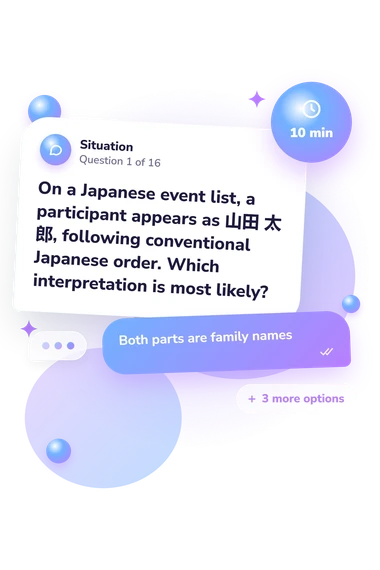
Each prompt presents a brief naming situation and four answer choices. You select the most accurate interpretation, so the result reflects recognition of conventions rather than written translation or open-ended explanation. No separate item-weighting rule is stated; read the displayed total as an overall indicator of knowledge rather than a formula to reproduce.
As an online self-report knowledge questionnaire, this assessment is conceptually consistent with Koop and Inada (2005) on name order, readings, and romanization, but it is not an adaptation of that manual. Gender-linked naming patterns connect with Baresova, Nakaya, and Matlach (2024), while Japanese honorifics such as -san, -kun, and -chan align with the variation described by Oshima (2023).
This questionnaire is not a standardized, norm-referenced scale, so its score is a snapshot of familiarity with the selected topics. Prior study, guessing, and uncertainty about a person's preferred presentation can affect performance; a result cannot establish fluency or predict how someone will use every name in real interaction. Careful confirmation of a person's reading or form of address can turn mistakes into specific learning goals.
- Koop, Albert J., and Hogitaro Inada. Japanese Names and How to Read Them: A Manual for Art Collectors and Students. Routledge, 2005. 10.4324/9780203040812.
- Baresova, Ivona, Tereza Nakaya, and Vladimir Matlach. “Gender-specific features in contemporary Japanese names.” Digital Scholarship in the Humanities 39, no. 2 (2024): 467-484. 10.1093/llc/fqae022.
- Oshima, David Y. “The semantics and sociopragmatics of the Japanese honorific titles san, kun, and chan: Some focal points of variation.” Journal of East Asian Linguistics 32, no. 2 (2023): 169-200. 10.1007/s10831-023-09255-9.
Updated: