
What Dating App Should I Use Quiz
How the Scales are Structured
Who Usually Takes This Test?
See How You Compare
Below is a preview of how scores are typically distributed across each scale.
Example Questions From the Test
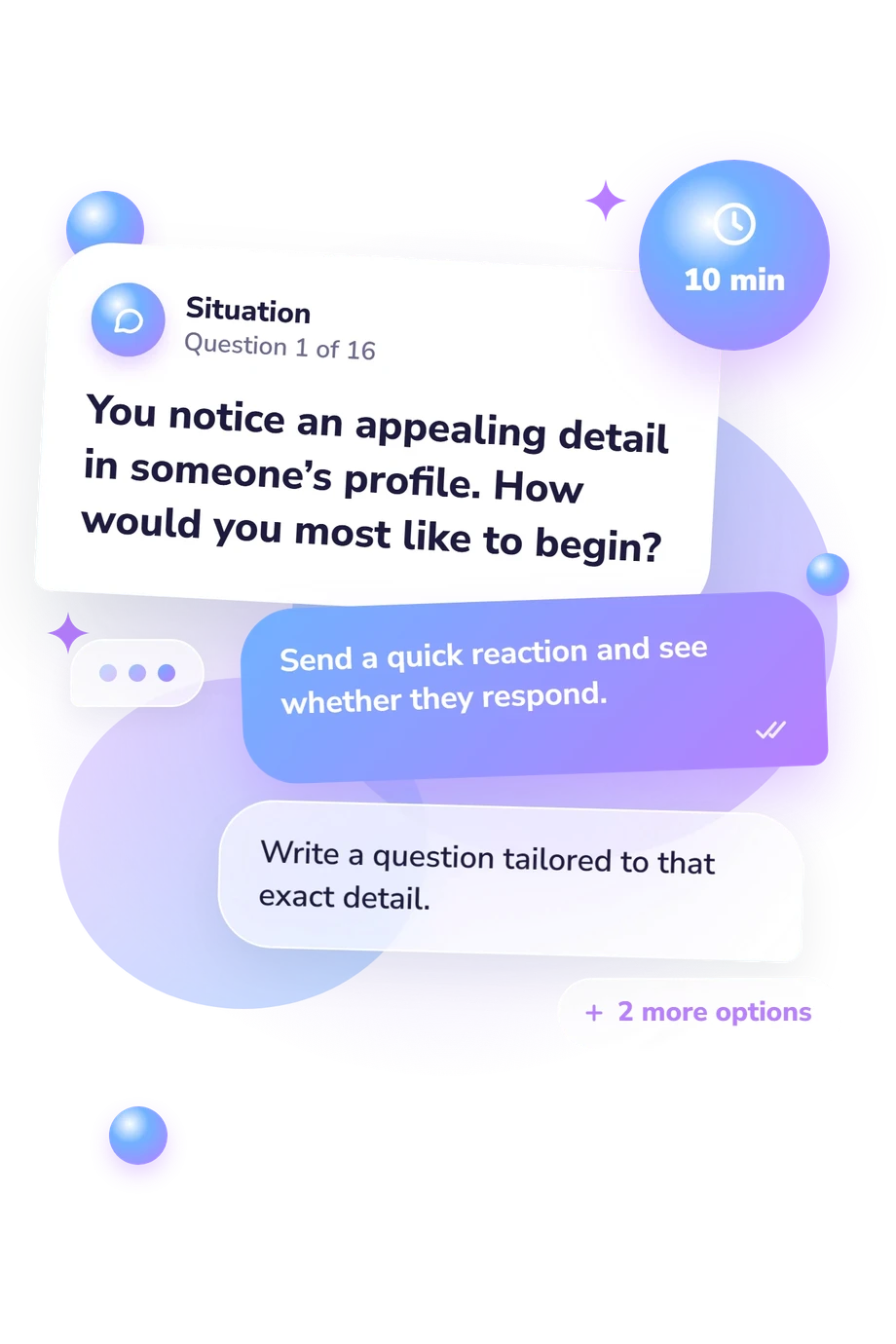
- Send a quick reaction and see whether they respond.
- Write a question tailored to that exact detail.
- Use a friendly greeting before getting specific later.
- Mention the detail briefly and add a playful comment.
- Keeping many brief chats moving at the same time.
- Starting broadly, then focusing on whichever chats gain momentum.
- Maintaining several conversations with attention to each profile.
- Concentrating on a small number of thoughtful exchanges.
- A detailed explanation of their values and worldview.
- A mix of basic information and overall presentation.
- An immediate visual impression or sense of energy.
- A thoughtful prompt that reveals how they communicate.
What Dating App Should I Use Quiz - Description and methodology of the test
People unsure how much profile detail, speed, initiative, or relationship direction they want can use this assessment to organize those preferences. The What Dating App Should I Use Quiz connects everyday dating-app choices with four recognizable app styles, helping a reader see where their habits may fit rather than declaring one universally correct option. It is also a useful dating app quiz for clarifying priorities before trying a platform.
What This Assessment Explores
Instead of predicting dating success, the questionnaire explores how you prefer to discover people and begin interaction. It covers profile effort, compatibility detail, conversational initiative, browsing pace, identity expression, credibility cues, and relationship intentions. It suits readers comparing app styles through preferences, including anyone wondering which dating app is best for me.
These are the displayed dimensions and their bands:
- Bumble (0-12) measures affinity for initiative, clear choices, and considerate boundaries: Limited affinity 0-4; Possible fit 5-8; Strong affinity 9-12.
- Hinge (0-12) measures affinity for thoughtful profiles, tailored openings, and intentional connection: Limited affinity 0-4; Possible fit 5-8; Strong affinity 9-12.
- OkCupid (0-12) measures affinity for nuanced self-expression, values, and detailed compatibility information: Limited affinity 0-4; Possible fit 5-8; Strong affinity 9-12.
- Tinder (0-12) measures affinity for quick discovery, broad browsing, and flexible connection: Limited affinity 0-4; Possible fit 5-8; Strong affinity 9-12.
Methodology and Evidence Base
Each item offers four response options covering browsing pace, profile effort, conversation, compatibility information, and relationship intentions. The chosen option contributes to app-specific affinity scores rather than one overall personality score. The highest score is the strongest fit; scores within one point indicate a blended result.
Someone asking which dating app should I use gets a structured comparison rather than a universal ranking. Hawkins and DeLuca Bishop (2025) offers the closest empirical context because it examines motivations among Tinder, Bumble, and Hinge users. This questionnaire is conceptually consistent with that work, not an adaptation of it. Parry, Filice, and Johnson (2024) situates app design and algorithmic assumptions, while Timmermans and De Caluwé (2017) provides a published example of measuring motives related to Tinder use.
It is an online self-reflection questionnaire, not a standardized clinical instrument, and its scoring has no stated population norms or diagnostic cutoffs. Results may shift with current goals, mood, previous experiences, and self-perception. A reader seeking the best dating app for me should use the profile as a starting point for comparing features and interaction cultures.
- Hawkins, Sophie E., and Haylee K. DeLuca Bishop. Dating App Motivations in Emerging Adulthood: Motivations Across Tinder, Bumble, and Hinge Users. Sexuality & Culture, 29(5), 2397-2415, 2025. 10.1007/s12119-025-10375-8
- Parry, Diana C., Eric Filice, and Corey W. Johnson. Algorithmic heteronormativity: Powers and pleasures of dating and hook-up apps. Sexualities, 27(8), 1589-1607, 2024. 10.1177/13634607221144626
- Timmermans, Elisabeth, and Elien De Caluwé. Development and validation of the Tinder Motives Scale (TMS). Computers in Human Behavior, 70, 341-350, 2017. 10.1016/j.chb.2017.01.028
Updated: