
Macroeconomics Quiz
How the Scales are Structured
Who Usually Takes This Test?
See How You Compare
Below is a preview of how scores are typically distributed across each scale.
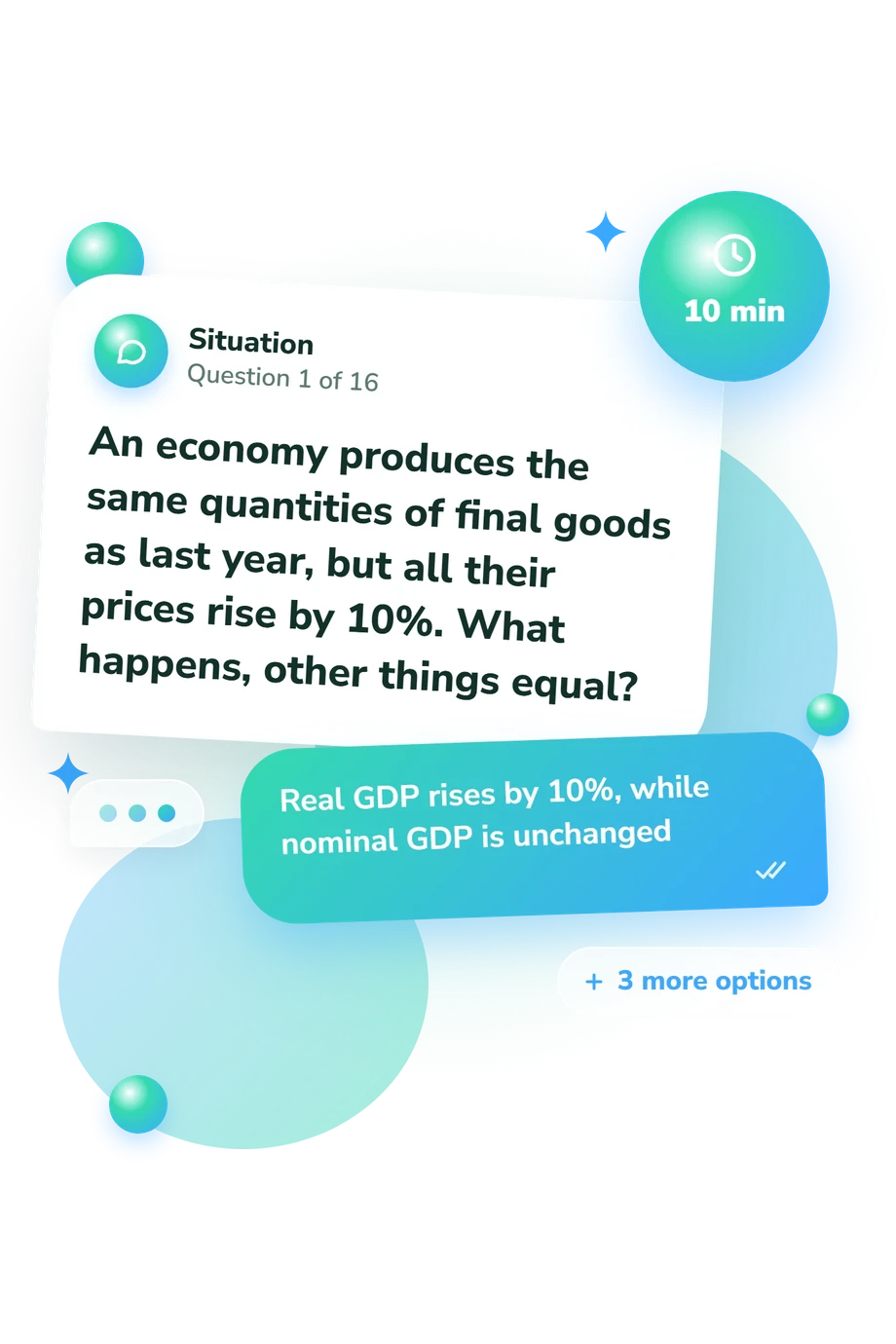
Example Questions From the Test
- Buying government securities to increase bank reserves
- Cutting taxes to increase disposable income
- Selling government securities to reduce bank reserves
- Increasing government purchases to raise aggregate demand
- A one-time tariff introduced during a downturn
- A newly approved infrastructure package
- A central bank’s emergency interest-rate decision
- Unemployment insurance payments
- 5%
- 10%
- 2%
- 20%
Macroeconomics Quiz - Description and methodology of the test
Students, instructors, and independent learners can use this macroeconomics quiz to check whether core ideas in national output, inflation, unemployment, policy, growth, and trade are understood well enough for further study. It is especially suitable for someone seeking a macroeconomics practice quiz before a class discussion or exam, with the result pointing to topics that deserve review rather than merely producing a percentage.
What This Assessment Explores
Questions cover GDP, prices, unemployment, productivity, trade, exchange rates, fiscal and monetary policy, and aggregate demand-supply effects. They require distinctions and short calculations rather than personal opinions.
This is a macroeconomic quiz with answers in which each selected response reflects a particular principle or model. Its thematic groups are:
- National accounting and prices show how you handle GDP, inflation, and the GDP deflator.
- Policy, growth, labor, and trade show how you connect tools with outcomes.
- Macroeconomic models show how you apply the multiplier, Phillips curve, and aggregate demand-aggregate supply framework.
Results use one catalogue scale: Macroeconomics Knowledge (0-16). Foundation to build (0-6) suggests reviewing core measures, models, and policy tools; Developing knowledge (7-12) means many principles are understood, though some distinctions or calculations remain difficult; Strong knowledge (13-16) indicates a well-rounded command of central concepts and their application.
Methodology and Scientific Basis
Each item presents four answer choices, and one point is awarded for each correct answer. The total counts correct responses across the set; the scoring description gives no separate weighting or penalty.
The content is conceptually consistent with the Test of Economic Literacy (Walstad et al., 2013), an objective economics knowledge instrument, and with the revision and pretest work of Walstad and Soper (1988). This questionnaire is not presented as an adaptation or administration of either published version.
An economic knowledge assessment can help locate gaps in national income accounting, stabilization policy, growth, labor markets, international trade, and short-run models. Correct answers can show recognition without proving transfer to a new situation, so review the reasoning behind missed items rather than treating the total as complete expertise.
This online self-reflection tool has no reported standardized administration or published norms for these results. Performance may vary with prior coursework, current concentration, wording interpretation, and self-assessment, making targeted revision its strongest use.
- Walstad, William B., Ken Rebeck, and Roger B. Butters. "The Test of Economic Literacy: Development and Results." The Journal of Economic Education, 44(3), 298-309, 2013. 10.1080/00220485.2013.795462
- Walstad, William B., and John C. Soper. "What Is High School Economics? TEL Revision and Pretest Findings." The Journal of Economic Education, 19(1), 24-36, 1988. 10.1080/00220485.1988.10845241
Updated: