
Adopt Me Quiz
How the Scales are Structured
Who Usually Takes This Test?
See How You Compare
Below is a preview of how scores are typically distributed across each scale.
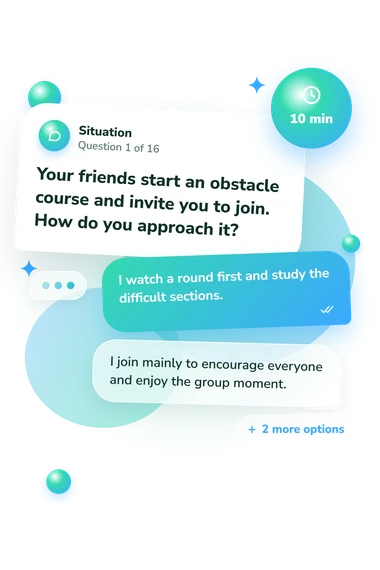
Example Questions From the Test
- Pause and work out exactly what caused the problem.
- Switch to an exciting new goal and get everyone moving again.
- Try a different approach while keeping part of the original plan.
- Let someone else choose the next activity while I adapt.
- Read the details and look for patterns before choosing a task.
- Start with the task that appears easiest to understand.
- Follow friends into whichever task they have selected.
- Jump into the busiest task and learn while moving.
- Keeping track of details that everyone else might miss.
- Leading the group toward the next big objective.
- Adding energy and stepping forward when action is needed.
- Helping individual players with whatever they are doing.
Adopt Me Quiz - Description and methodology of the test
Players who want to understand their in-game preferences can use this playful assessment to connect everyday choices with a pet-style profile. The Adopt Me Quiz What Pet Are You focuses on preferences rather than skill, rarity, or trading knowledge. For readers taking the What Adopt Me Pet Am I Quiz, the result shows whether their style leans toward bold action, flexible problem-solving, careful observation, or imaginative warmth.
What This Assessment Explores
The items turn moments into preference cues involving obstacles, plans, exploration, design, helping, and trades. When someone takes the What Pet Are You in Adopt Me Quiz, the result describes tendencies rather than ability; the highest score identifies the leading profile, while totals within one point indicate a blend.
The result shows four profiles:
- Dragon (0-12) measures bold momentum, courage, competition, and self-expression; Measured Flame (0-4), Rising Fire (5-8), and Dragon Affinity (9-12) show levels.
- Kitsune (0-12) measures resourcefulness, flexible strategy, distinctive style, and freedom; Steady Path (0-4), Clever Turn (5-8), and Kitsune Affinity (9-12) show levels.
- Owl (0-12) measures patient decisions, cozy routines, and noticing details; Open Skies (0-4), Thoughtful Perch (5-8), and Owl Affinity (9-12) show levels.
- Unicorn (0-12) measures imagination, encouragement, and magical touches; Grounded Spark (0-4), Gentle Glow (5-8), and Unicorn Affinity (9-12) show levels.
Methodology and Evidence Base
Each item presents a familiar Adopt Me situation with four response options. The choices contrast approaches to action, planning, flexibility, observation, support, creativity, and social play, making the format a preference exercise rather than a knowledge test. The format supports the playful purpose of the Which Adopt Me Pet Are You Quiz, connecting the profile to concrete in-game choices.
Methodologically, the profile is conceptually consistent with BrainHex (Nacke et al., 2014), which distinguishes player motivations and styles, and with Park and Henley (2007), who linked personality with fantasy-game character preferences. These are comparison points, not evidence that this questionnaire is an adaptation or validation of either published instrument.
Scoring compares the four pet totals, identifies the highest affinity, and treats totals within one point as blended. No standardized norms or clinical cutoffs are stated, so the labels describe preference intensity rather than a fixed identity. Self-report can vary with mood and interpretation; Holden, Wheeler, and Marjanovic (2012) show that random responding can distort personality scores, making thoughtful answers important. Read the outcome as a reflective snapshot.
- Nacke, Lennart E., Chris Bateman, and Regan L. Mandryk. "BrainHex: A Neurobiological Gamer Typology Survey." Entertainment Computing 5, no. 1 (2014): 55-62. 10.1016/j.entcom.2013.06.002
- Park, Anna E., and Tracy B. Henley. "Personality and Fantasy Game Character Preferences." Imagination, Cognition and Personality 27, no. 1 (2007): 37-46. 10.2190/IC.27.1.d
- Holden, Ronald R., Sarah Wheeler, and Zdravko Marjanovic. "When Does Random Responding Distort Self-Report Personality Assessment? An Example with the NEO PI-R." Personality and Individual Differences 52, no. 1 (2012): 15-20. 10.1016/j.paid.2011.08.021
Updated: