
Am I Gross Quiz
How the Scales are Structured
Who Usually Takes This Test?
See How You Compare
Below is a preview of how scores are typically distributed across each scale.
Example Questions From the Test
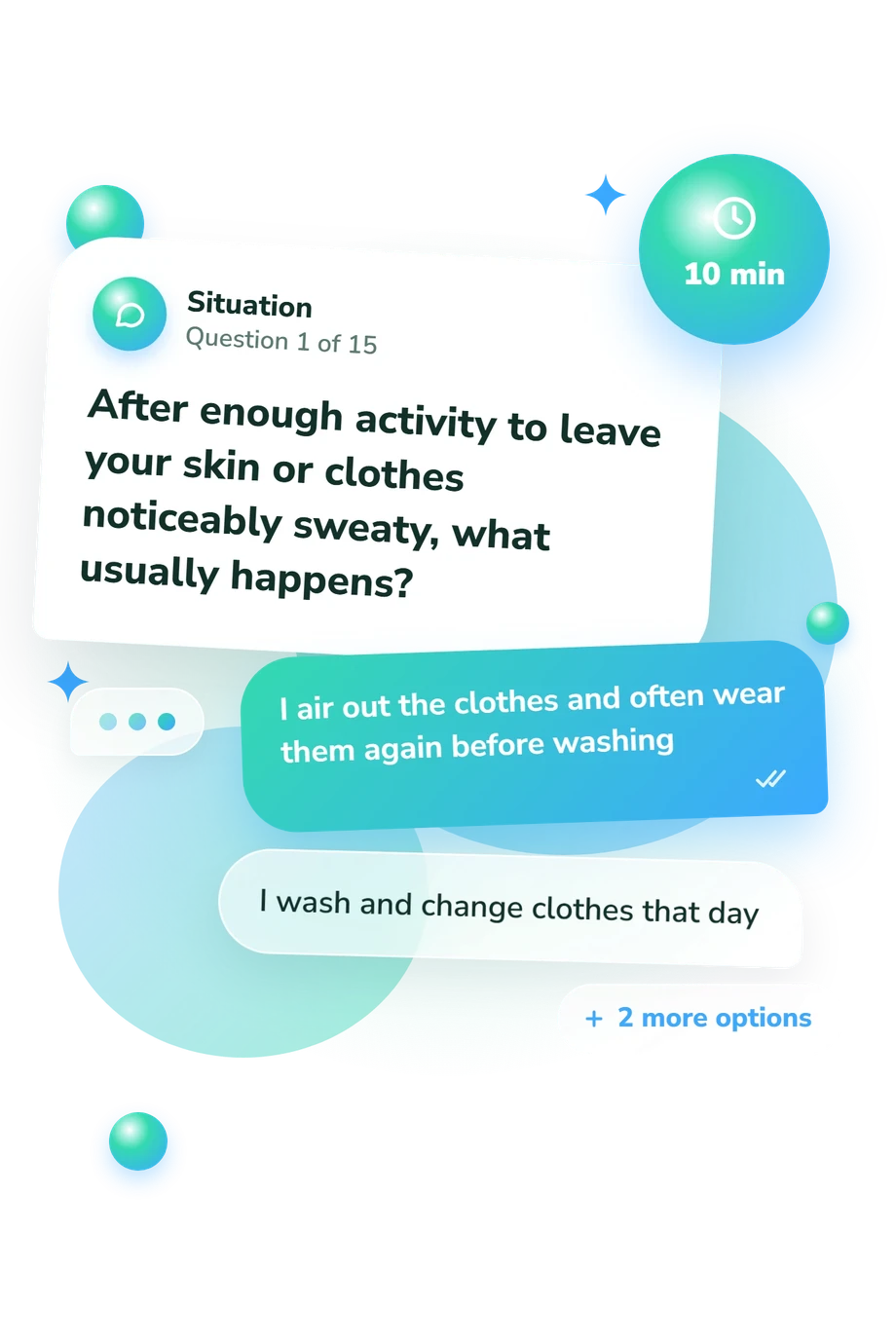
- I air out the clothes and often wear them again before washing
- I wash and change clothes that day
- I wait for my usual wash time, even if some odor remains
- I change clothes and wash key areas, then take a full wash later
- Leave it until its owner or another person handles it
- Discard it and clean the affected shelf
- Move or contain it, then clean the area later
- Ask the likely owner and wait for a response before acting
- Leave it until I next need the pot or sink
- Rinse or soak it and finish cleaning the next morning
- Clean it or place it in the dishwasher before leaving
- Let it remain for several days if nobody asks about it
Am I Gross Quiz - Description and methodology of the test
For people who want a candid look at everyday habits that may affect comfort, cleanliness, or shared living, the Am I Gross Quiz turns familiar situations into a structured self-reflection exercise. As a gross quiz, it focuses on patterns that can be adjusted, not on labeling someone as good or bad. The format turns practical behaviors into a structured self-reflection exercise, helping identify one or two routines worth changing first.
What This Assessment Explores
Questions address washing and grooming, shared-area upkeep, food and bathroom habits, and bodily behavior around others. It suits general self-reflection; the result describes reported patterns rather than a permanent character trait.
The displayed scales show:
- Personal Hygiene Consistency (0-15) covers routine washing, clothing changes, and oral care: Steady routine (0-5), Inconsistent routine (6-10), Repeated gaps (11-15).
- Shared-Space Cleanliness (0-15) covers responses to spills, dishes, waste, and residue: Prompt upkeep (0-5), Delayed upkeep (6-10), Accumulating mess (11-15).
- Social and Sensory Boundaries (0-15) covers adjustment of grooming, bodily functions, and graphic topics: Boundary-aware (0-5), Audience-dependent (6-10), Frequent boundary friction (11-15).
Viewed as a how gross am I quiz, the result is a profile of situations rather than a judgment, while allowing for differences in culture, health, resources, household expectations, and relationships.
Methodology and Scientific Basis
Each item presents an everyday scenario with four response options. The choices distinguish timing, context, discretion, and reactions to feedback, so the questionnaire samples practical patterns rather than one global self-rating. Answers are converted into three scale scores; since point values for individual options are not stated, no finer scoring rule should be inferred.
Conceptually, the hygiene items are consistent with Hygiene Inventory (HI23), the shared-home content aligns with Larson and colleagues’ home-hygiene assessment, and the social section reflects evidence that hygiene judgments vary across cultures and relationships. This questionnaire is an original self-reflection tool and has not been standardized; the published instruments are conceptual comparators, not sources of norms for this result.
Self-report may be shaped by memory, social desirability, current stress, living arrangements, and access to facilities. Handwashing self-report research illustrates a possible reporting bias, but it does not validate these scores or establish their accuracy. The framing of this quiz as a how gross are you quiz can invite self-judgment, so use the result to review one routine or shared-space behavior against respectful feedback and the setting’s realities.
- Stevenson RJ, Case TI, Hodgson D, Porzig-Drummond R, Barouei J, Oaten MJ. A scale for measuring hygiene behavior: development, reliability and validity. American Journal of Infection Control. 2009;37(7):557-564. 10.1016/j.ajic.2009.01.003
- Larson EL, Gomez-Duarte C, Qureshi K, Miranda D, Kain DJ, Cablish KL. How clean is the home environment?: a tool to assess home hygiene. Journal of Community Health Nursing. 2001;18(3):139-150. 10.1207/S15327655JCHN1803_01
- Lin S-Y, Lin C-Y, Hsin M-C. Comparison of social and culture based risk perception of personal hygiene behaviours. Heliyon. 2018;4(10):e00839. 10.1016/j.heliyon.2018.e00839
- Contzen N, De Pasquale S, Mosler H-J. Over-Reporting in Handwashing Self-Reports: Potential Explanatory Factors and Alternative Measurements. PLOS ONE. 2015;10(8):e0136445. 10.1371/journal.pone.0136445
Updated: