
Vet Assistant Quiz
How the Scales are Structured
Who Usually Takes This Test?
See How You Compare
Below is a preview of how scores are typically distributed across each scale.
Example Questions From the Test
- Away from the body's midline
- Toward the tail
- Toward the body's midline
- Toward the head
- A disease found only in zoo animals
- An illness caused only by contaminated animal food
- A hereditary condition limited to one animal breed
- A disease that can be transmitted between animals and humans
- Apply to the skin
- Administer into a muscle
- Administer by mouth
- Place into the ear canal
Vet Assistant Quiz - Description and methodology of the test
People preparing for veterinary support work can use this vet assistant quiz to check their overall grasp of everyday clinic decisions. Learners, applicants, and assistants may use the veterinary assistant test to orient review before supervised practice. The result is an unvalidated educational score, so its band cannot establish hands-on competence or authorization for clinical tasks.
What This Assessment Measures
This veterinary assistant quiz examines knowledge for safe clinic support. It suits people entering veterinary work and assistants reviewing expectations. Items address terminology, infection control, records, medication directions, emergency escalation, animal handling, and boundaries rather than personality or diagnosis.
Results appear on the Vet Assistant Knowledge scale, ranging from 0-16. Foundations to build covers 0-6, Developing knowledge covers 7-12, and Strong knowledge covers 13-16. Rather than a topic profile, the overall band can help a learner decide whether foundational review or more supervised learning would be useful.
The questions cover these themes:
- Terminology shows how well you recognize anatomical and disease language.
- Infection control and documentation indicate understanding of hygiene, isolation, and transparent records.
- Medication safety and escalation reflect routes, storage, dose calculations, and responses to risk.
- Handling and boundaries show how choices protect welfare and respect the veterinarian’s role.
Methodology and Evidence Base
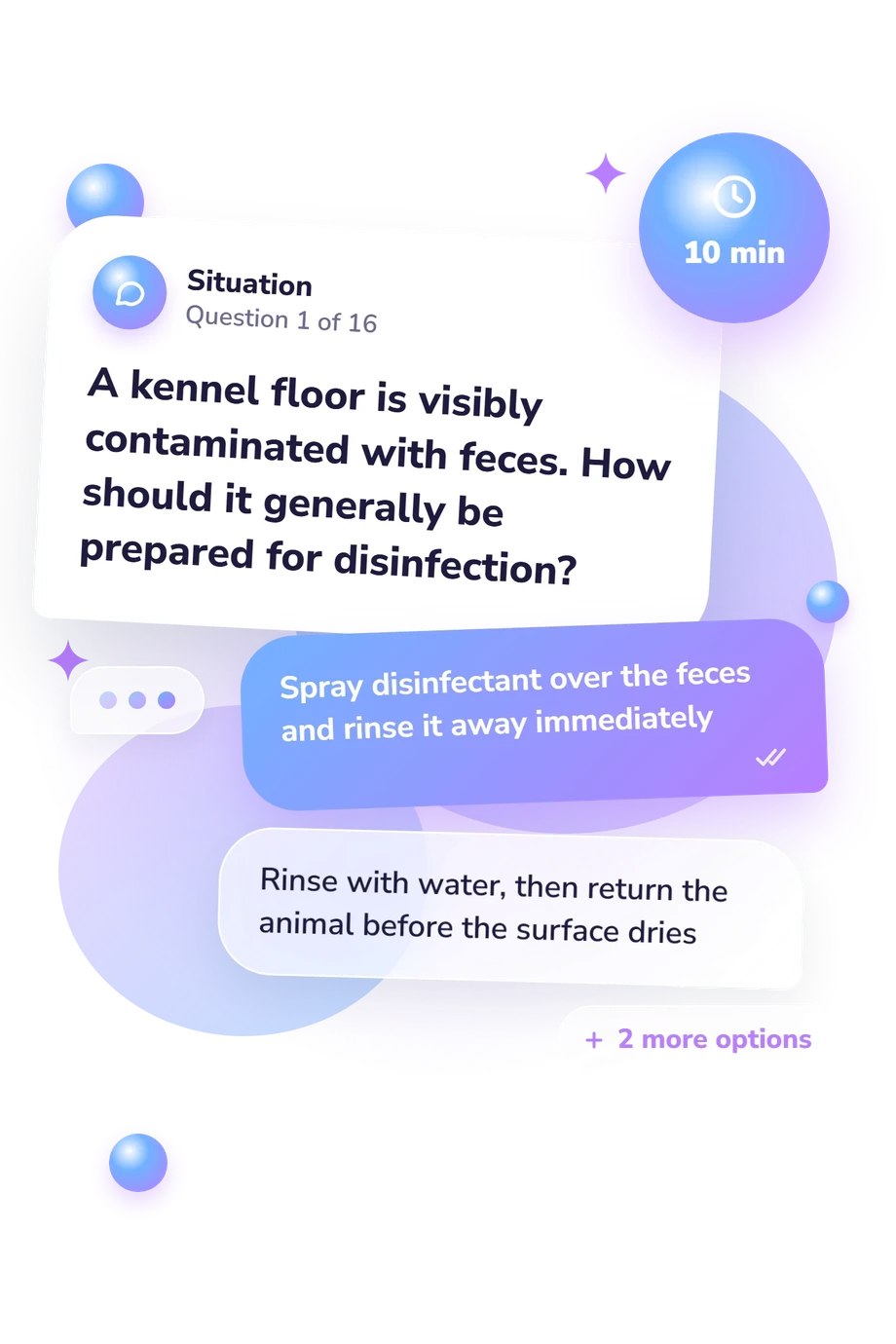
Each item presents four answer choices. Some ask for direct terminology or procedure knowledge, while others describe a brief workplace situation requiring the safest response. The result is presented as an unvalidated educational score with the displayed bands; its point-calculation and norming procedure are not documented.
For study planning, the vet assistant knowledge test can help learners decide whether foundational review or supervised learning would be useful. Veterinary Assistant assessment (8619) is a related content reference for foundational duties and safety decisions. The questionnaire is conceptually consistent with Burns and Renda-Francis (2022), while its cat-handling content aligns with interaction principles described by Rodan et al. (2022). These references address subject coverage; they do not establish that this online questionnaire was adapted, standardized, or validated from them.
During supervised learning, it can direct revision and help learners use clinic protocols responsibly. Results can reflect prior study, wording interpretation, and the situation-based format.
- Oklahoma Department of Career and Technology Education, CareerTech Testing Center. Veterinary Assistant Study Guide: Assessment 8619. Stillwater, OK: Oklahoma Department of Career and Technology Education; 2021.
- Burns, Kara M., and Lori Renda-Francis. Textbook for the Veterinary Assistant. 2nd ed. Hoboken, NJ: Wiley-Blackwell; 2022. ISBN 978-1-119-56531-4.
- Rodan, Ilona, Nathalie Dowgray, Hazel C. Carney, Ellen Carozza, Sarah L. H. Ellis, Sarah Heath, Lee Niel, Kelly St. Denis, and Samantha Taylor. 2022 AAFP/ISFM Cat Friendly Veterinary Interaction Guidelines: Approach and Handling Techniques. Journal of Feline Medicine and Surgery. 2022;24(11):1093-1132. 10.1177/1098612X221128760
Updated: