
Is My Marriage in Trouble Quiz
How the Scales are Structured
Who Usually Takes This Test?
See How You Compare
Below is a preview of how scores are typically distributed across each scale.
Example Questions From the Test
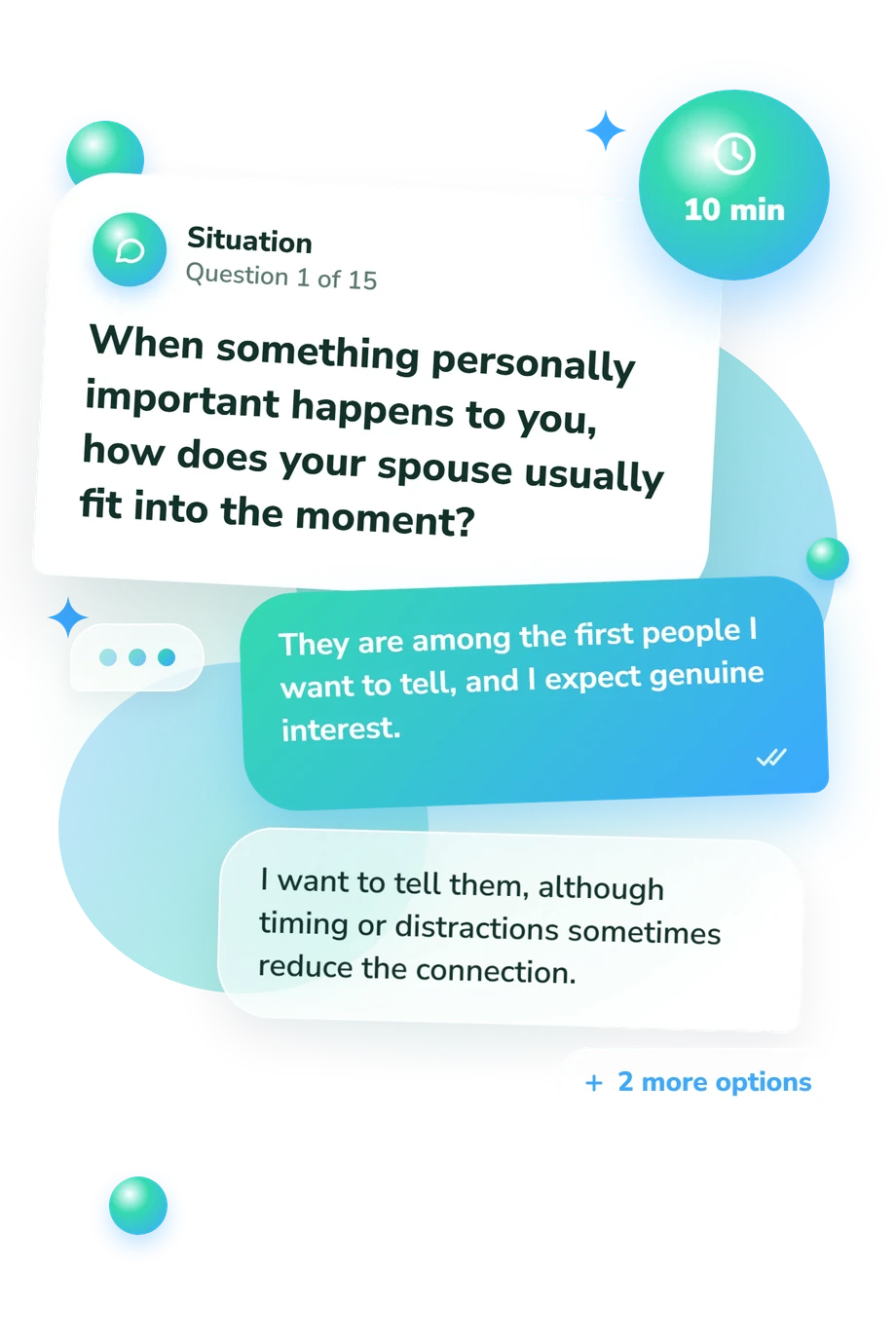
- They are among the first people I want to tell, and I expect genuine interest.
- I want to tell them, although timing or distractions sometimes reduce the connection.
- I often tell someone else first because I expect more engagement from that person.
- I usually keep important experiences to myself because sharing with my spouse feels unrewarding.
- We clarify the meaning without treating the mistake as a larger problem.
- An assumption causes brief tension, but we check it before long.
- The tension lasts because neither of us wants to reopen the exchange.
- The mix-up becomes evidence in a broader argument about each other's character or intentions.
- Rarely; quiet time can still feel companionable.
- Occasionally, especially when one of us is tired or preoccupied.
- Often; we share space without feeling meaningfully connected.
- Nearly always; being together tends to intensify the loneliness.
Is My Marriage in Trouble Quiz - Description and methodology of the test
For people trying to understand whether repeated tension reflects a wider pattern, the Is My Marriage in Trouble Quiz offers a focused way to examine daily relationship functioning. It is intended for partners who want to name concerns, notice strengths, and identify conversations that deserve attention. As a marriage trouble quiz, it organizes reflection without reducing a marriage to one difficult moment.
What This Test Measures
Rather than judging a relationship from a single argument, this assessment examines recurring situations involving disclosure, misunderstandings, conflict, responsibilities, decisions, future plans, reliability, companionship, affection, and repair. It suits partners reflecting on their experience, whether concerns are concentrated in one area or appear across the relationship. As a marriage relationship quiz, it turns broad unease into a profile.
The three dimensions describe:
- Communication and Repair (0-15) shows difficulty raising concerns, managing disagreement, and repairing hurt; its bands are Constructive foundation (0-5), Repair under strain (6-10), and Persistent rupture (11-15).
- Emotional Connection (0-15) indicates distance in companionship, affection, and emotional availability; its bands are Connection present (0-5), Growing distance (6-10), and Marked disconnection (11-15).
- Trust and Partnership (0-15) reflects strain in reliability, shared decisions, and confidence; its bands are Working partnership (0-5), Uneven teamwork (6-10), and Partnership in question (11-15).
Methodology and Evidence Base
Each item presents a marital situation with four response options, ranging from constructive interaction toward avoidance, distance, unreliability, or unresolved conflict. Respondents select the description that best matches the usual pattern rather than an isolated event.
Responses are aggregated within the relevant domain to produce three separate scores. The displayed bands are reflective descriptions, not norm-based standards or clinical cutoffs. Viewed as a marriage in trouble quiz, the profile shows whether strain appears narrowly or across several aspects of the relationship.
Methodologically, the questionnaire is conceptually consistent with Gottman and Levenson (1992), whose longitudinal work examined interaction patterns associated with later marital dissolution. It also aligns with Gottman (1993) on conflict engagement, escalation, and avoidance, and with Rempel, Holmes, and Zanna (1985) on trust in close relationships. These sources support the constructs addressed here; the questionnaire is not a direct adaptation or standardized administration of those instruments.
Current stress, illness, caregiving, grief, unequal responsibilities, and recent conflict can shape self-report. It is an online self-reflection questionnaire, not a diagnostic method. Fear, coercion, threats, or violence require attention regardless of the score, while the profile can help identify patterns worth discussing and whether focused relationship support is appropriate.
- Gottman, J. M., & Levenson, R. W. (1992). Marital processes predictive of later dissolution: Behavior, physiology, and health. Journal of Personality and Social Psychology, 63(2), 221-233. 10.1037/0022-3514.63.2.221
- Gottman, J. M. (1993). The roles of conflict engagement, escalation, and avoidance in marital interaction: A longitudinal view of five types of couples. Journal of Consulting and Clinical Psychology, 61(1), 6-15. 10.1037/0022-006X.61.1.6
- Rempel, J. K., Holmes, J. G., & Zanna, M. P. (1985). Trust in close relationships. Journal of Personality and Social Psychology, 49(1), 95-112. 10.1037/0022-3514.49.1.95
Updated: