
The Legend of Sleepy Hollow Quiz
How the Scales are Structured
Who Usually Takes This Test?
See How You Compare
Below is a preview of how scores are typically distributed across each scale.
Example Questions From the Test
- A saddle
- A severed-looking head later associated with a pumpkin
- A lantern taken from the church
- A cannonball recovered from the battlefield
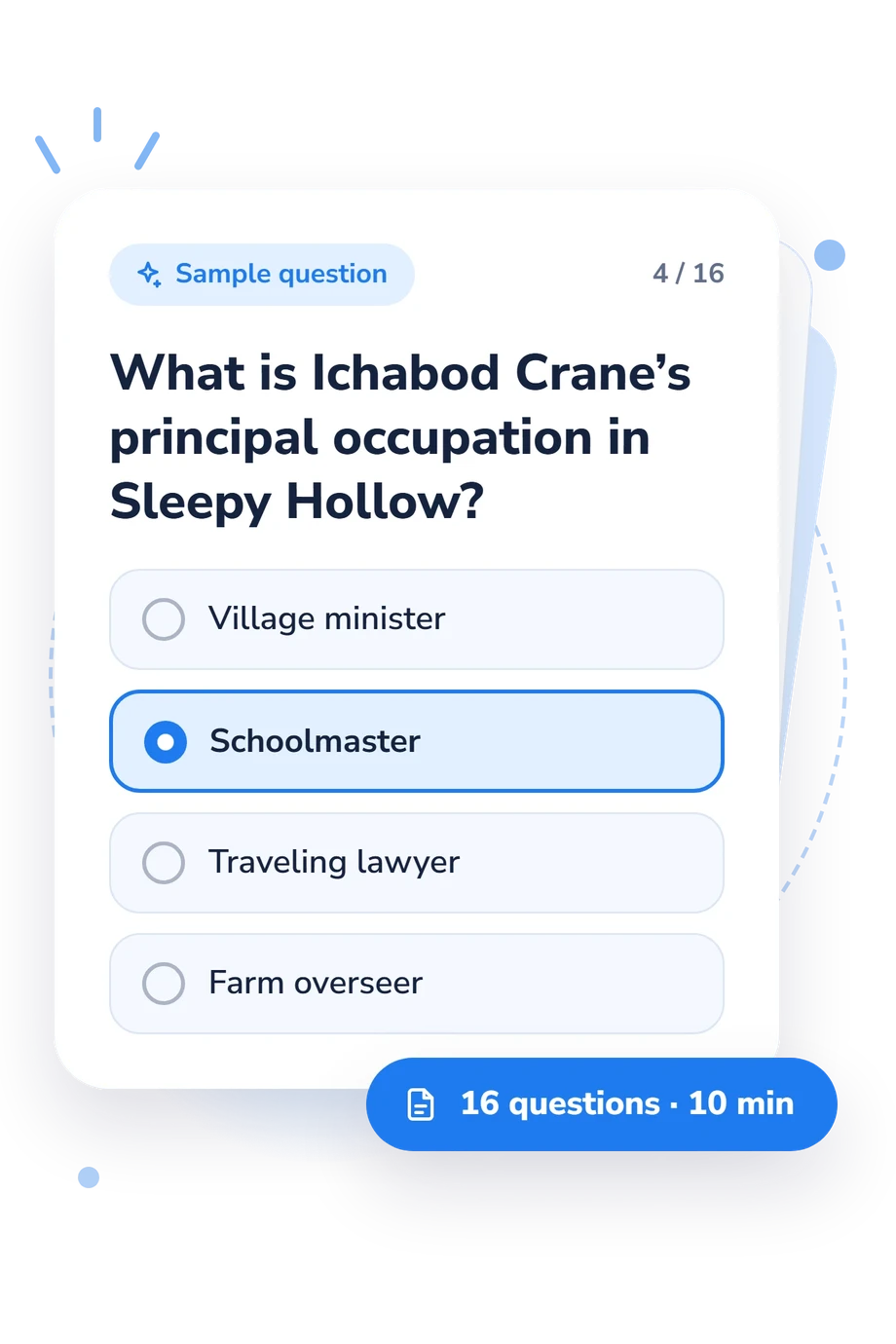
- Village minister
- Schoolmaster
- Traveling lawyer
- Farm overseer
- Brom had previously seen the genuine ghost near the bridge
- Brom believes Ichabod secretly returned to Connecticut
- Brom may have impersonated the Horseman to frighten Ichabod away
- Brom arranged for Katrina to hide Ichabod’s belongings
The Legend of Sleepy Hollow Quiz - Description and methodology of the test
Readers who want to check their memory of Washington Irving’s tale can use The Legend of Sleepy Hollow Quiz as a focused way to test that knowledge. It suits students, book-club members, and anyone revisiting the story who wants a concise, self-guided check. The Sleepy Hollow quiz results show how securely you recognize its characters, setting, folklore, framing device, and deliberately uncertain ending.
What This Assessment Explores
This assessment checks recall of the story world and the clues that shape its mystery. The questions in this literary quiz on Sleepy Hollow combine direct recall with interpretation and inference, asking readers to connect people, place, folklore, framing, and chase without literary terminology.
The scale is The Legend of Sleepy Hollow Knowledge (0-16): Emerging (0-6) indicates hazy recall, Developing (7-12) shows command of the main narrative with details to strengthen, and Strong (13-16) reflects a well-rounded grasp of ambiguity, characterization, and structure. The result describes story knowledge, not reading ability.
These are the main areas brought together:
- Plot and character recall shows whether central roles and events remain clear.
- Folklore recognition reflects memory for the Horseman legend and its setting.
- Narrative framing indicates understanding of the tale’s storytelling layers.
- Ambiguity and inference show whether competing explanations can be weighed.
Methodology and Evidence Base
Each item uses multiple-choice format with one best answer drawn from the tale. Some test direct recall; others ask what a detail suggests, such as Brom’s possible role in the chase or the pumpkin’s significance. The approach is a structured literary knowledge check, not an essay or personality inventory.
The questionnaire produces a story-specific total with displayed bands and is not presented as a norm-referenced psychometric measure. It reports a combined score rather than separate subscores, so the result summarizes overall performance across recall and interpretation items.
Legend of Sleepy Hollow (Irving, 1820) is the direct literary reference point. Hoffman’s work situates the Horseman and related motifs within American folklore, while Crawford’s study supports attention to environment and unresolved alternatives. The questionnaire is conceptually consistent with these literary analyses but is not an adaptation of their published studies. That relationship informs its recall-and-interpretation format, which keeps plot details alongside questions about ambiguity. Results can vary with prior readings, film versions, current attention, and personal interpretation.
- Irving, Washington. The Legend of Sleepy Hollow and Other Stories. Introduction and notes by Elizabeth L. Bradley. Penguin Classics, 2014.
- Crawford, Benjamin. “By Supernatural Means”: Environment and Ambiguity in Irving’s “The Legend of Sleepy Hollow.” ISLE: Interdisciplinary Studies in Literature and Environment, 28(4), 2021, 1507-1533. 10.1093/isle/isaa119.
- Hoffman, Daniel G. “Irving’s Use of American Folklore in ‘The Legend of Sleepy Hollow.’” PMLA, 68(3), 1953, 425-435. 10.2307/459863
Updated: