
Seminary Quiz
How the Scales are Structured
Who Usually Takes This Test?
See How You Compare
Below is a preview of how scores are typically distributed across each scale.
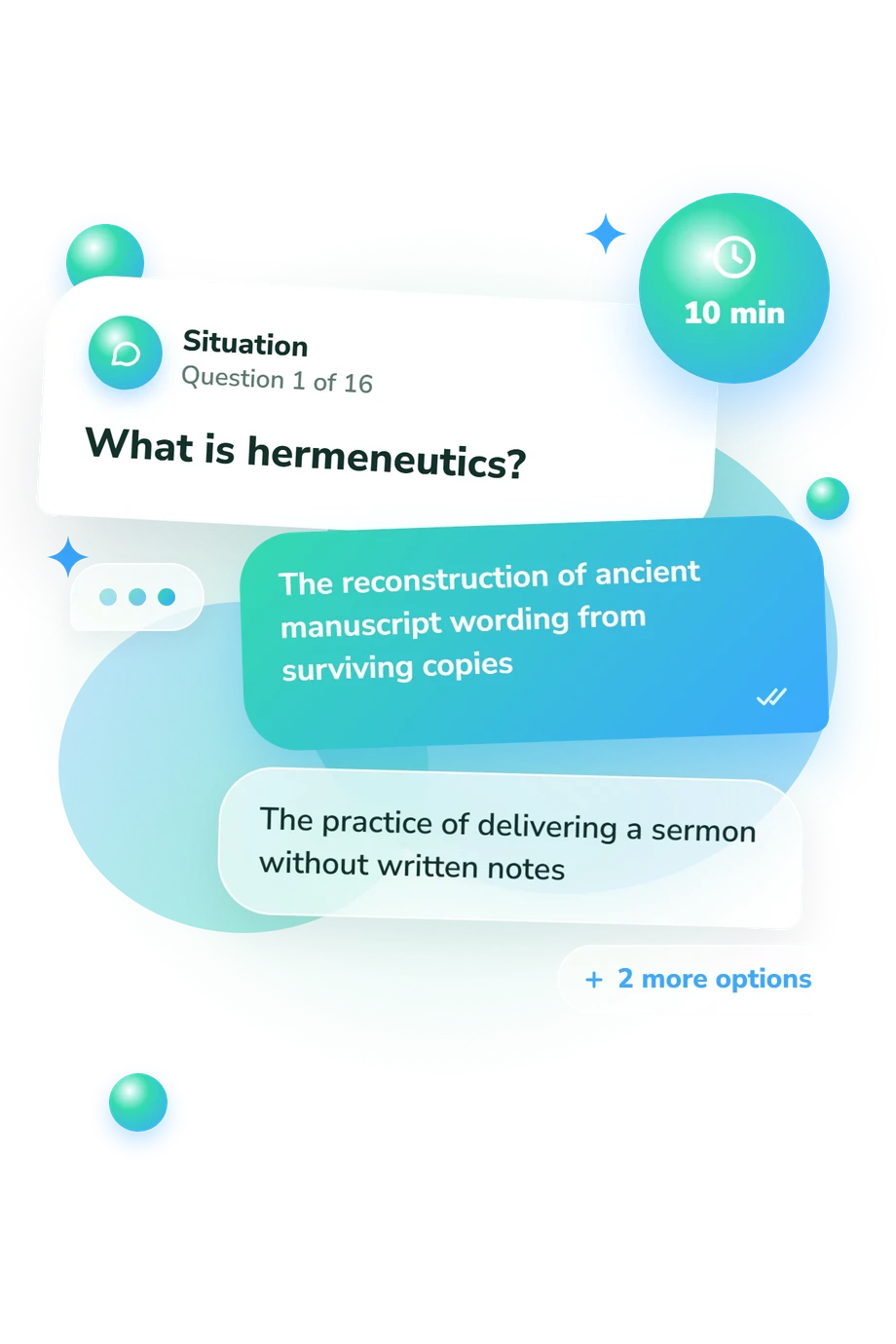
Example Questions From the Test
- The reconstruction of ancient manuscript wording from surviving copies
- The practice of delivering a sermon without written notes
- The classification of doctrines according to historical periods
- The study of the principles and processes used in interpretation
- Koine Greek, with some Hebrew
- Latin, with some Koine Greek
- Biblical Hebrew, with some Aramaic
- Syriac, with some Latin
- Matthew, Luke, and John
- Matthew, Mark, and Luke
- Mark, Luke, and John
- Matthew, Mark, and John
Seminary Quiz - Description and methodology of the test
Students considering formal theological study, applicants reviewing their preparation, and curious readers can use the seminary quiz to check familiarity with core concepts across several areas. The result can function as a seminary readiness quiz, highlighting strengths and topics needing more study. Readers wondering whether they should go to seminary should treat the result as a knowledge snapshot, not a measure of calling, spiritual commitment, or vocational fit.
What This Assessment Measures
The questionnaire is intended for readers who want a snapshot of introductory seminary knowledge while preparing for study or choosing topics to review. It samples biblical interpretation, doctrine, history, preaching, pastoral response, and academic responsibility rather than measuring faith or vocation.
The result draws on four thematic groups:
- Biblical interpretation tests attention to language, context, genre, and textual evidence.
- Theology and history assess recognition of doctrines, councils, traditions, and Christian development.
- Ministry practice examines basic judgment in sermon preparation and pastoral-care situations.
- Academic reasoning reflects source use, evidence evaluation, and responsible handling of borrowed ideas.
Together, these domains make the assessment a seminary knowledge test. Seminary Knowledge runs from 0-16: Foundations to Build (0-6), Developing Literacy (7-12), and Strong Foundation (13-16). The band describes performance on sampled educational material, not faith, calling, or an admissions decision.
Methodology and Evidence Base
Each item presents a question with four answer choices, and the respondent selects the best response. The content moves through terminology, language, context, doctrine, pastoral safety, preaching, and citation. Methodologically, this is a multiple-choice educational assessment rather than a clinical or personality measure. Results combine performance across the knowledge items; the displayed range does not establish how individual answers are weighted.
Conceptually, the questionnaire aligns with the ABHE Bible Knowledge Exam (2020) and with domains represented in Presbyterian ordination examinations, but it is not presented as an adaptation of either source. Fee and Stuart’s approach supports attention to literary, historical, and linguistic context. Nelson’s study is relevant because it distinguishes biblical knowledge from moral judgment instead of treating them as one ability.
For readers preparing for formal study, the result works as a seminary preparation quiz, yet performance may reflect prior coursework, translation familiarity, test-taking habits, current study context, and guessing. No normative sample, admissions cutoff, or credentialing function is stated, so a strong band does not demonstrate comprehensive readiness for seminary study.
- Association for Biblical Higher Education. (2020). Bible Knowledge Exam: An ABHE Bible Knowledge Assessment Tool. Association for Biblical Higher Education.
- Presbyterian Church (U.S.A.). (2024). Handbook on Standard Ordination Examinations in the Presbyterian Church (U.S.A.). Presbyterian Church (U.S.A.).
- Nelson, Daniel. (2004). Bible Knowledge and Moral Judgment: Knowing Scripture and Using Ethical Reasoning. Journal of Research on Christian Education, 13(1), 41-57. 10.1080/10656210409484959
- Fee, Gordon D., and Douglas K. Stuart. (2014). How to Read the Bible for All Its Worth (4th ed.). Zondervan.
Updated: