
Forces Quiz
How the Scales are Structured
Who Usually Takes This Test?
See How You Compare
Below is a preview of how scores are typically distributed across each scale.
Example Questions From the Test
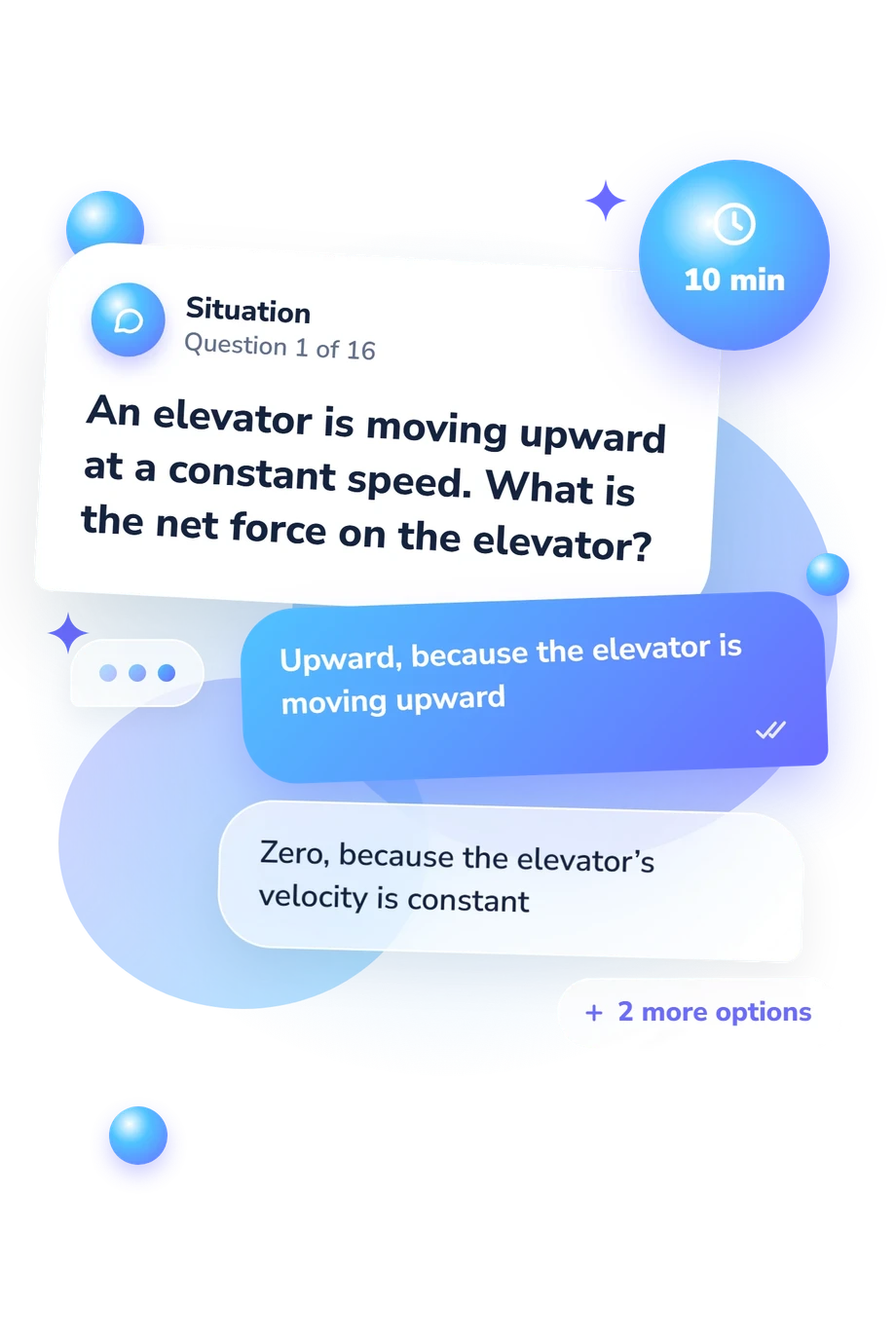
- Upward, because the elevator is moving upward
- Zero, because the elevator’s velocity is constant
- Downward, because gravity continues to act
- Equal to its weight and directed upward
- Opposite the ball’s instantaneous direction of travel
- Away from the center of the circle
- Along the ball’s instantaneous direction of travel
- Toward the center of the circle
- Static friction from the table
- Air resistance acting upward
- The book’s gravitational pull on Earth
- The normal force from the table
Forces Quiz - Description and methodology of the test
For learners checking their grasp of introductory mechanics, a short test of force concepts can help decide what to study next; taking the forces quiz gives students, independent learners, and anyone revising core physics a single overall result. As a quiz about forces, it makes gaps visible without reducing understanding to one topic: the result shows a current performance band and points to areas worth reviewing.
What This Assessment Explores
Here you identify forces, determine their net effect, and connect force with acceleration, motion, and shape. Scenarios cover Newton’s laws, equilibrium, friction, circular motion, springs, gravity, mass, weight, units, and applications. Its force quiz questions sample distinctions and relationships learners often confuse.
Forces Knowledge, 0-16, summarizes performance. Foundations to build is 0-6, Developing understanding is 7-12, and Strong understanding is 13-16. The bands reflect tested performance, not overall physics ability.
These groups show what the result samples:
- Newton’s laws show whether you recognize inertia, paired forces, and F = ma.
- Force balance shows whether you distinguish zero net force from changing motion.
- Applications show whether you can apply friction, circular motion, units, Hooke’s law, gravity, mass, and weight.
A higher band indicates successful performance, while a lower band points to areas for review.
Methodology and Scientific Basis
Each item presents a situation or short calculation with four choices. The items test recognition and quantitative reasoning; one point is awarded for each correct answer, producing the displayed total. A selected answer cannot show whether the choice was guessed.
Taken together, the questions cover concepts also examined by the Force Concept Inventory (Hestenes et al., 1992), which probes misunderstandings in introductory mechanics. This physics force quiz is separate from that published instrument, with its own wording and result bands; it is not a standardized administration or validated reproduction.
The result is a focused snapshot of performance on tested concepts. It can point to Newton’s laws, force diagrams, net force, units, or applications for review, but it cannot establish mastery of all mechanics. Lasry et al. (2011) reported variation in Force Concept Inventory reliability, but that finding cannot be transferred to this questionnaire. Its result is best interpreted alongside worked problems, classroom evidence, or broader assessment. Results depend on reading accuracy, guessing, prior instruction, and context, and the 16 answers do not provide a broader performance profile.
- Hestenes, David, Malcolm Wells, and Gregg Swackhamer. "Force concept inventory." The Physics Teacher 30(3), 141-158 (1992). 10.1119/1.2343497
- Hestenes, David, and Malcolm Wells. "A mechanics baseline test." The Physics Teacher 30(3), 159-166 (1992). 10.1119/1.2343498
- Lasry, Nathaniel, Steven Rosenfield, Helena Dedic, Ariel Dahan, and Orad Reshef. "The puzzling reliability of the Force Concept Inventory." American Journal of Physics 79(9), 909-912 (2011). 10.1119/1.3602073
Updated: