
Alpha Female Quiz
How the Scales are Structured
Who Usually Takes This Test?
See How You Compare
Below is a preview of how scores are typically distributed across each scale.
Example Questions From the Test
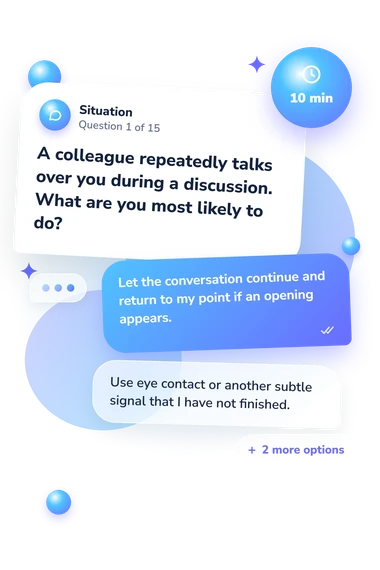
- Let the conversation continue and return to my point if an opening appears.
- Use eye contact or another subtle signal that I have not finished.
- Say in the moment that I would like to finish my thought.
- Stop the interruption and later set a clear expectation about taking turns.
- Listen longer to understand which direction is gaining support.
- Ask a question that helps someone else clarify the decision.
- Recommend one next step and explain why it could move things forward.
- Take responsibility for defining the path and assigning the immediate actions.
- Look for an established example I can adapt.
- Ask someone experienced what they would do.
- Gather a few perspectives and form my own method from them.
- Define my own criteria and test the approach that best matches them.
Alpha Female Quiz - Description and methodology of the test
For anyone examining how she handles influence, choice, and disagreement, the Alpha Female Quiz offers a structured reflection on tendencies rather than a verdict. It is intended for readers who want to consider how they communicate limits, make decisions, and step forward when a group lacks direction. Readers wondering whether they fit the alpha-female archetype may use this alpha female self-assessment to reflect on everyday situations.
What This Assessment Explores
Scenarios involve interruption, pressure, criticism, uncertainty, and unclear group roles. They examine how readily someone states needs, relies on personal reasoning, and creates direction. The result describes tendencies associated with a leadership archetype, not a ranking of worth.
The alpha-woman archetype remains context rather than a second name; the leadership style assessment separates directness, autonomy, and initiative across decisions.
The three displayed dimensions are:
- Assertive Boundaries (0-15) measures openness about needs, limits, and disagreements: Harmony-First (0-5) favors flexibility; Selectively Direct (6-10) adapts to context; Clearly Assertive (11-15) states expectations promptly.
- Independent Judgment (0-15) measures reliance on personal conclusions: Input-Oriented (0-5) prefers guidance; Balanced Decider (6-10) weighs outside views; Self-Directed (11-15) follows personal convictions.
- Leadership Initiative (0-15) measures readiness to create direction: Supportive Contributor (0-5) helps without leading; Situational Initiator (6-10) leads when needed; Direction Setter (11-15) starts and coordinates plans.
Methodology and Scientific Basis
As an assertiveness test, each scenario presents four behavior-based response choices. The respondent selects the option closest to her likely behavior, rather than an idealized answer; the choices are not presented as a single progression from accommodation to initiative.
Results are reported on the three displayed scales, whose bands describe broad patterns. The item-level weighting is not specified, so the ranges do not show how many points any individual answer adds. Together, the scales profile directness, independent decision-making, and initiative, with the alpha archetype serving as context rather than a category the questionnaire establishes.
The questionnaire is conceptually consistent with the Alpha Female Inventory, a published measure of female leadership. That comparison helps place autonomy, initiative, and leadership in context, while this result remains a profile of tendencies rather than a measure of identity or leadership ability.
As an online self-report profile, it can vary with self-perception, current confidence, relationships, and the situation imagined. Read it as a snapshot for reflection, not a fixed identity or a definitive description of behavior.
- Rose Marie Ward, Halle C. Popson, and Donald G. DiPaolo. Defining the Alpha Female: A Female Leadership Measure. Journal of Leadership & Organizational Studies, 17(3), 309-320, 2010. DOI 10.1177/1548051810368681
- Monika K. Sumra. Masculinity, femininity, and leadership: Taking a closer look at the alpha female. PLOS ONE, 14(4), e0215181, 2019. DOI 10.1371/journal.pone.0215181
- Rose Marie Ward, Donald G. DiPaolo, and Halle C. Popson. College Student Leaders: Meet the Alpha Female. Journal of Leadership Education, 7(3), 100-117, 2009. DOI 10.12806/V7/I3/RF2
Updated: