
Sanity Quiz
How the Scales are Structured
Who Usually Takes This Test?
See How You Compare
Below is a preview of how scores are typically distributed across each scale.
Example Questions From the Test
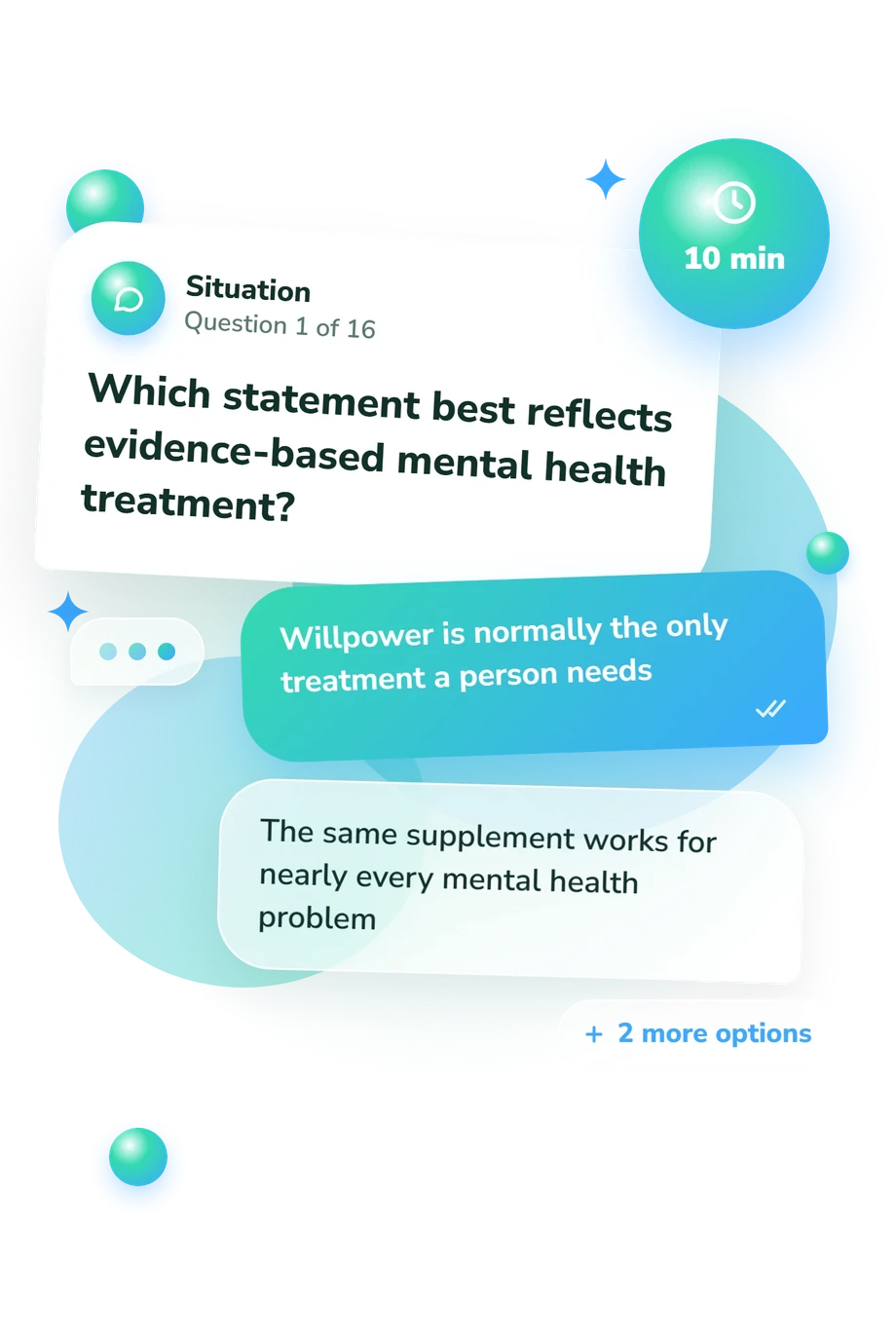
- Willpower is normally the only treatment a person needs
- The same supplement works for nearly every mental health problem
- Psychotherapy, medication, or a combination may help, depending on the person and concern
- Hospital admission is required whenever someone seeks mental health care
- Intelligence and logical ability alone
- The complete absence of uncomfortable emotions
- A person’s mood at one particular moment
- Emotional, psychological, and social wellbeing that can change over time
- Avoid mentioning suicide because asking about it creates suicidal thoughts
- Ask directly and calmly whether they are thinking about suicide, then connect them with appropriate help
- Post about the comment publicly so more people can investigate
- Assume the comment is only dramatic unless they repeat it several times
Sanity Quiz - Description and methodology of the test
For readers who want to check their understanding of mental health language, common concerns, and supportive action, this sanity quiz offers a structured knowledge check rather than a judgment about a person. It can help students, peers, caregivers, and curious adults identify concepts they know well and topics that deserve further learning. A mental health knowledge quiz can be a useful starting point for reflection.
What This Assessment Explores
This assessment checks mental health literacy by asking whether a reader can recognize concerns, understand varied experiences, respond supportively, and identify next steps. Its situations cover treatment, trauma, panic, mood, sleep, self-care, suicide risk, medication side effects, stigma, and assumptions about violence. The result offers a practical knowledge profile, not a label.
Calling it a sane quiz should not suggest that the result judges whether anyone is sane. The result is organized as Mental Health Knowledge (0-16):
- Foundations to build (0-6) means some core ideas are recognized, while myths or support decisions may remain unclear.
- Developing literacy (7-12) means many essentials are understood, with room to strengthen recognition and response skills.
- Strong literacy (13-16) means the reader shows a solid grasp of concepts, supportive action, and help-seeking principles.
These bands identify learning opportunities; they measure knowledge only and do not determine mental state or diagnosis.
Methodology and Scientific Basis
Each item presents a mental-health situation or concept with four answer choices. The alternatives separate evidence-based understanding from common myths and unsafe responses, so the task tests recognition and judgment rather than personal symptom disclosure. As a mental health literacy quiz, it functions as an educational knowledge check.
The questionnaire reports a total and assigns it to a descriptive band. It does not give a point-by-point formula, so interpret the displayed output rather than infer how individual answers were weighted.
Its framework is conceptually consistent with Jorm et al. (1997), who linked mental health literacy with recognizing disorders and understanding treatment. It also overlaps with the Mental Health Literacy Scale described by O’Connor and Casey (2015), while its helping guidance is consistent with public mental health first-aid research by Kitchener and Jorm (2002). This questionnaire is not an administration or adaptation of those instruments.
Without displayed norms or clinical validation, results may reflect guessing, wording familiarity, or recent learning. They cannot establish personal safety, functioning, or a diagnosis; immediate danger or possible self-harm requires local emergency or crisis support.
- Jorm AF, Korten AE, Jacomb PA, Christensen H, Rodgers B, Pollitt P. “Mental health literacy”: a survey of the public’s ability to recognise mental disorders and their beliefs about the effectiveness of treatment. Medical Journal of Australia. 1997;166(4):182-186. 10.5694/j.1326-5377.1997.tb140071.x
- O’Connor M, Casey L. The Mental Health Literacy Scale (MHLS): A new scale-based measure of mental health literacy. Psychiatry Research. 2015;229(1-2):511-516. 10.1016/j.psychres.2015.05.064
- Kitchener BA, Jorm AF. Mental health first aid training for the public: evaluation of effects on knowledge, attitudes and helping behavior. BMC Psychiatry. 2002;2(1):10. 10.1186/1471-244X-2-10
Updated: