
Should I Get a Lab or Golden Retriever Quiz
How the Scales are Structured
Who Usually Takes This Test?
See How You Compare
Below is a preview of how scores are typically distributed across each scale.
Example Questions From the Test
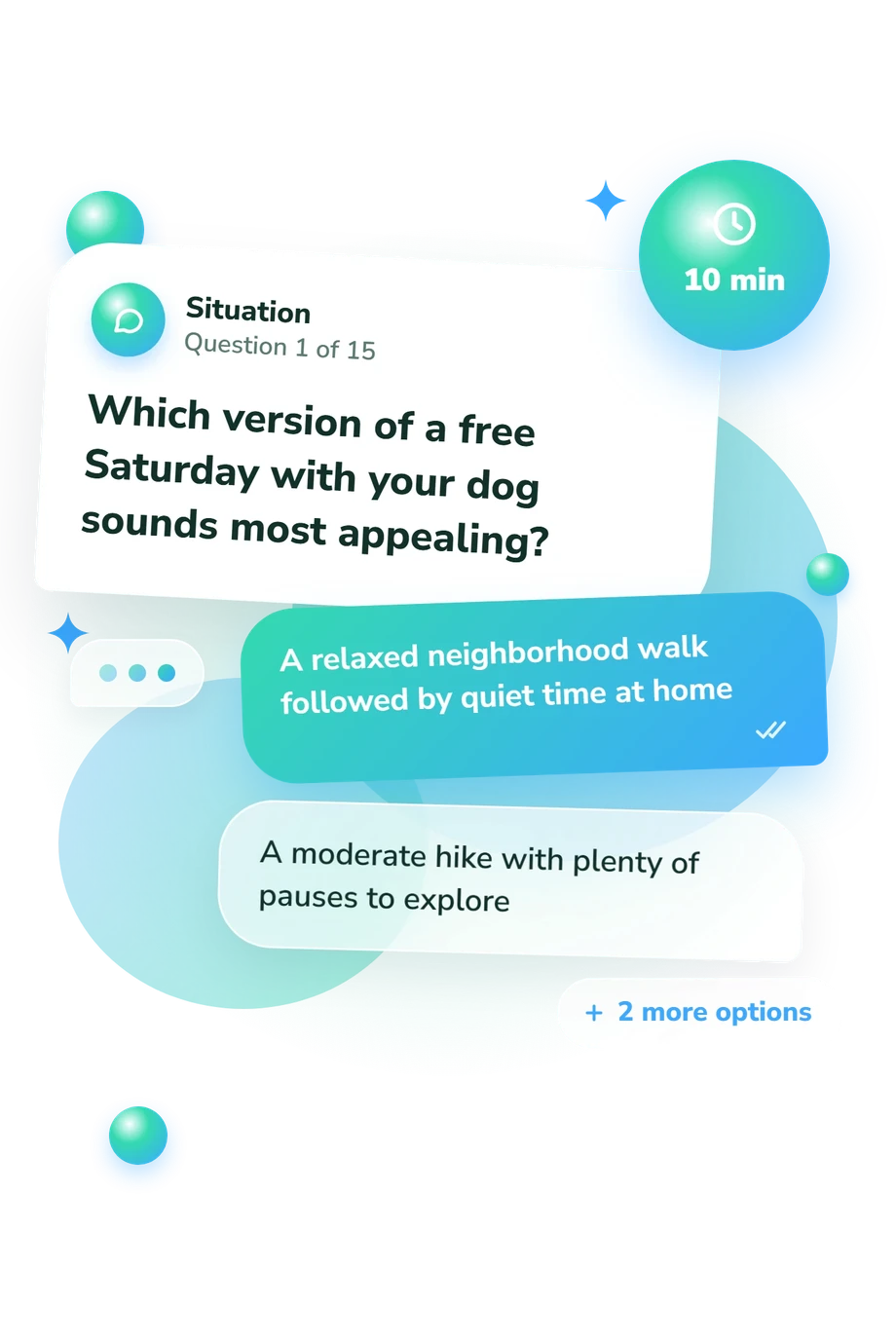
- A relaxed neighborhood walk followed by quiet time at home
- A moderate hike with plenty of pauses to explore
- A vigorous outing built around swimming, fetching, or repeated games
- A short outing followed by independent time for both of us
- I would rather avoid dogs that regularly seek water, mud, and rough outdoor play
- I could manage it occasionally if most outings stayed tidy
- I would accept regular towel-downs because energetic outdoor fun matters more
- I enjoy outdoor adventures but would try to choose cleaner routes and calmer games
- I can accommodate substantial exercise, shedding, training, and a period of adjustment
- I can handle most retriever needs but would seek an individual matched carefully to my household
- I need a reliably low-energy or low-shedding dog with limited training demands
- I have some flexibility, but one major retriever trait would be difficult for me
Should I Get a Lab or Golden Retriever Quiz - Description and methodology of the test
People choosing between these retrievers need more than a preference for a friendly face; they need to consider daily activity, coat care, social expectations, finances, and practical support. The Should I Get a Lab or Golden Retriever Quiz turns those decisions into a focused comparison for prospective owners. The retriever breed quiz compares both profiles with an owner's routines and support, revealing fit and preparation needs.
What This Assessment Explores
Questions cover exercise, water, mud, shedding, coat care, social contact, training, adolescent energy, time, finances, household agreement, and housing. They measure fit with recurring routines and responsibilities, not the fixed personality of one dog. The questionnaire's Lab or Golden Retriever comparison shows attraction and friction: someone may enjoy retrieving games yet lack weekday help, or welcome affection while finding grooming burdensome.
The result separates three result scales:
- Golden Retriever Match (0-15) measures fit with Golden care and companionship patterns: Limited alignment (0-5), Mixed alignment (6-10), or Strong alignment (11-15).
- Labrador Retriever Match (0-15) measures fit with Lab activity, training, and care patterns: Limited alignment (0-5), Mixed alignment (6-10), or Strong alignment (11-15).
- Pause or Consider Another Dog (0-15) identifies conflicts needing resolution: Fewer reasons to pause (0-5), Important questions remain (6-10), or Pause or consider another dog (11-15).
Methodology and Scientific Basis
Each item presents a situation with four response options. Choices range from strong fit to manageable tradeoffs, limited capacity, or a barrier. Answers contribute to three totals, but the questionnaire does not state a universal point value for each option. Interpretation therefore follows the displayed ranges and comparison among totals, not an invented weighting rule.
The themes are conceptually consistent with Eken Asp et al. (2015), which examined everyday behavioral differences among dog breeds. Persson et al. (2018) adds context on human-directed social behavior in Golden and Labrador Retrievers. Hsu and Serpell’s (2003) C-BARQ provides a model for owner-report assessment of canine behavior and temperament. This questionnaire is not a standardized administration or adaptation of those instruments; they support the relevance of the subject areas, not its provenance.
Interpretation is comparative: the highest total shows the strongest affinity, while any totals within one point of the highest form a blended result. A higher pause total flags unresolved issues involving time, money, housing, consent, or care. The questionnaire's Golden-versus-Labrador comparison reflects circumstances and honest self-report, so it cannot predict an individual dog's behavior.
- Eken Asp, Helena, Freddy Fikse, Katja Nilsson, and Erling Strandberg. "Breed differences in everyday behaviour of dogs." Applied Animal Behaviour Science 169 (2015): 69-77. 10.1016/j.applanim.2015.04.010
- Persson, Mia E., Ann-Sofie Sundman, Lise-Lotte Halldén, Agaia J. Trottier, and Per Jensen. "Sociality genes are associated with human-directed social behaviour in golden and Labrador retriever dogs." PeerJ 6 (2018): e5889. 10.7717/peerj.5889
- Hsu, Yuying, and James A. Serpell. "Development and validation of a questionnaire for measuring behavior and temperament traits in pet dogs." Journal of the American Veterinary Medical Association 223, no. 9 (2003): 1293-1300. 10.2460/javma.2003.223.1293
Updated: